Print Story
X




Measures needed in financial and health services to achieve universal healthcare in Pakistan
In Pakistan, half the population lacks access to primary healthcare, leaving the universal health coverage goal—access to quality healthcare services, without any financial hardship—unfulfilled. Despite showing slight improvements over the past decade, UHC indicators still present a bleak picture, particularly in access to primary healthcare services—73 percent of out-of-pocket expenditure is incurred on out-patient services.
The progress in achieving UHC or SDG 3.8 is monitored through two key indicators. The Service Coverage Index indicates the average coverage of a set of essential health services, for tracking progress on how many people receive promotive, preventative, curative, rehabilitative and palliative care. The most recent Health Ministry data shows Pakistan’s SCI score is 53.9 (2023), i.e. in medium service coverage level.
At national level, the SCI sub-indicator RMNCH has improved by 28 percent (from 2015 to 2023). However, there are stark regional health inequities in this progress as evident by low RMNCH score of 36.9 in Balochistan, in contrast to about 66.6 national aggregate score and above 50 score in other provinces. These structural problems reflect in the maternal mortality rate of Balochistan, which stands at 298 deaths per 100,000 live births, compared to the national average of 186 deaths.
Such regional disparities extend to other indicators as well, underscoring the need for special attention towards geographical health inequities in health system, for truly advancing UHC in Pakistan.
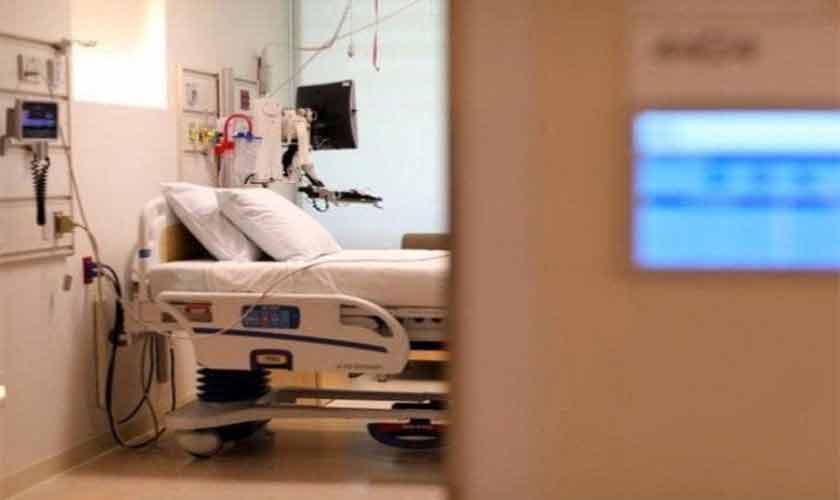
The Services Capacity and Access indicator also demonstrates notable progress, improving from 33.9 in 2015 to 51.6 in 2023, although the pace of progress appears to be slowing down. This indicator represents the capacity of health system, primarily, as hospital bed and essential health workforce density. The hospital bed density as documented in 2022 is only 10.67 beds per 10,000 population, while the recommended threshold is 18 per 10,000 of the population. For health workforce density, against the requirement of 3.34 nurses/ midwives per 1,000 population, Pakistan has a ratio of only 0.65 per 1,000 population (2022) demonstrating significant shortage.
Apart from UHC’s service coverage dimension, financial hardship is critically important in Pakistan’s context, as affordability of health services is a prerequisite for UHC.
Recent data shows that due to catastrophic health expenditure about 13.4 million people in Pakistan face impoverishment. The 2021-2022 National Health Accounts data shows that government spending accounts for 47 percent of the total health expenditure and private spending for 52.6 percent, out of which 89 percent is out-of-pocket expenditure. The current health expenditure out-of-pocket payment comparison shows Pakistan has a very high OOP expenditure. This is due to persistently low government spending on health, constituting only 0.9 percent of the GDP. In comparison, the Indian government spends 1.9 percent of its GDP on health.
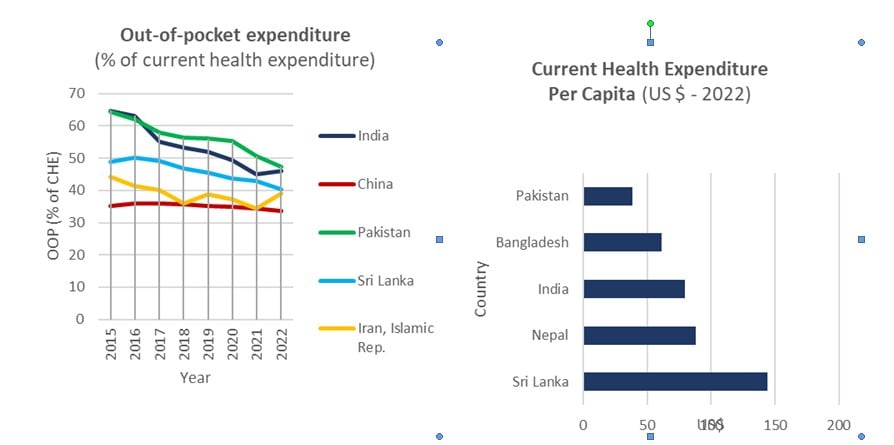
Source: Global Health Expenditure database, World Health Organisation
The OOP health expenditure in NHA 2021-2022, was Rs 984 billion whereby households in the Punjab accounted for the most OOP spending. Moreover, medicines and vaccine comprise the highest share of OOP spending—50.63 percent. This is consistent with the global trend as spending on medicines on average accounted for 56 percent OOP health expenditure globally.
High OOP payments mean that health spending comes at the expense of basic needs for poorer and more vulnerable households. The challenge is compounded by low service coverage and accessibility, forcing many people experiencing health issues to not seek health services at all. The incidence of foregone care is exacerbated by income status, geographical disparities and gender.
There is need for urgent reflection on health-financing policy in Pakistan, including the role of Sehat Sahulat Programme, in reducing the health cost burden. Designing health finance strategy on the principle of health equity is fundamental to achieving UHC across the country.
Although Sehat Sahulat Programme effectively reduces OOP health expenditure for low-income households, the low utilisation of the programme and its limitation to in-patient service coverage necessitate a more sustainable and region-specific approach to the expansion of social health insurance in Pakistan. Considering regional disparities in service coverage and socioeconomic indicators, the programme may be tailored for better impact at district or sub-regional level.
Considering the sustainability of the programme, adopting a co-contributory model for high income groups is a more feasible policy alternative amid shrinking public health spending due to fiscal constraints.
More importantly, to reduce the financial burden of outpatient services, Pakistan has already committed to implementing an Essential Package of Health Services, of 88 health services at primary care level. Robust planning and effective health financing measures, from departmental to local health authority level are crucial for providing quality care services through primary level.
Systematic measures for pooling of resources are needed for effective health financing. Districts with high health inequities need to be prioritised in the EPHS delivery. Sources of health financing need to be expanded. By introducing earmarked health tax or sin tax on tobacco and sugar sweetened beverages, health outcomes for non-communicable diseases and revenue for financing in health can be enhanced.
The weakness of primary healthcare in Pakistan is the foremost driver of unaffordable health costs, as 70 percent of essential health services recommended by Disease Control Priorities 3 are meant to be delivered at primary care level. To achieve UHC, financial health protection and service coverage enhancement at primary care level should be prioritised in healthcare policy.
The writer is a senior policy advisor at SDPI Islamabad. She can be reached at [email protected].