Print Story
X




All about the Sindhi novel at the heart of the World Culture Festival
| T |
he World Culture Festival, held at the Arts Council of Pakistan, Karachi, transformed the city into an international hub of creative exchange. From French mural art to Japanese theatre, from Latin music to Pakistani cinema, the festival demonstrated that art and culture have the power to transcend borders.
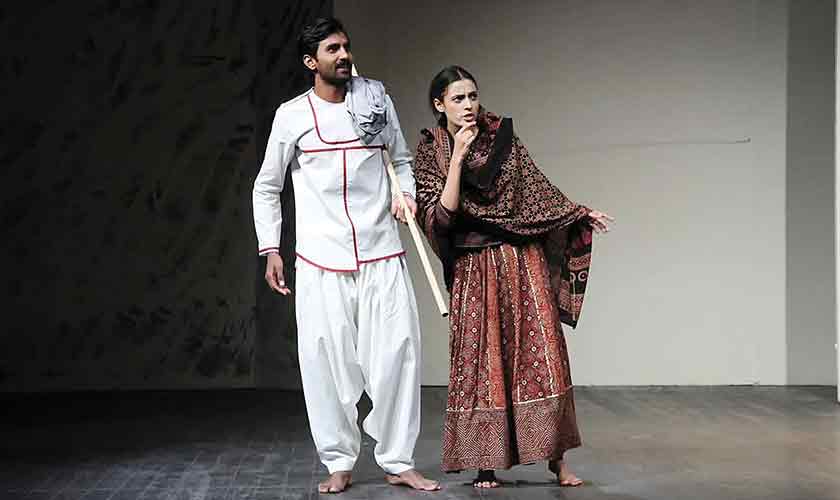
The most powerful and emotionally stirring presentation was the Urdu tragedy The Dead River, adapted from the celebrated novel of renowned Sindhi writer Abdul Qadir Junejo.
The story centred on the Hakro River, which once irrigated the eastern region of Sindh, but has long since dried up. Historically, the river was also known as Saraswati and Gaggar.
Junejo, born in the desert district of Tharparkar in the village of Jinhan, located on the banks of Hakro, had previously written the acclaimed desert-based drama Karavan.
The play’s director, Shahnawaz Bhatti, hails from Umerkot, another ancient settlement connected to the Hakro.
Actors dressed in traditional Thari attire transported the audience to a desert filled with the thirst for water, the grief of a dying river and the looming threat to their culture and heritage.
Bhatti said that rivers were not just environmental lifelines but also part of cultural identities of respective societies so that their disappearance signalled the death of a civilisation.
Explaining why The Dead River was selected for the World Drama Festival, he said that Junejo had portrayed the consequences of vanishing rivers with exceptional beauty. “The flow of the river, and the moment it dried, are described not only creatively but with historical precision.”
“All regions connected to the Thar desert once prospered because of the Hakro. When it dried up, the entire region fell into severe water scarcity. Though the river has not flowed for centuries, its memory lives on in the stories of the people. This enduring remembrance reflects the deep emotional bond Sindh holds with the river.”
Earlier this year, when plans were initiated to construct canals in the Punjab, widespread protests erupted across Sindh, began in Khairpur on the National Highway and later spreading throughout the province. The protesters argued that the new canals would further deplete the Indus River.
That concern is what Bhatti brought to the stage through The Dead River. The director said that whether in Sindh or anywhere else in the world, when the natural flow of rivers is blocked through dams or barriers, every living being suffers. The play captures the impact of that obstruction and its far-reaching consequences.
Actors Zubair Baloch, Yasmeen Usman, Mati Mukhtalif, Tooba Naeem, Omeed Akbar and Ali Bakhsh delivered powerful performances.
Omeed Akbar said that, under Bhatti’s guidance, he had learned a lot about the characters and their history. He said he found Junejo’s writing deeply beautiful and that it had helped him understand the empathy, kindness, hospitality and wisdom of his character Ambaram.
“My most difficult scene was the third one, where Ambaram tries to persuade the Sikhs to buy land for farming. The scene reflects the pain of the people of Sindh. I wanted to portray that truthfully. To do so, we had to understand the struggles of people from that era and today. Only then could we bring their pain to the stage,” the actor said.
Provincial Minister for Education Syed Sardar Ali Shah, a poet and columnist, praised the drama, calling it “extraordinary.”
He said Junejo had fought the historical cases of the Hakro, Ravi, Sutlej and Chenab rivers through his writing. “When the British blocked their natural flow, entire regions suffered,” said Shah.
He added that the novel mentioned the Dhahtan camel, which the character Rano rode to meet Momal in the famous romantic tale Momal Rano. The drama, he said, formed a symbolic bridge between past and present.
Actor Mutee Mukhtalif, who played Jano, spoke about his personal connection to the theme:
“Since coming to Karachi, shortage of water is the one thing I have felt most deeply. I had previously thought water commanded no price. You get sick of constantly having to buy water, 50 rupees for a bottle to drink, 1,500 rupees for a tanker to bathe. I believe that in the years to come, no conflict will be bigger than the one for water. I had to do my part and raise my voice.”
The World Culture Festival 2025 will continue till December 7, spanning 39 days. It offers a diverse lineup including 60 music shows, 25 dance performances, six art exhibitions, 25 workshops and 15 panel discussions, covering a wide range of music, dance, film and visual arts. The scale underscores its role as a major platform for cultural exchange, connecting local and international artists with Karachi’s audiences.
The Urdu play Behrupiya, produced by Tehrik-i-Niswan, was written and directed by Anwer Jafri, with choreography by dancer Sheema Kermani. The play is adapted from Molière’s classic Tartuffe (The Imposter or The Hypocrite).
Asked why she had chosen this play for the festival, Kermani said, “I wanted to present a play that was both entertaining and meaningful. Behrupiya is a comedy that makes people laugh, but it is also deeply relevant to our society, where hypocrisy has taken over.”
“One of Pakistan’s biggest problems issues is the hypocrisy attached to religiosity. Many people use religion for exploitation rather than becoming better humans. Fake pirs and fraudulent spiritual figures deceive innocent people every day. This play makes us question morality, appearances, truth and rationality. Turning it into a musical with stylised movement, songs and fantastical costumes makes it delightful and enjoyable,” she said.
The production cleverly highlighted false piety and religious hypocrisy through humour and wit, highlighting human weakness and pretentiousness in a way that evoked both laughter and reflection. Its satire targeted those who exploit religious pretensions for personal gain.
The award-winning Pakistani film Saawan, written by Faryad Khan and directed by Farhan Alam, was also screened at the festival. The film portrays the story of a differently-abled child and highlights themes of humanity, courage, survival and social injustice.
The Japanese theatre play Salaryman Macbeth, based on Shakespeare’s Macbeth and reimagined in modern Japan, was another audience favourite. Written by Tetsuya Fuchigami and directed by Kayo Tamura, the play follows the tragicomic rise of an ordinary office worker who becomes a tyrant after encountering witches. Performers included Kayo Tamura, Nono Miyasaka, Ryo Nishihara, Rinya Kiji, Junko Matsuoka and Kana Kana.
French Ambassador Nicolas Galey praised the festival for connecting cultures worldwide. He noted that French mural artist Shifoome is painting a cultural mural on the Arts Council’s wall, a symbol of Pakistan-France friendship.
LAPA Dance Company’s head, Fareah Al Saqqaf, expressed gratitude for the warm reception in Pakistan and said she was honoured to present the story of Palestinian journalists through art.
Earlier, a fine art workshop by Iranian artist M Reza Ferdowsi Fard focused on the fundamentals of Islamic calligraphy. He explained that the purity of script comes from the purity of the heart, noting that calligraphy begins with the dot beneath the letter , the symbolic essence of Bismillah. He added that the first letter in calligraphy is always .
The festival also screened the Pakistani film Na Maloom Afraad, directed by Nabeel Qureshi and written by Fizza Ali Meerza. Set in Karachi, the dark comedy captures the city’s chaos, economic strain and social disparities. During a discussion session, Qureshi confirmed that Na Maloom Afraad 3 was in development. Meerza proposed converting the Auditorium II into a dedicated cinema space considering several cinemas in Karachi have closed down.
President of the Arts Council, Muhammad Ahmed Shah, said, “Culture has the power to define a nation’s identity. Many countries try to tarnish Pakistan’s image, but our artists, creators, singers and actors show the true face of our country to the world. Our themes this year are peace and environment.”
The writer is a freelance journalist and a researcher. Her X handle: @FehmidaRiaz