Print Story
X




Why young people are the corrective force at COPs
| E |
very year, the world turns its eyes to the Conference of the Parties. Under the United Nations Framework Convention on Climate Change, these massive gatherings are supposed to be where humanity saves itself. We see photos of world leaders shaking hands, urgent speeches and ambitious pledges. It is the central global platform for climate negotiations. But for young people in Pakistan watching their country grapple with heatwaves and devastating floods, there is often a frustrating disconnect between what happens in those conference halls and the reality on the ground.
While the COP activity is necessary, it is flawed because it suffers from the same symptoms of slow, complicated multilateralism that plague other global negotiations. The system has structural cracks that often hinder real progress. This is exactly why the representation of young Pakistanis, specifically through programmes like Youth@COP, is not simply a nice symbolic gesture but a necessary corrective for a broken system.
To understand why youth voices matter, we first have to look at why the UNFCCC process often stumbles.
The biggest issue is consensus-based decision-making. In the UNFCCC sessions, every single country has to agree for a decision to pass. Imagine trying to decide on a pizza topping with nearly 200 people—you usually end up with just cheese because that’s the only thing no one objects to. In climate terms, this leads to the lowest common denominator outcomes. Instead of bold, life-saving action, we get watered-down agreements that satisfy everyone but save no one.
Then there is the issue of enforcement.
Countries make big promises about cutting emissions or providing money to developing nations, but there is no “climate police” to ensure they keep their word. Pledges for climate finance often go unmet, leaving countries like Pakistan to pay the bill for a crisis they didn’t cause.
The Global South, which houses the most vulnerable populations, often struggles just to be heard. Add to this the overwhelming complexity of global diplomacy, filled with technical jargon and parallel negotiating agendas, and you have a place that is inaccessible to normal people. Perhaps worst of all is the influence of vested interests. When fossil fuel lobbyists have more access to the negotiations than the victims of climate change, the agenda for climate justice gets diluted.
This is where the youth come in.
Including young Pakistanis isn’t about ticking a diversity box—it is about bringing a fresh, moral perspective to a stale room. Young people from Pakistan don’t view climate change as an abstract economic problem. They see it through the lens of human survival. They have lived through the heat and the displacement. Their presence shifts the narrative from national interest to human lives.
When a young person speaks about their community drowning, it cuts through the diplomatic noise in a way a statistic never could.
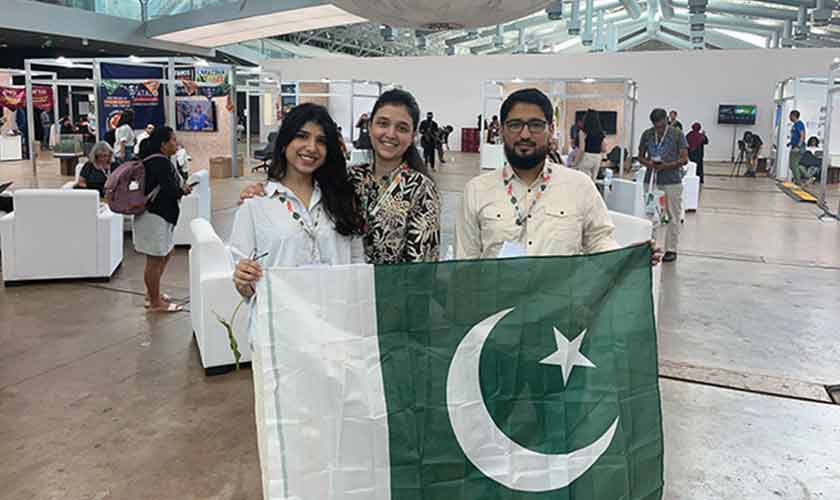
Young people from Pakistan don’t view climate change as an abstract economic problem. They see it through the lens of human survival.
The young can take the complex, high-level outcomes of a COP and translate them into something actionable for their local communities. They also help balance the scales against corporate interests. The youth have no shareholders to please; their only interest is their future. This allows them to demand accountability and transparency, pushing for actual implementation rather than empty promises.
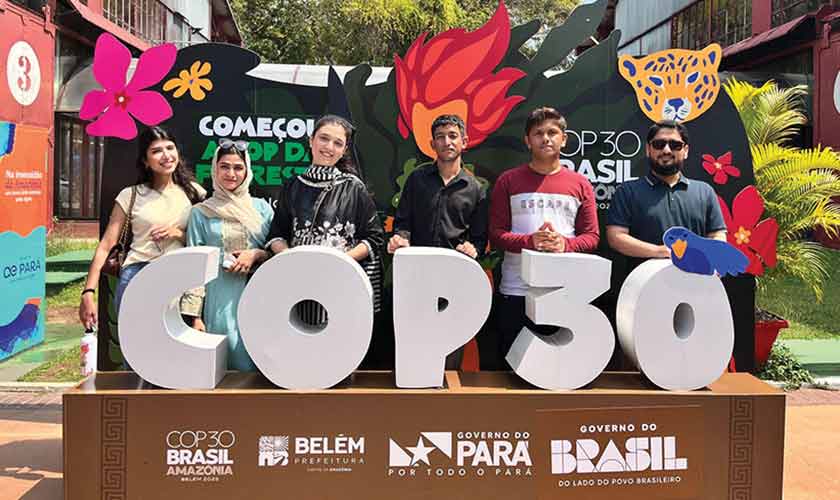
This is why initiatives like Youth@COP programme by Climate Forward Pakistan are vital. You cannot just send a young person into a UN negotiation room without preparation and expect them to succeed. These programmes provide structure and capacity. They teach young Pakistanis the science and the art of diplomacy as well as how to communicate effectively. Crucially, these programmes help democratise access. They work to ensure that the youth come from diverse social backgrounds; to bring up issues that are often get ignored, like the mental health toll of climate anxiety; non-economic loss and damage; and community resilience.
By doing this, they are building future leaders. They are creating the institutional memory that Pakistan needs to fight for its rights on the global stage for decades to come.
The impact of this engagement is profound.
“COP30 reminded me how essential youth voices are in shaping real climate solutions. Interacting with young advocates from across the globe gave me a much-needed reality check on how deeply we need to rethink just transition and climate finance, especially the urgent need for adaptation support for countries like Pakistan, and not just ‘bankable’ projects,” says Syed Arfa, a youth delegate of Youth@COP Programme.
“When global platforms lose sight of grassroots realities, young voices amplify the profound concerns of communities enduring the harshest impacts of the climate emergency,” she adds.
Of course, there is a need to be realistic, especially with the challenges one faces.
Travelling to COPs is expensive. Getting accreditation is a hurdle that keeps many deserving young people away from these negotiations. There is also the danger of tokenism, where the youth are invited on stage for a photo-op but their demands are ignored once the doors close.
However, the alternative is a silence Pakistan cannot afford.
The multilateral climate system is flawed, slow and often unfair. But until we build something better, it is what we have. For climate-vulnerable countries, leaving those seats empty is not an option.
Pakistan must scale up its investment in better representation of young voices. We need young people not just holding signs outside but sitting at the policymaking table, helping with adaptation planning and driving advocacy. If the global system remains stuck in its old ways, the youth are the catalysts needed to shake it up. They keep reminding everybody that we are negotiating for survival, not just a treaty.
The writer, a co-founder of Climate Forward Pakistan, has been dedicated to youth climate advocacy since 2017. He has represented Pakistan’s youth on national and global platforms, driving initiatives that promote sustainability and environmental justice.