How many ways do I agonise over the impoverishment of Pakistani society? I have been counting the ways in my columns, off and on. And this week, I have another thought to add to this list.
Incidentally, this lament is an extension of a few other issues that have caught my attention. But the overall reference is to our intellectual deprivations that, I believe, have undermined our capacity to make progress as a nation. One undeniable evidence of this failure is our ranking in various global surveys of social and economic development.
I became acutely aware of this deficit during a session of SPELT’s 42nd International Conference last Sunday at Habib University in Karachi. SPELT, of course, is the Society of Pakistan English Language Teachers. This year, the theme of the conference was: ‘Bridging Language and Learning: Designing Equitable Practices for Diverse Classrooms.’
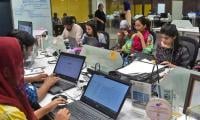
So, what further deepened my apprehensions about the future of Pakistan? Well, the extent of our learning poverty is, yes, 80 per cent. We have all been mindful of the poor state of our education. There are so many dimensions of this national tragedy. We have been talking about the number of children who are out of school and about the massive disparity between the facilities available to the elite and those available to common citizens. But isn’t the insight that our learning poverty is 80 per cent a little hard to comprehend?
First, let me explain this rather recent concept of learning poverty. The World Bank defines it as the inability of children to read and understand a simple text by age 10. All children are expected to be able to read by the age of 10. This is crucial because “reading is a gateway for learning as the child progresses through school and university”.
The point is that not all children enrolled in primary schools and who go through the drill of moving from one class to the next, higher class, can read and understand a simple, age-appropriate text. The terrifying finding is that 80 per cent of late primary-age children cannot read.
Think of what this means in the context of building human capital for social development. Does this not amount to losing the war before even setting foot on the battlefield? Consider also the fact that children grow and become adults. The situation may have remained the same for a number of years.
We have a measure of how disgraceful our educational performance is. According to the World Bank, learning poverty in Pakistan is 18.3 percentage points higher than the South Asian average and 16.6 percentage points higher than the lower-middle-income average. As I have noted earlier, we lag behind all South Asian countries.
Somehow, this state of affairs does not seem to be a matter of urgency for our rulers, who are breathlessly engaged in their own games of governance. The nation is currently engrossed in the political backlash over what PPP Chairman Bilawal Bhutto-Zardari said at the Karachi Press Club on Tuesday. Consultations at the highest level in the country have been held and political alliances are under strain.
One question that has not been posed is whether the quality of our primary education will improve if there are more provinces. Nor is there any debate on how the plight of the poor masses would be reduced with the establishment of new administrative units. It was initially said that the system of governance has collapsed. But what they seem to be protecting are the privileges and perks of those who preside over this system. We see on a daily basis, on our television screens, the pomp and show of the life they live.
Anyhow, I said that there are other related issues that are related to our learning poverty. I have long mourned our very poor reading habits. Leaving children aside, our educated citizens are generally averse to reading books. Comparison with other countries, including those of South Asia, would put us to shame in this respect, too. Books, libraries and a passion for reading among a sizable section of the population are, in my view, essential ingredients of progress and economic development.
People find it hard to believe when I quote numbers about books published and sold in many countries and royalties earned by prominent writers. These may be fairy tales for some of us. A snippet: The US military had sent 123 million copies of pocket-sized paperbacks – works of fiction – to American troops during the Second World War. Before that, American citizens had donated 18 million books for the troops.
This week, a book has created political turmoil in India. It is Sonia Gandhi’s memoir, ‘Belonging: A Journey of Love’. Over 200,000 copies of the book were sold in India within less than a week of its release on November 11. It has broken Indian publishing records as the fastest-selling book and has ignited a national debate. A large part of the book is devoted to Sonia’s account of her love affair with Rajiv.
I am reminded of another memoir of another woman of substance. It is Michelle Obama’s ‘Becoming’. More than 14 million copies of the book that was published in November 2018 were sold worldwide and it was translated into dozens of languages.
Barack Obama and Michelle had signed a record-breaking joint book deal with Penguin Random House worth an estimated $65 million in February 2017. Obama’s book about his presidency was titled ‘A Promised Land’. However, Michelle’s book was a deeply personal account of her life and sold more copies.
There are so many other tales to be told about how books have changed the lives of not only individuals but also of nations. It may be news to some, but reading is not dead, and the global book market is growing. So are bookshops and libraries. Ah, but we in Pakistan have to contend with our learning poverty – and the prosperity of our ignorance.
The writer is a senior journalist. He can be reached at: [email protected]