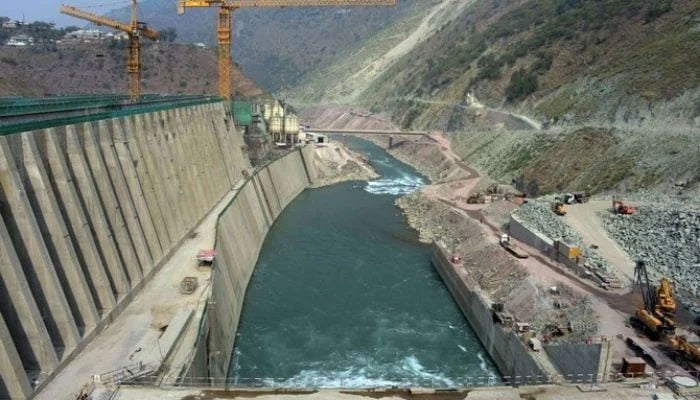
Neelum-Jhelum did not become a problem after commissioning. It entered service carrying the consequences of choices made much earlier: a bigger design, deeper tunnels, weaker risk discipline, inflated costs and a strategic narrative that made hard questioning politically inconvenient.
The original concept was sound. Pakistan needed indigenous hydropower. The Neelum River offered real generation potential. The Kishanganga dispute with India gave the project strategic urgency. A timely, technically conservative scheme could have supplied low-cost electricity, reduced dependence on fuel imports and strengthened Pakistan’s water-use position.
But the project did not remain technically conservative. The decisive planning shift was from a smaller, shorter and less hazardous layout to the eventual 969MW scheme. The earlier option appears to have involved a lower head and simpler tunnel alignment. The revised design sought a much higher head by using a longer underground waterway system, thereby raising the installed capacity but increasing geological and construction risks.
That trade-off was the essence of the matter. Pakistan bought roughly 400MW of additional headline capacity by accepting a vastly more complex tunnel system. The public heard the capacity number. It did not hear, with equal clarity, the price of that number: longer tunnels, deeper excavation, greater hydraulic pressure, weaker rock exposure, seismic sensitivity, construction uncertainty and a much heavier financial burden.
A megawatt in a planning document is cheap. A megawatt inside a mountain is not. The larger design had obvious appeal. It was grander, more marketable and more useful for official speeches. But capacity only matters if the plant can be built safely, financed rationally and operated reliably for decades. On that test, Neelum-Jhelum’s planning stage deserved far more scepticism than it received.
India’s Kishanganga project was a genuine concern. Pakistan had reason to move quickly. But urgency should have meant sharper decision-making, not weaker scrutiny.
The project cost tells its own story. What began as a far more modest undertaking crossed the Rs500 billion mark by the time of final approval. That cannot be explained away as inflation. It reflected design ambition, financing delays, geological surprises, contract changes and weak project control.
The dollar cost is even more damning than the rupee headline suggests. ECNEC ultimately approved the project at Rs506.8 billion in 2018. This was not merely a Wapda balance-sheet number: the project equity was partly funded by electricity consumers through the Neelum-Jhelum surcharge collected on their power bills. Dividing the final rupee cost by the 2018 exchange rate also understates the burden because much of the expenditure occurred when the rupee was stronger.
Converting estimated annual construction spending at each year’s average official exchange rate places the nominal dollar cost at roughly $5.1 billion, or about $5.3 million per MW. The Planning Commission’s own third-party validation terms put the unit construction cost at $4.23 million per MW and compared it with Dasu at $2.25 million, Bunji at $1.87 million, Diamer-Basha at $2.48 million and Lower Palas at $1.66 million per MW. On any fair benchmark, this became one of the most expensive tunnel-heavy run-of-river hydropower projects of comparable scale; if there is a more expensive example of its nature, the public has never been shown it.
A broader international comparison removes the last refuge of excuses. The relevant benchmark is not an ordinary dam or a thermal plant, but other diversion, tunnel-heavy or run-of-river hydropower schemes. Even allowing for differences in terrain, project year, scope, transmission treatment and exchange rates, Neelum-Jhelum remains an outlier. It is more expensive per MW than Kishanganga, Karot, Xayaburi, Nam Theun 2, Tala and even China’s giant Jinping-II diversion project. That is the true comparison: Pakistan paid a premium price for a project that still failed to deliver premium reliability.
The missing question was brutally simple: was the additional capacity worth the additional risk? If a smaller scheme could have delivered substantial power earlier and at lower risk, the larger option needed a hard economic and engineering defence. That defence should have been revisited after the 2005 earthquake, when the region’s geological and seismic risks became impossible to ignore. Instead, the larger design remained the path of least resistance inside the project machinery.
By the time construction moved into full execution, the central decision had already been made. Implementation teams then inherited the consequences: difficult tunnelling, rock stress, pressure issues, delays and rising costs. Later controversies over tunnelling methodology were not isolated management glitches. They were symptoms of a design whose risk profile had been under-assessed at the planning stage.
The tunnel boring machine story captures the same failure in metal form. The TBMs were brought in to fast-track excavation; instead, their installation reportedly took seven months and their removal and dismantling was expected to take another seven. A cabinet committee was reportedly told that the machines were a poor decision and that disposal was itself a problem because the contract carried a salvage value of $4.065 million, while the machines were custom-made for Neelum-Jhelum and not usable elsewhere in Pakistan. The instrument bought to save time became another example of how haste, weak geology, poor contracting and thin accountability can turn engineering equipment into stranded capital.
This is why later remarks by Wapda Chairman Muzammil Hussain were so significant. He reportedly described Neelum-Jhelum as poorly designed and ill-conceived from the beginning, citing weak surveys, vague estimates, rock bursting, water seepage and mid-course changes. That was an institutional admission that the project had been structurally flawed before it became operational.
Yet Pakistan treated the warning as another item in the archive. No national reckoning followed. No full public account was placed before consumers, taxpayers or Parliament explaining why the larger design was chosen, who evaluated the geological risk, what alternatives were rejected and how the cost-benefit case changed over time.
Before commissioning, Neelum-Jhelum already displayed the classic symptoms of Pakistani mega-project failure: inflated ambition, weak scrutiny, strategic sloganeering, delayed execution and blurred accountability. The project was too important to question, too expensive to stop and too politically useful to examine honestly.
Commissioning later provided a photograph, not a verdict. The deeper verdict had already been written into the design. Pakistan chose the grander tunnel-heavy scheme and failed to build the governance discipline needed to match it.
Neelum-Jhelum’s first tragedy was therefore not the tunnel collapse. The first tragedy was that the design risk was visible before generation began, yet the state marched ahead as if ambition itself were an engineering solution.
The writer is a former member of the Planning Commission.