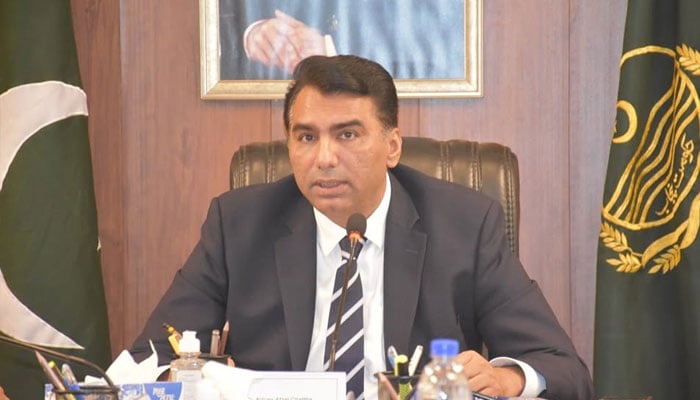
LAHORE: Defending the Punjab government’s Crime Control Department (CCD) against criticism from the opposition, Pakistan Muslim League-Nawaz (PMLN) MPA Adnan Afzal Chattha on Monday said isolated incidents should not be used to malign an institution that, according to him, had significantly contributed to improving law and order across the province.
Speaking during a debate in the Punjab Assembly, Mr Chattha accused the Pakistan Tehreek-i-Insaf (PTI) of pursuing a “calculated narrative-building exercise” aimed at discrediting state institutions, arguing that the opposition had previously employed similar tactics against the country’s armed forces and was now targeting Punjab Police and the newly-established CCD.
Referring to the recently launched Operation Bunyan-un-Marsoos, the PML-N legislator said Pakistan’s success had exposed what he called the opposition’s ability to construct “false narratives.”
Rejecting repeated comparisons with policing standards in the United Kingdom, Chattha maintained that key crime indicators in Punjab had improved considerably and argued that incidents such as armed robberies and violent street crimes remained lower than those recorded by police in London.
Chattha said that before recent improvements in policing, residents of several districts, including Mandi Bahauddin, Gujrat and Wazirabad, had lived under constant fear because contract killers operated with impunity.
“Respectable citizens were being assassinated through hired shooters. I myself was targeted, and shooters were sent after me,” he said, adding that ordinary people could now move about with a greater sense of security.
Responding to the debate, Punjab Assembly Speaker Malik Muhammad Ahmad Khan observed that hired assassins and contract killers were a recognised feature of organised criminal networks worldwide and that policing models in cities such as Mumbai, New York and Bangkok, as well as in the Philippines, had evolved specifically to dismantle such underworld structures.
The Speaker said criminals involved in organised violence must invariably be brought to justice through due legal process and appreciated the concerns raised by the treasury member. However, he stressed that the House should now focus on strengthening legislation aimed at preventing crime rather than merely responding to criminal incidents after they occur.
Expressing concern over the growing influence of social media on young people, the Speaker questioned the kind of content being consumed by underage children and urged lawmakers to consider introducing legal restrictions for users below the age of 16.
“As the government, you have the authority to legislate through this House,” he remarked. Supporting the proposal, Chattha said countries including Australia and the United Kingdom had already introduced restrictions to protect minors from harmful online content and argued that Pakistan should move in the same direction.
He said that while governments often highlighted infrastructure projects and welfare initiatives during public campaigns, citizens increasingly regarded improved law and order as one of the administration’s most significant achievements.
Chattha said that in Lahore, dacoities had declined by 54 percent, house dacoities by 82 percent, robberies by 77 percent, house robberies by 57 percent, motorcycle snatching by 71 perecnt and motorcycle theft by 57 percent.
Similarly, in Gujranwala, dacoities had fallen by 54 percent, house dacoities by 79 percent, robberies by 46 percent, house robberies by 44 percent, motorcycle snatching by 82 percent and motorcycle theft by 54 percent.
Comparable improvements, he added, had also been recorded in Rawalpindi, Sargodha, Faisalabad, Sahiwal, Multan, Bahawalpur and Dera Ghazi Khan, resulting in enhanced protection of both lives and property throughout the province.