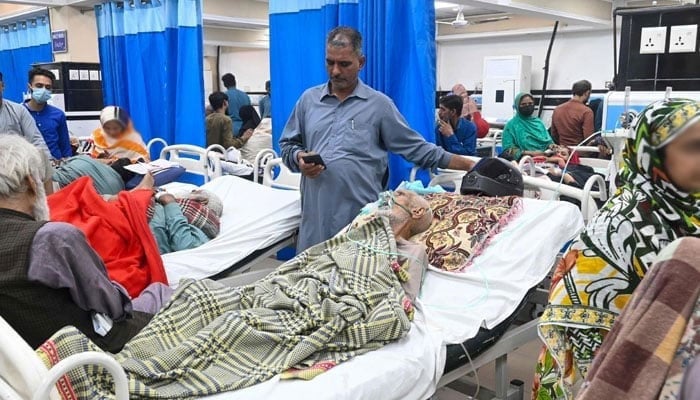
Moving critically ill patients, including newborns, infants, seriously ill adults and elderly people from one hospital to another remains one of the most poorly coordinated aspects of Pakistan’s healthcare system where families are often left to arrange referrals themselves, search for available intensive care beds and transport patients with little or no assistance from the treating hospital.
Health experts say the problem extends far beyond arranging an ambulance. In many cases, attendants must personally contact hospitals across the city to determine whether an intensive care unit (ICU), neonatal intensive care unit (NICU), high dependency unit (HDU) or specialist bed is available because the referring hospital often does not coordinate with potential receiving facilities or actively facilitate the transfer process.
The challenge is compounded by the absence of standardised transfer documentation. Patients’ families, attendants and health care professionals say many public, private and charitable hospitals either refuse or hesitate to provide a concise clinical summary while treatment is ongoing, even when families wish to seek a second opinion or transfer a critically ill patient to another hospital offering services unavailable at the referring facility.
The issue came into focus this week when the family of a critically ill three-month-old infant receiving treatment at a charitable paediatric emergency facility operating at the Lyari General Hospital, Karachi, tried to transfer the baby to another NICU but was left to search for an available bed on its own.
The attendants alleged they were denied a concise one-page clinical summary and were instead given four pages of treatment notes, making it difficult to explain the baby’s condition to hospitals that requested a brief medical summary before considering admission.
Health care professionals say this is not an isolated incident as families trying to transfer critically ill patients frequently encounter two major barriers: they receive little assistance in locating an appropriate receiving hospital and often struggle to obtain standardised referral documentation before arranging the transfer.
Several attendants who spoke to this scribe described similar experiences at public, private and charitable hospitals, saying they were frequently told that discharge summaries could only be issued after formal discharge or after the patient had been recorded as having left against medical advice (LAMA).
They argued that this created a serious dilemma because receiving hospitals often required medical documentation before agreeing to admit a critically ill patient. Health experts warn that such delays can have serious consequences in emergency medicine, where treatment decisions frequently depend on rapid communication between health care providers.
A standard transfer summary generally includes the working diagnosis, current clinical condition, important investigations, procedures performed, medications administered, response to treatment and the reason for referral, allowing the receiving medical team to continue care without unnecessary delay.
Internationally, inter-facility transfers are usually supported through structured referral systems in which the referring hospital communicates directly with the receiving institution, helps confirm bed availability where possible and provides standardised transfer documentation before the patient arrives. Such systems improve continuity of care, reduce duplication of investigations and minimise delays during medical emergencies.
In Pakistan, however, no uniformly implemented mechanism requires hospitals to actively coordinate transfers or promptly provide a concise referral summary while treatment is still ongoing. As a result, distressed families are often left to navigate Pakistan’s fragmented health care system on their own while critically ill patients wait for definitive care.
Medical ethics experts maintain that while original medical records remain the property of the treating institution, providing patients or their legal attendants with essential clinical information needed to facilitate continuing treatment elsewhere is consistent with patient-centred care, medical ethics and continuity of care. They argue that when lives are at stake, facilitating safe and timely transfer should take precedence over administrative procedures.