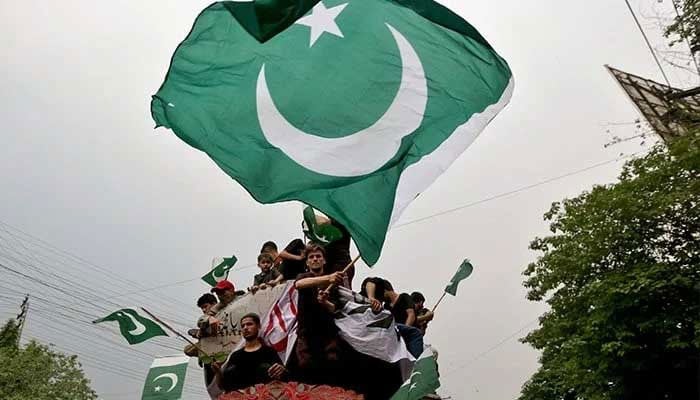
Pakistan should not have survived. That is not a provocative claim; it was the considered judgment of many serious observers in 1947.
A state divided by more than 1,600 kilometres of hostile territory, united by no single language, ethnicity, or tribe, absorbing one of history’s largest refugee movements, and surrounded by a hostile neighbour and a turbulent frontier, the odds were against it. Yet Pakistan survived.
More than that, it endured wars, terrorism, economic crises, and relentless external pressure and emerged as a nation of over 252 million people. The explanation is not simply military strength or geography. It is Pakistaniat.
Nations are not sustained by borders alone. They endure because people believe they share a common destiny. The French thinker Ernest Renan described a nation as a “daily plebiscite”, a continuing choice by citizens to live together. That choice is never automatic. It must be earned, renewed and protected. In an age of information warfare and social engineering, protecting that choice has become one of Pakistan’s most urgent strategic challenges.
Pakistaniat is one of the most invoked and least examined concepts in Pakistani public discourse. It is not a slogan, a political catchphrase or a demand for cultural uniformity. Pakistaniat is the civic idea that binds together a profoundly diverse population, Punjabis, Sindhis, Pashtuns, Baloch, Kashmiris, Gilgitis, Baltis, Saraikis and Mohajirs, into a single political community with a shared history, shared sovereignty and shared future. Its genius lies in what it does not require. A citizen does not stop being Pashtun to become Pakistani. A Sindhi does not choose between Sindhi and Pakistani. A Baloch does not surrender cultural identity to claim national belonging. Pakistaniat creates the larger frame within which multiple identities coexist, not despite differences, but through them.
This is a form of civic nationalism, and it has proven one of the most durable political inventions of the modern era. The US forged a national identity across continents of origin and centuries of immigration. Indonesia unified hundreds of ethnic groups across thousands of islands under Bhinneka Tunggal Ika, Unity in Diversity. Switzerland maintains national cohesion across four official languages and sharply distinct regional cultures. Pakistan’s founders understood this. The Pakistan Movement was not an ethnic movement. It was a political movement. Islam provided its civilizational foundation, and Pakistaniat provided the national framework that would hold a diverse federation together after independence.
To understand why Pakistaniat matters, it helps to think of Pakistan as resting on three interconnected pillars. The first is ideology, the rationale for statehood, rooted in the aspiration for Muslim self-determination and a distinct political identity for the Muslims of the Subcontinent. The second is the constitution, the framework of governance, fundamental rights, and citizenship. The third, and most fragile, is Pakistaniat itself, the emotional, civic, and psychological bond that transforms a population into a nation.
A state can be governed through the first two. But only the third makes people defend a country, sacrifice for it, and choose it daily over narrower allegiances. That is precisely why it has become the primary target of modern subversion.
Contemporary conflict has shifted decisively. The objective of hostile actors today is rarely territorial conquest. It is cognitive conquest, the shaping of perceptions, the manipulation of identities, and the erosion of the shared beliefs that sustain national cohesion. The strategy is not to create new grievances but to weaponise existing ones. Every society has fault lines, economic inequality, regional disparities, political disagreements, historical injustices. These are normal features of national life. The danger emerges when these fault lines are systematically amplified, reframed and transformed into competing political identities intended to challenge the national framework itself.
Pakistan’s scale and demographic profile make it particularly exposed. Home to more than 252 million people, 161 million broadband users, and over 207 million mobile subscribers, Pakistan has one of the largest and youngest digital populations in the Muslim world. Nearly two-thirds of its citizens are under thirty. The same connectivity that creates opportunity also creates vulnerability. Algorithms reward outrage. Echo chambers entrench polarisation. Narratives engineered to fragment identity can spread nationally within hours, reaching tens of millions before institutions can respond.
The target is always Pakistaniat itself, an effort to convince the Pashtun that Pashtunwali is incompatible with the federation, to convince the Baloch that the state has nothing to offer, to persuade citizens across all provinces that their primary loyalty must be ethnic, provincial or sectarian rather than national.
Once people begin to see each other through narrow identity lenses rather than a shared national one, cohesion erodes and the state becomes vulnerable to external manipulation. The experience of Yugoslavia, Lebanon and the countries swept by the Arab Spring teaches the same lesson: states rarely collapse because external enemies overpower them. They weaken when the internal bonds of trust, identity, and shared purpose begin to unravel.
Pakistaniat cannot be preserved through rhetoric alone. Slogans do not bind nations. Inclusion does. Citizens must feel they have a genuine stake in the national project, through governance that delivers justice across all provinces, economic opportunity that reaches beyond major cities, and educational institutions that build a shared national narrative while genuinely celebrating regional diversity.
Crucially, it also requires the confidence to engage honestly with Pakistan’s contradictions. Suppressing legitimate grievances does not protect Pakistaniat, it weakens it by generating resentments that subversive actors exploit. A strong national identity is not fragile. It does not fracture when challenged. It absorbs complexity, acknowledges failure, and reforms itself without abandoning its core.
The contest facing Pakistan today is not between Punjabi and Pashtun, between province and federation, or between local identity and national identity. These are false choices, deliberately constructed. The real contest is between Pakistaniat and fragmentation. It is between the proposition that 252 million people share a common future and the calculated effort to convince them that they do not. It is a contest between the version of Pakistan that was imagined in 1947 and the version that hostile narratives seek to impose today, a Pakistan permanently at war with itself, too divided to govern, too polarised to develop, and too fragmented to defend its sovereignty.
Pakistan was created through ideology. It is governed through its constitution. But it survives, and will only continue to survive, through Pakistaniat. The battle for Pakistan’s future is not being fought only on its borders. It is being fought in classrooms and on social media feeds, in the narratives that shape how Pakistanis understand themselves and each other.
In the twenty-first century, ensuring that citizens continue to choose a common future freely, confidently and with reason is a national security imperative.
The writer is a public policy expert and leads the Country Partner Institute of the World Economic Forum in Pakistan. He tweets/posts @amirjahangir and can be reached at: [email protected]