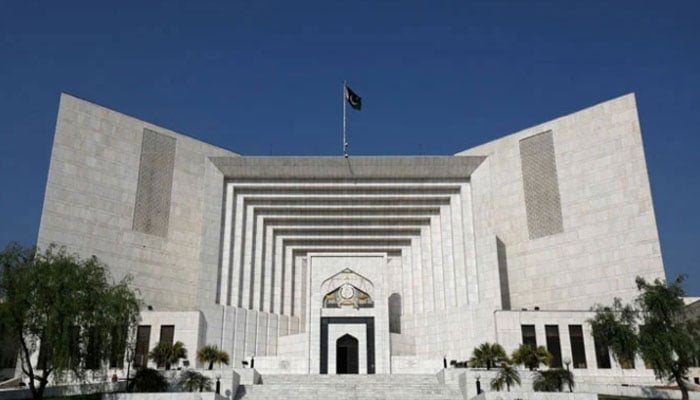
ISLAMABAD: The Supreme Court has observed that if a government employee is honourably acquitted of charges brought against him in a criminal case, he is entitled to receive full salary, allowances and other benefits that were due to him during the period of his service.
A two-member bench of the apex court, comprising Chief Justice Yahya Afridi and Justice Muhammad Ali Mazhar, announced judgement in a service matter case titled Mian Abdul Saeed versus Government of Khyber Pakhtunkhwa.
Petitioner Mian Abdul Saeed had filed an appeal in the apex court against the judgement passed by the Khyber Pakhtunkhwa Service Tribunal, Peshawar Camp Court Swat, on May 7, 2019.
“When an employee is honourably acquitted in a criminal case, he cannot be deprived of the rights and benefits that he would have enjoyed had he remained in service throughout that period,” says an eight-page judgement authored by Justice Mazhar.
The court held that the period during which the petitioner remained separated from service should also be treated as time spent on duty. As per the case, petitioner Mian Abdul Saeed, a Grade-17 government school teacher from Bannu, was dismissed from service by the Education Department after he was convicted by a trial court in a criminal case. However, upon hearing his appeal, the Peshawar High Court honourably acquitted him.
Although the department reinstated him to his position, it refused to pay his salary and other benefits for the period during which he remained out of service due to the criminal proceedings.
He challenged this decision before the Service Tribunal, but after his appeal was dismissed, he approached the Supreme Court. The court, after hearing the case in detail, allowed the appeal of the petitioner and set aside the Service Tribunal judgement.
The court noted that the Competent Authority (Directorate of Elementary & Secondary Education, Khyber Pakhtunkhwa, Peshawar) had reinstated the appellant in service with immediate effect vide Office Order dated April 19, 2018.
The court, however, by means of the judgement, directed the competent authority to reconsider the case of the appellant and pass a fresh order to the extent of granting back benefits to the appellant in terms of Fundamental Rule 54 within a period of two months from the date of receiving the copy of the judgement.
The court held that departmental proceedings and criminal proceedings are different in nature; therefore, both proceedings may continue independently and simultaneously. The court, however, held that before dismissing a government employee through disciplinary proceedings, the employee must be given a proper opportunity to present his case and defend himself.
“Failing to do so would render such action contrary to the law and the Constitution,” said the judgement. “What we have perceived is that no reasons were jotted down by the revising/ appellate authority in the reinstatement order passed in exercise of powers conferred under the Khyber Pakhtunkhwa Government Servants (Efficiency and Discipline) Rules, 2011, as to why the appellant was not entitled to the back benefits in terms of F R 54 or as to why the intervening period with effect from December 19, 2013, was treated as leave without pay and not with pay,” the judgement noted.
Furthermore, the court held that the competent authority also failed to determine arrears of pay in terms of Section 17 of the Khyber Pakhtunkhwa Civil Servants Act, 1973, while setting aside the order of removal from service and according reinstatement to the appellant.
“The record shows that no show cause notice or departmental inquiry was conducted before the appellant’s removal from service. Instead, the department relied solely on the appellant’s criminal case and subsequent acquittal without initiating independent disciplinary proceedings.”
The court held that a show cause notice and statement of allegations are the essential first steps to commence a lawful inquiry. It further contended that Section 17 of the Khyber Pakhtunkhwa Civil Servants Act, 1973, gives the competent authority discretion to grant or refuse back benefits, while not disputing the applicability of F R 54 in Khyber Pakhtunkhwa.