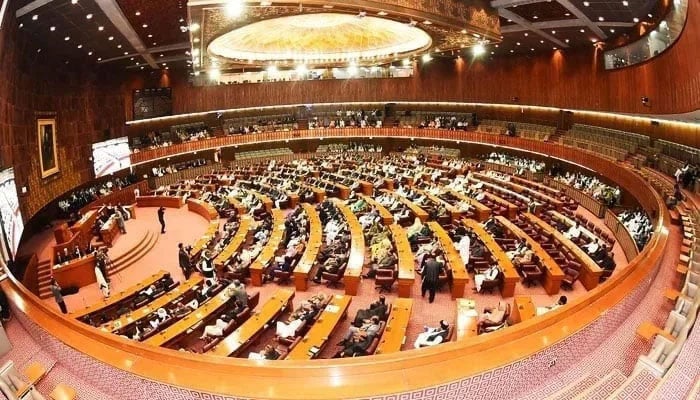
ISLAMABAD: As part of its deliberations on the federal budget 2026-27, the National Assembly on Sunday unanimously approved Rs3 trillion for the armed forces, with the allocations passing without opposition, as no cut motions were moved.
The House approved a total of 125 demands for grants for the upcoming financial year, setting the stage for the passage of Rs18.77 trillion federal budget 2026-27.
The demands for grants were related to various ministries, divisions and departments.
The lower house is scheduled to pass the federal budget on June 23 (Tuesday), while supplementary grants will be taken up on June 24.
During discussions on cut motions, the government, the National Assembly Secretariat and the opposition reached an understanding to restore live transmission of opposition speeches, subject to a code of conduct. Under the understanding, the members will avoid discussing the conduct of sitting judges, criticising institutions and will confine their speeches to the budget.
PTI Chairman Barrister Gohar also demanded the lifting of Iqbal Afridi’s suspension, complaining of a blackout of opposition speeches. Afridi had been suspended on June 11 for the remainder of the session due to misconduct with the assembly staff and unparliamentary behaviour. After assurance to Speaker Sardar Ayaz Sadiq that Afridi would not repeat misconduct, the House approved a motion restoring his membership.
Barrister Gohar and Ali Muhammad Khan also complained about the ban on live transmission of opposition speeches. Ayaz said there was no rule regarding live transmission of speeches and advised that a code of conduct be agreed first, including the formation of a joint committee.
Defence Minister Khawaja Asif termed “Vigo Dala” vehicles as “vulgarity” and suggested they be banned from the Parliament House parking and roads. He said whoever drives such vehicles “reaches another world”, drawing laughter in the House. He added that police escort members when in government and chase them in opposition.
He also urged parliamentarians to maintain the sanctity of the House and avoid talking to visitors sitting in the gallery.
The House approved Rs0.709 billion for the cabinet, Rs5.941 billion for the Cabinet division, Rs1.796 billion for emergency relief and repatriation, Rs0.895 billion for the Prime Minister’s Office (Internal), Rs0.921 billion for the Prime Minister’s Office (Public), Rs1.048 billion for the National Disaster Management Authority, Rs0.858 billion for the Board of Investment, Rs0.2 billion for the Prime Minister’s Inspection Commission, Rs0.952 billion for the Special Technology Zone Authority, Rs0.205 billion for the National Anti-Money Laundering and Counter Financing Terrorism Authority and Rs0.25 billion for the Cannabis Control and Regulatory Authority.
Among other allocations, Rs10.177 billion were approved for the Establishment Division, Rs1.474 billion for the Federal Public Service Commission, Rs3.515 billion for the National School of Public Policy, Rs2.088 billion for the Civil Services Academy, Rs0.118 billion for the Council of Common Interests Secretariat, and Rs0.354 billion for the Special Investment Facilitation Council Division. The House also approved Rs63.516 billion for development expenditure of the Cabinet Division.
In the energy and power sector, the House approved six demands for grants worth Rs661.27 billion, including Rs578.837 billion for the Power Division, Rs1.112 billion for the Petroleum Division and Rs1.201 billion for the Geological Survey of Pakistan. Development allocations included Rs3.197 billion for the Power Division, Rs0.312 billion for capital outlay on the Petroleum Division and Rs76.608 billion for external development loans and advances of the Power Division.
Other approvals included Rs5.66 billion for the Finance Division, Rs9.87 billion for other expenditure of the Finance Division, Rs14.91 billion for the Controller General of Accounts, Rs1,162.0 billion for superannuation allowances and pensions, and Rs2,504.0 billion for grants, subsidies and miscellaneous expenditure. The House also approved Rs85.60 billion for the Federal Board of Revenue, Rs0.106 billion for the Revenue Division, Rs94.71 billion for federal miscellaneous investments, Rs231.08 billion for other development expenditure, Rs2.35 billion for capital outlay on federal investments, Rs169.21 billion for development loans and advances, and Rs2.30 billion for external development loans and advances.
The House also approved grants for multiple ministries and institutions including Atomic Energy, Pakistan Nuclear Regulatory Authority, Naya Pakistan Housing Development Authority, National Security Division, Intelligence Bureau, Climate Change, Commerce Division, Communications Division, Pakistan Post, Defence Division, Airports Security Force, Defence Services, Defence Production Division, Economic Affairs Division, Federal Education and Professional Training Division, Higher Education Commission, National Rahmatul-Lil-Alameen Wa Khatamun Nabiyyin Authority, NAVTTC, National Heritage and Culture Division, Foreign Affairs Division, Housing and Works Division, Human Rights Division, Industries and Production Division, Information and Broadcasting Division, Information Technology and Telecommunication Division, Inter-Provincial Coordination Division, Kashmir Affairs and Gilgit-Baltistan and States and Frontier Regions Division, Law and Justice Division, Council of Islamic Ideology, National Accountability Bureau, District Judiciary Islamabad Capital Territory, Maritime Affairs Division, National Assembly, Senate, National Health Services, Overseas Pakistanis and Human Resource Development Division, Parliamentary Affairs Division, Planning, Development and Special Initiatives Division, Privatization Division, Railways Division, Religious Affairs and Interfaith Harmony Division, Science and Technology Division, Water Resources Division, Board of Investment, Development Expenditure of Special Technology Zones Authority, Development Expenditure of Establishment Division, SUPARCO, Development Expenditure of Special Investment Facilitation Council, Development Expenditure of Finance Division, Development Expenditure of Revenue Division and Development Expenditure of Interior and Narcotics Control Division.
Power Division Minister Sardar Awais Ahmad Khan Leghari rejected the opposition claims in cut motions, saying the figures presented did not reflect the actual situation in the power sector. He said criticism mainly focused on consumer services rather than infrastructure performance.
He said the fiscal burden of the power sector had declined from Rs1,287 billion in FY2024-25 to Rs893 billion, with expectations of a further reduction to Rs700 billion. He added that circular debt had been reduced by Rs780 billion from Rs2.4 trillion, while reforms in distribution companies had cut losses from Rs591 billion to Rs335 billion.
He said revised agreements with Independent Power Producers would save Rs3.5 trillion in future liabilities, while 76 percent of electricity generation now came from indigenous sources. He added that economic load-shedding was being carried out on around 3,500 of 14,500 feeders, with a Rs50 billion programme launched to eliminate it by June next year.
Finance Minister Muhammad Aurangzeb, winding up the debate, expressed confidence in achieving the revenue target for the next fiscal year. He said no new taxes had been imposed and Rs450 billion had been recovered through litigation.
He said key macroeconomic indicators had improved since 2022, including 3.7 percent growth, a primary surplus at historic levels and a current account surplus recorded in both the previous and current fiscal years. He said the debt-to-GDP ratio had declined from around 70 percent to 68 percent and highlighted ongoing reforms in the Federal Board of Revenue.
Opposition members criticised the budget during cut motions. Shahram Khan Tarakai said poverty had reached unprecedented levels, while Naeema Kishwar of JUI-F said tax relief was being given to elites, including first and business class passengers and luxury vehicles, with little benefit for the common man. Sibghatullah questioned the effectiveness of FBR reforms and revenue performance, while Shahid Khattak said the government was increasing the burden on taxpayers instead of broadening the tax base.