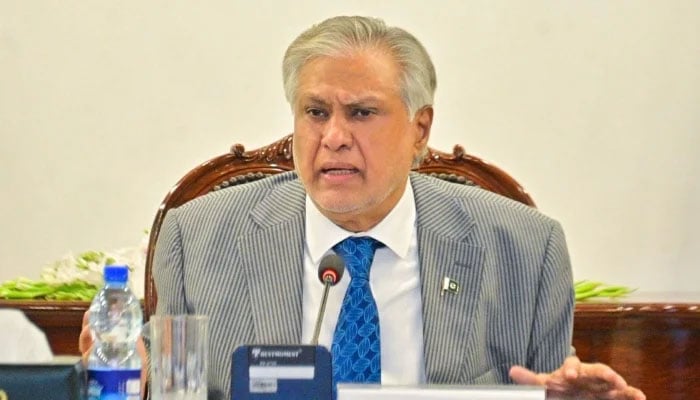
BRUSSELS: Deputy Prime Minister/Foreign Minister Ishaq Dar expressed concern over recent Indian reservoir expansion and water diversion projects on the Indus River system, warning that such measures could alter natural river flows, foster “hydro-hegemony”, and pose serious risks to regional stability and water security.
Addressing a conference on transboundary water resources in Brussels virtually on Thursday, Dar said Pakistan’s concerns were not based solely on Indian statements but also on actions taken under the Indus River System.
“It is important to underscore that our concerns are not merely based on Indian statements,” DPM Dar said. He added that India had pursued projects including reservoirs, the expansion of existing structures and diversion schemes on the Indus, Chenab and Ravi rivers.
“In total, at least 17 such projects will drastically alter the river system as a whole, giving India the tools for ‘hydro-hegemony’ that it so desires,” he added.
Addressing the seminar earlier in the day, the deputy prime minister further said Pakistan remained committed to the principles of the UN Charter and international law, noting that the Indus Waters Treaty (IWT) signed in 1960 had provided a framework for the utilisation of six rivers of the Indus River system and had survived multiple conflicts over the decades.
He said Pakistan had previously raised concerns through international mechanisms and respected decisions even when they did not fully meet its expectations. However, DPM Dar stressed that “responsible states act within established legal frameworks rather than abandoning them.”
The deputy prime minister described rivers as “lifelines” carrying historical, cultural and economic significance. He warned that any attempt to deprive populations of access to water could have serious consequences. “Water must never be viewed as an instrument of coercion,” he said, adding that the future of transboundary water governance should be based on cooperation and respect for international law.