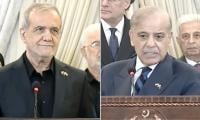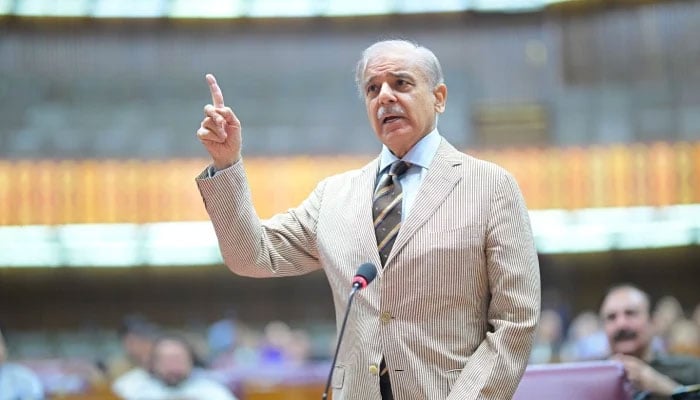
ISLAMABAD: Prime Minister Shehbaz Sharif on Saturday renewed his offer of talks to the opposition leaders to uphold democratic values and for strengthening the Constitution and law in the country.
The prime minister, while speaking on the floor of the National Assembly, said that in the past also, he, more than once, offered the opposition a Charter of Democracy and Charter of Economy but every time his offer was turned down. He said that he was always available. “I am here. Let us sit together and talk. It is never too late.”
He said that he continued to hold respect for opposition leaders, including Mahmood Khan Achakzai and Barrister Gohar Ali Khan.
He said Achakzai in his speech talked about the Jati Umra residence, adding that he wanted to say that Achakzai was welcomed there. He said that members in the House come from all parts of the country and this esteemed House is likened to a home, accommodating people from the four provinces.
He opined that their visions, thoughts and politics might differ, but to make Pakistan stronger and enhance its esteem among the comity of nations, they must give the message that they would thrive if the country exists.
Referring to a remark of the leader of the opposition, the prime minister said that there were no two opinions that inhabitants of the respective provinces have rights over resources. In this connection, he referred to the Reko Diq agreement, saying that it was reached in consultation with the provincial leadership and the residents.
Terming it as ‘a bright example’, he further said that during 2010, a historic NFC award was reached in which the shares of people of Balochistan had been enhanced by 100 percent.
He recalled that Punjab had allocated the major share at that time by earmarking Rs11 billion annually, adding that other provinces also contributed. The prime minister also pointed out that Rs75 billion had been allocated for solarisation in the province, which benefited farmers, while from Gwadar to Chaman, a road was being constructed for Rs300 billion.
He said the demand for the road was not made by the opposition leader, but considering it as his responsibility as the prime minister, he approved its construction. It was the onus of his office that all provinces should equally move on the path of progress and prosperity. Expressing grief over the martyrdom of 22 security personnel in a helicopter crash, he said that two crew members belonged to the Christian community.
He said terrorism in Balochistan was being supported by foreign hands and they had proved their involvement with solid evidence.
On another point of the opposition leader, the prime minister justified the fencing of the Durand Line for the security of people and the country and said that it was the right decision. “If a child’s life in the country is saved, I consider spending an amount on border fencing justified,” he maintained. He said that Khyber Pakhtunkhwa had been affected by terrorism, where personnel of law enforcement agencies, security forces and armed forces were sacrificing their lives. “They left their children orphans but saved millions of children of the nation. We should pay homage to martyrs,” he stressed.
Responding to the speech of prime minister, Pakistan Tehreek-e-Insaf (PTI) Chairman Barrister Gohar said that the Leader of the House did not react to some important points raised by the opposition leader in the house.
He said that all the PTI-supported MNAs who are sitting in the National Assembly were elected because of party founder Imran Khan, with whom no meeting had been allowed since October last year. He said the prime minister did not say when the family members and party leaders would be provided access to Imran Khan. “Family members, party leaders and Imran Khan’s supporters are concerned about his health,” he said.
He said that no such impression should be given that the opposition was against the country and the Pakistan Army. “This is our country and this is our army,” he said. He said that the country’s defence would be strengthened when there was economic and political stability in the country.
Responding to prime minister’s offer of talks, Barrister Gohar wondered if he is authorised to initiate the process of dialogue. He also questioned the prime minister as to what he wanted from the PTI founder. Minister for Law and Justice Senator Azam Nazeer Tarar, in response, said that the matter of meetings with the PTI founder was currently before the court. He said that necessary measures are being taken by the government on Imran Khan’s health. He said that the opposition should play a constructive role during the budget session. “We will take note of all suggestions made by the members. At the conclusion of the budget speech, the finance minister will respond to these suggestions,” he said, adding that both the government and opposition members should present their proposals.
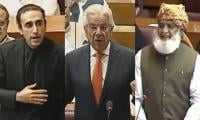
Earlier, initiating debate on the federal budget, Leader of the Opposition in the National Assembly Mehmood Khan Achakzai appealed to the prime minister to strengthen parliament.
“I appeal to Prime Minister Shehbaz Sharif to strengthen parliament. Hold transparent elections in the country. Whichever political party wins the election, let it govern. Do not take the country towards destruction.”
Achakzai said that problems will not be solved by using force against the people. “The Constitution gives citizens the freedom to protest and express their opinions. Firing bullets at peaceful protesters is condemnable. Balochistan’s issues should be resolved through political dialogue. The government is accountable for actions against political workers. A democratic and constitutional path should be adopted to solve public problems. Dialogue and reconciliation are needed to resolve political differences. Instead of suppressing the people’s voice, their concerns should be addressed. “We will never compromise on parliament. Mistakes made in the past can be corrected. Parliament is the source of Pakistan’s power. Those who voted for the 26th and other constitutional amendments violated their oath. Constitutional amendments could not have been passed without our votes.”
He said that in Balochistan, going to the mountains to protest is a tradition. He strongly condemned calling Pashtuns terrorists. The merger of Fata into Khyber Pakhtunkhwa was not on the assembly’s agenda. The decision to merge Fata into Khyber Pakhtunkhwa was made suddenly.
He regretted that MNA Iqbal Afridi had been kicked out while law enforcement personnel entered the Parliament House to search for parliamentarians, but the Speaker did nothing in reaction. In response, Speaker Sardar Ayaz Sadiq said that Iqbal Afridi misbehaved with the assembly officials and abused them. “I have no right to sit here if I cannot protect my people,” he said.
Achakzai said the government should not behave harshly with Imran Khan, saying that putting opponents in jail would not serve any political purpose. PPP MNA Samina Khalid Ghurki said the current budget has been prepared according to the circumstances and available time, but it was not a people-friendly budget.
JUIF MNA Naeema Kishwar said the Benazir Income Support Programme (BISP) is not the right system as it is making people dependent. She suggested that at least skill-development programmes for women should be run through the BISP.
MQM-P’s Dr Farooq Sattar said that in the “Marka-e-Haq,” Pakistan’s armed forces and Field Marshal Syed Asim Munir proved their strength to the world, and no amount of tribute would be sufficient. He said the government that defended the nation must now lead it toward prosperity, and the time has come for long-overdue structural reforms. He said the 8th National Finance Commission must ensure fair resource distribution, and districts should also be included alongside the federation and provinces. He said that under Article 107, districts should also receive a share in NFC resources. Southern Sindh, northern Sindh, southern Punjab and Hazara Division have suffered economic injustice. “Karachi, a city that contributes enormously to the economy, is being neglected,” he said.
Major (retd) Tahir Iqbal termed the 7 percent increase in government employees’ salaries as insufficient, saying salaries should have been increased by at least 15 percent so people could manage their living expenses. He also suggested that instead of the BISP, programmes should focus on creating skilled Pakistanis.
Opposition member Ali Muhammad Khan said budget-making is the job of elected representatives, not bureaucrats. He said that as long as governments are formed by those who do not truly represent the public, a people-friendly budget cannot emerge.
PPP’s Shahla Raza said that it was an IMF budget and many targets have not been achieved. She said that Ali Muhammad Khan delivered a political speech instead of discussing the budget.
Opposition member Rana Atif said that poverty has increased in Pakistan, but the budget is a maze of words that nobody understands. He said that industries in Faisalabad are shutting down as electricity prices have become excessively high. Sher Afzal Marwat said that he comes from an area affected by terrorism and terrorists have established a strong presence there. He said that roads in his constituency are in a state of disrepair.
PTI’s Dr Nisar Jutt said that he has a 53-page budget speech before him, saying the budget has no value and it will push the poor further into poverty. He said that around 190 small industries in Faisalabad have closed down and workers have been left without livelihoods. Jamal Raisani questioned when Gwadar’s youth will benefit from development projects.
Opposition member Riaz Fatyana, expressing concern over an increase in the price of agricultural machinery, asked the government to take practical measures to support farmers.