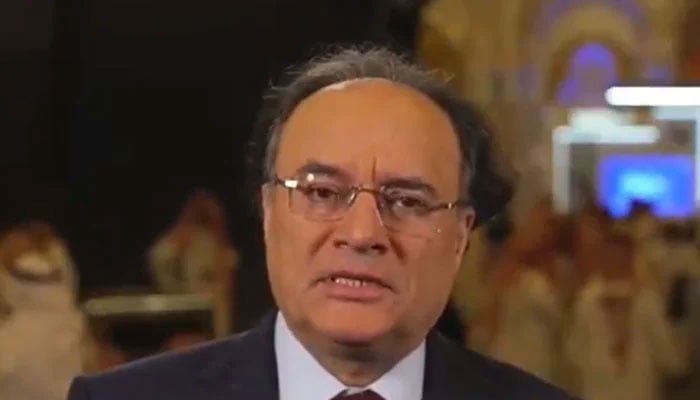
ISLAMABAD: Finance Minister Muhammad Aurangzeb Saturday announced that the provinces have provided a grant to the federal government for defence requirements and to create a buffer against the second and third wave impacts of the ongoing Gulf region conflict.
“This arrangement with the provinces has been struck for three years, and it has nothing to do with the National Finance Commission (NFC),” the minister stated during a post-budget press conference at the P Block here in the Federal Secretariat.
The budget document shows that the provinces provided Rs1,035 billion as a grant to the Centre under Article 164 of the Constitution. To absorb exogenous shocks, the government has allocated Rs430 billion, according to the budget documents.
The minister said that consultation with the International Monetary Fund (IMF) is a process which will continue until the budget is finalised.
Flanked by Minister for Information Attaullah Tarar, Minister of State for Finance Bilal Azhar Kiani, Finance Secretary Imdadullah Bosal and FBR Chairman Rashid Mahmood Langrial, the finance minister stated that there is a need to change the population criteria in the upcoming NFC Award. He added that the prime minister has instructed the abolition of super tax for exporters.
Responding to a query about the announced 7 percent salary hike, the finance secretary explained that the government decided to incorporate two ad hoc allowances from 2022 and 2025 into the basic pay before granting a 7 percent increase. However, the pay scale will be adjusted according to the 2022 scales. The disparity allowance has been increased by 15 percent, while the conveyance allowance has been raised by 50 percent in the budget for 2026-27. The minister added that the government was moving toward export-led growth.
Finance Minister Aurangzeb said the economy was on the right track and the government will now move from stabilisation to growth — but without rushing, to avoid creating economic imbalances.
He noted that the super tax has been abolished for six slabs and reduced for earners above Rs50 million, where the rate has been cut from 10 percent to 8 percent.
The government will stick to the tariff rationalisation plan, he said, adding that duties on importing agricultural equipment such as harvesters and tractors from China have been reduced to zero. The duty rate on raw materials and intermediary goods has also been slashed. The tax burden on the salaried class has been reduced, and transaction taxes on property sales and purchases have been significantly lowered.
On taxation, the minister said the government is taking steps to deepen and broaden the tax base. A new tax operating model using artificial intelligence (AI) will help establish a Central Data Hub (CDH) to nudge compliance through the integration of Nadra data and transactional information available with the FBR, enabling the detection of potential non-filers.
Minister of State for Finance Kiani described the budget as people-centric, providing relief to all segments of society. Regarding a fixed tax scheme for retailers, he said the government aims to bring 3.5 to 4 million retailers into the tax net. The scheme will be optional, however, if a retailer does not join either this fixed scheme or the normal tax regime, penalties will be imposed --Rs10,000 in the first month, Rs25,000 in the second and Rs50,000 in the third. A green plate will be provided to small shopkeepers who avail this scheme, and FBR officials will not raid their premises, he added.
Minister for Information Tarar said that clouds of default no longer hover over the country’s economy, and substantial efforts have been made to reach this stage.
When FBR Chairman Langrial was asked about expanding the list of packaged items in the Third Schedule of GST, he responded that this arrangement is temporary, as the implementation of the Value Added Tax (VAT) will continue. He added that once retailers are brought into the tax net, the Third Schedule will be abolished.