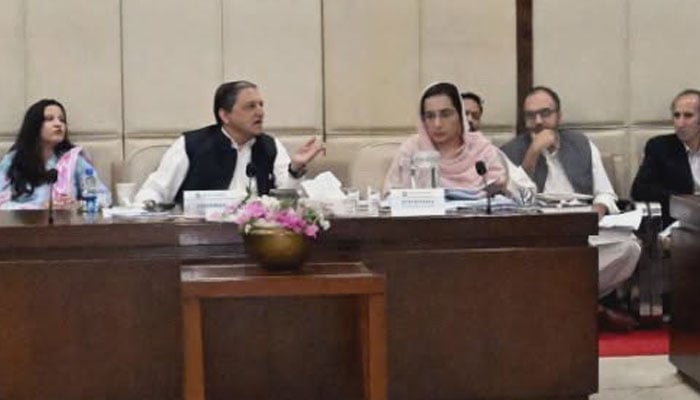
ISLAMABAD: The Senate Standing Committee on Finance and Revenue, under the chairmanship of Senator Saleem Mandviwalla, has kick-started deliberations to finalise recommendations on the Finance Bill 2026-27.
The preliminary session of the committee commenced with a clause-by-clause examination of the Customs Act, 1969 during which recommendations and observations of committee members were sought on the proposed amendments. The committee continued deliberations throughout the day on various provisions of the Finance Bill 2026-27, including Customs and sales tax measures.
Senator Abdul Qadir expressed concern that the super tax was discouraging investment in Pakistan.
Senator Sherry Rehman observed that provincial tax collection performance was improving and, in some areas, showing better results than the FBR. She further stated that it remained uncertain whether the FBR would be able to achieve its annual tax collection targets.
The committee also reviewed a proposal seeking authority for the FBR to impose fines for violations of Customs laws. Senator Anusha Rehman opposed the proposal, stating that such authority belonged to the government and should not be delegated to the FBR board. She informed the committee that the authority had instead been placed with the federal finance minister.
The forum considered an FBR proposal to outsource the auction process of seized goods to third parties. Officials maintained that the private sector should conduct auction activities instead of Customs officers. Following deliberations, the committee approved the proposal.
Senator Mandviwala stated that a clearly defined timeline should be prescribed for Customs clearance and decisions on imported consignments. He observed that importers often suffered due to delays in Customs processing and stressed that officers responsible for unnecessary delays should also be held accountable. The chairman subsequently directed the Ministry of Law and Justice to incorporate an appropriate timeline in the relevant legal provisions.
Later, Federal Minister for Finance and Revenue Muhammad Aurangzeb joined the proceedings and participated in discussions on fiscal reforms and economic policy.
The finance minister stated that investors require predictability and consistency in government policies. He emphasised that all stakeholders must work together to move the economy forward and announced that economic consultations would continue throughout the year rather than ending on June 30.
FBR officials briefed the committee on the proposed implementation of an Advance Receipt Invoice system. Questioning the proposal, Senator Mandviwala asked why an advance receipt invoice was necessary when tax deductions were already being made under existing mechanisms.
Officials informed the committee that a new method for issuing and recording sales tax invoices was being introduced. They further explained that a legal definition of the National Faceless Centre was being incorporated into the Sales Tax Act, and that a Production Monitoring System was being introduced to monitor production and sales activities more effectively.
Bilal Azhar Kiani said the implementation of electronic invoicing would significantly strengthen monitoring of business transactions. He informed the committee that the business community had welcomed the initiative and viewed it as an incentive-based scheme. He explained that businesses opting out of the scheme would remain under the normal tax regime, while those refusing to join either framework would face penalties. He added that the new structure differentiates between large and small retailers.