WASHINGTON/ISLAMABAD: US forces carried out “proportional” strikes against Iran on Tuesday in response to the Islamic republic shooting down an Apache attack helicopter the day before, the US military said.
American forces “began launching self-defense strikes against Iran, at 5 p.m. ET today at the Commander in Chief´s direction, in response to yesterday’s downing of a U.S. Army Apache helicopter,” US Central Command said in a post on X. “The mission is a proportional response to unjustified Iranian aggression,” it added.
President Trump vowed earlier on Tuesday to respond after he accused Iran of shooting down a US military helicopter the previous night, hours after he said negotiations to end the Middle East war were in their final stages.
Mohammad Bagher Ghalibaf, Iran’s parliament speaker and its chief negotiator in talks with Washington, meanwhile warned the United States on Tuesday against breaking its “commitments”.
The comments came a day after Iran and Israel halted attacks that threatened to reignite the regional war, which was sparked by US and Israeli strikes on Iran on February 28.
In a statement, Trump said he had been informed “that last night the Iranians shot down one of our highly sophisticated Apache Helicopters while patrolling over the Strait of Hormuz”. While the crew members were uninjured, “the United States must, of necessity, respond to this attack,” he said.
US Central Command (CENTCOM), which is responsible for US forces in the Middle East, said earlier that two Apache crew members “were rescued by American forces after their helicopter went down near the coast of Oman.”
“The Soldiers were safely rescued within approximately two hours and are in stable condition,” CENTCOM said in a post on X. The command also said a naval surface drone helped rescue the downed helicopter’s crew.
Iran’s Ghalibaf issued a warning on Tuesday. “We prefer the language of diplomacy, but we speak other languages far more fluently. Break your commitments, and we’ll switch to what we speak best. You ride the horse you saddled!” he said on X.
The Apache helicopter is the second crewed aircraft that Washington has confirmed was shot down by Iran during the war, following the loss of an F-15 fighter plane in April.
The downing and the prospect of a US response pose the latest threat to a shaky ceasefire in place since April 8, as the US and Iran struggle to negotiate an end to the conflict.
Iran’s Foreign Minister Abbas Araghchi urged foreign forces on Tuesday to leave the Strait of Hormuz and surrounding areas, warning they faced a persistent risk of being caught in the crossfire if they remained.
“The Strait of Hormuz is NOT international waters but shared between Iran and Oman... Foreign forces in proximity to our territory are at constant risk on account of their own human errors, plain accidents, or potentially being caught in crossfire,” Araghchi posted on X. “To reduce risk, best solution is for them to leave,” he added.
President Trump said negotiations over a peace deal to end the Middle East war were in their final stages, after Iran and Israel halted attacks that threatened to reignite the months-long conflict.
Iran and Israel “were going back and forth and now they both agreed through me to stop and we’re in the final throes of what will be a very, very good deal,” the US leader told reporters on his return from an NBA Finals game.
When asked whether a deal would be a matter of days or weeks, he said it would take “two or three days.”
US Vice President JD Vance told Fox News on Monday that while the United States and Israel shared interests, their positions did not always align.
“The Israelis and the United States, we have a lot of shared interests,” Vance said. “But we also have some situations where our interests diverge.”
Trump has claimed at least 38 times in more than two months that a deal between the United States and Iran was close, yet no final agreement has emerged, CNN reported. In statements dating back to March 23, Trump repeatedly said that both sides were in agreement on key issues, while Iran initially denied that any negotiations were taking place.
Meanwhile, Al Arabiya reported on Tuesday that a Pakistani source told it that Islamabad is communicating with all parties to reach an agreement to end the Iran-US war this week.
Oil prices fell with Brent crude briefly dipping below $90 per barrel for the first time since April 14, after US President Donald Trump hinted at a deal with Iran in the coming days, despite renewed strikes by Israel on Hezbollah targets in Lebanon.
US Energy Secretary Chris Wright said on Tuesday that ship traffic in the Gulf and oil exports through the Strait of Hormuz are rising even as Washington and Tehran struggle to reach a deal on ending their more than three-month-old war.
“I would say rising very meaningfully,” Wright said when asked how ship traffic is flowing through the strait compared to a week or two ago. He said oil exports through the strait and the Gulf have risen and “will continue to rise.”
Hezbollah on Tuesday urged Lebanese authorities to mend their relationship with the group’s backer Iran and benefit from Tehran’s support, days after Iran struck Israel in response to bombardment on south Beirut.
Iranian state television on Tuesday said at least two members of the army’s air defence force were killed in Israeli strikes a day earlier in the Middle East war’s latest exchange of fire, which both sides said they have halted.
“These esteemed martyrs of the Army Air Defense Force attained martyrdom while carrying out their mission of defending the country’s skies during yesterday’s (Monday) aggression by the Zionist regime,” state television said.
The US embassy in Jerusalem has lifted a shelter-in-place order that it issued for all employees and families late Sunday night, as Israel appeared on the verge of resuming its conflict with Iran.
With the truce holding through Tuesday evening, the embassy announced that it has lifted the shelter-in-place order. “As a result of changes to the current security situation in Israel, [IDF] Home Front Command has updated its guidelines, which permit full activity with no restrictions, except for in certain communities in the north of Israel,” the US embassy posted on X. “The shelter-in-place order for US government employees and their family members has ended.”
Britain said that a law to crack down on proxies acting for states deemed to be hostile such as Iran was expected to come into force next month, as it steps up powers to counter what it says is a growing threat posed by such groups.
Emirates will roll out incentives aimed at winning back travellers worried about the protracted Iran war, focusing on reliability and customer support rather than lower fares, the Gulf airline’s President Tim Clark told Reuters on Tuesday.
UN Secretary-General Antonio Guterres said on Tuesday he was “deeply alarmed” by a renewed escalation of violence in the Middle East and called on Israel to reopen crossings into Gaza.
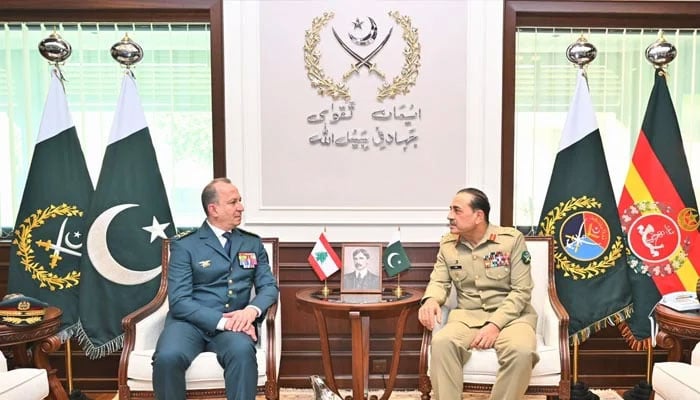
Meanwhile, Chief of Defence Forces (CDF) and Chief of Army Staff (COAS) Field Marshal Syed Asim Munir and Lebanese Armed Forces Commander-in-Chief General Rodolphe Haykal discussed the evolving regional security environment and defence cooperation during a meeting at General Headquarters (GHQ) on Tuesday, Geo News reported.
Upon his arrival at GHQ, General Haykal was presented a guard of honour by a smartly turned-out tri-services contingent, according to a statement issued by the Inter-Services Public Relations (ISPR).
During the meeting, the two military leaders exchanged views on matters of mutual interest, regional security situation, defence cooperation and prospects for enhancing bilateral military relations.
The discussions focused on strengthening professional interactions, training cooperation and institutional linkages between the armed forces of Pakistan and Lebanon.
Field Marshal Munir reaffirmed the importance Pakistan attaches to its longstanding and cordial relations with Lebanon and underscored the Pakistan Army’s commitment to expanding defence collaboration with the Lebanese Armed Forces.
General Haykal appreciated the professionalism and operational excellence of the Pakistan Armed Forces and acknowledged their contributions to regional peace, stability and international peacekeeping efforts.
According to the ISPR, the visit reflects the shared commitment of both armed forces to fostering closer military-to-military cooperation.
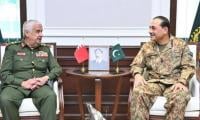
Meanwhile, the commander of the Bahrain National Guard on Tuesday praised Pakistan’s Armed Forces’ contribution towards regional peace and stability, expressing interest in further cooperation in training and capacity-building initiatives.
The remarks came as General Shaikh Mohammad Bin Isa Bin Salman Al Khalifa called on the tri-services chiefs separately during his visit to Pakistan, according to a statement issued by the Inter-Services Public Relations (ISPR).
The Bahraini commander met Field Marshal Asim Munir at the General Headquarters (GHQ) in Rawalpindi, where they underscored the need to strengthen bilateral military cooperation, the military’s media wing said.
“During the meeting, matters of mutual interest, regional security environment, and avenues for enhanced bilateral defence and security cooperation were discussed,” it added.
According to ISPR, Field Marshal Munir and General Shaikh Mohammad expressed satisfaction over the longstanding brotherly relations between Pakistan and Bahrain.
Before calling on the army chief, the Bahraini commander separately met Chief of the Naval Staff Admiral Naveed Ashraf and Chief of the Air Staff Air Chief Marshal Zaheer Ahmed Baber Sidhu. His meeting at the Naval Headquarters focused on bilateral defence collaboration and regional security dynamics.
General Shaikh Mohammad commended the Pakistan Navy’s constructive role in advancing cooperative maritime security across the region, expressing appreciation for its role as the regional maritime security stabiliser.
In the meeting at the Air Headquarters, Air Chief Marshal Sidhu highlighted Pakistan Air Force’s modernisation efforts, including capability enhancement, infrastructure development, indigenisation, and advanced training reforms.
Discussions also focused on emerging defence technologies such as drones, artificial intelligence, autonomous systems, advanced sensors, and digital innovation, as well as evolving air defence challenges and integrated defence architectures. The Bahraini commander lauded the professionalism, operational readiness, and contributions of Pakistan’s Armed Forces towards regional peace and stability.
He also praised the modernisation initiatives and indigenous capabilities of the Pakistan Armed Forces.
The ISPR said the Bahraini commander’s visit reflected the strong and enduring defence partnership between Pakistan and Bahrain, adding that the visit was expected to further advance bilateral military cooperation for the mutual benefit of both nations.