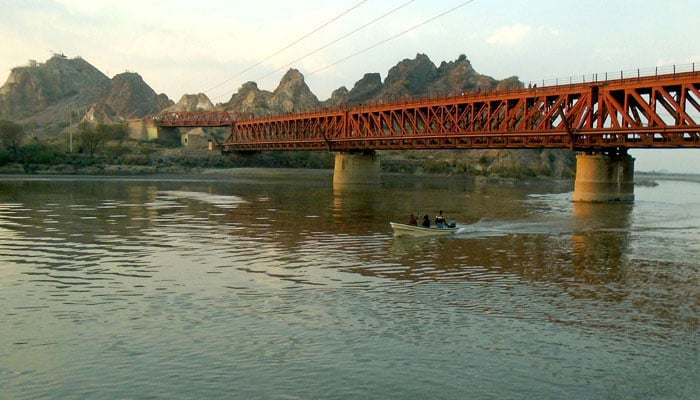
LAHORE: After gaining full control of three eastern rivers under the Indus Waters Treaty, which for centuries irrigated lands in areas now part of Pakistan, India has lately set its sights on another; Chenab River, one of the most prominent of the three western rivers that feed Punjab, the land of five rivers.
Back in 1960, in exchange for three eastern rivers — Ravi, Beas, and Sutlej — India accepted Pakistan’s control over three western rivers — Indus, Jhelum, and Chenab — under Indus Waters Treaty.
This deal was brokered by the World Bank, with financial support for replacement works from United States, the United Kingdom, Germany, Australia, Canada, New Zealand, and others. Following a single stroke of the pen, India gained full control of three eastern rivers, which had played a pivotal role in development of Punjab’s agrarian economy on this side of the border.
Under the watch of the superpower and other developed nations, inking such an agreement that resulted in forsaking right over entire rivers is not a normal happening, rather an extremely rare event in the world history.
Yet that is precisely what Pakistan agreed to regarding three eastern rivers including Ravi, which once fed the heart of Punjab province. Lahore, provincial capital and one of subcontinent’s greatest cities, is nestled on the banks of Ravi.
Today, that river is parched and reduced to a sewer drain and Lahorites are pleading for water amid fast depletion of its once prized and regularly replenished aquifer.
Beas River, another eastern river, joins Sutlej River in Indian Punjab. The Sutlej, last of the three eastern rivers, enters Pakistan nearly 50 kilometres from Lahore and historically fed Bahawalpur valley, one of the wealthiest princely states of its time due to abundant agriculture produce.
Bahawalpur later merged into Punjab, but its lifeblood was severed under Indus Waters Treaty. Like other eastern rivers, India was given full control over Sutlej’s entire flows — an extremely rare phenomenon in human history where river is completely stopped beyond a certain point — in this case, just before entering Pakistan.
Ferozepur Headworks is located on Sutlej River is now part of India, just ahead of newly drawn Pakistan-India border near Ganda Singh Wala, Kasur. Observers believe this area was tactfully awarded to India by outgoing British Empire during the partition of subcontinent, despite having a Muslim-majority population exceeding 50 percent.
Consequently, Sutlej was reduced to a mere trickle downstream, turning into a dry, sand-blown bed upon entering this side of border. Canals that offtake from detached Ferozepur Headworks used to irrigate areas included in Pakistan.
The resultant lack of flows downstream has placed strain on western rivers, requiring water to be transferred through newly-constructed barrages and link canals to feed erstwhile Bahawalpur state, spreading from Cholistan Desert along the Indian border to fertile plains of Rahim Yar Khan district in today’s South Punjab.
Had Ferozepur been part of Pakistan based on its Muslim majority population, India would have had no leverage to stop water flowing to Bahawalpur State from the canals emanating from headworks on Sutlej River. This leverage — ability to unilaterally stop water flowing towards Pakistan — became a critical pressure point soon after partition in 1947, and subsequently one of the primary reasons Pakistan agreed to Indus Waters Treaty.
Now, despite Pakistan’s sovereign right over western rivers, including Chenab under Indus Waters Treaty, India has advanced a controversial plan to impound and divert out-flowing water through a tunnel.
To the detriment of lower riparian Pakistan, same pattern of reducing river flows is in motion.
India has formally given a go-ahead to build a tunnel to divert water from the Chenab River to link with Beas River.
Under the Indus Waters Treaty, this action would constitute a gross violation on two fundamental grounds. First, Article III(2) of the Treaty explicitly states India “shall be under an obligation to let flow all the waters of western rivers, and shall not permit any interference with these waters, except for restricted uses in the case of each of the rivers, The Indus, the Jhelum and the Chenab, to the drainage basin thereof”.
This means use of Chenab water must physically occur within natural drainage basin of Chenab River, according to agreed quantities. Diverting Chenab water through a tunnel to link with Beas River — an eastern river basin — falls entirely outside permitted drainage basin and is therefore prohibited.
Secondly, Annexure D of the Treaty, which governs hydroelectric plants on western rivers, further reinforces this restriction. The Treaty permits only “run-of-river” plants, which cannot remove water permanently from the river system.
Any tunnel or diversion that transfers water from outside Chenab basin for consumptive use violates the letter and spirit of agreement.
In spite of this, a clear pattern of unending upstream control is visible — from Ravi, Beas and Sutlej, and now, to Chenab. After usurping three full rivers, India now appears adamant to empty another. This pattern constitutes a clear violation of set universal rights of lower riparian and Indus Waters Treaty.
The ensuing confrontation, if left unaddressed, may snowball into a full-fledged war between nuclear arch-rivals, as Pakistan already declared any such move an intolerable red line.