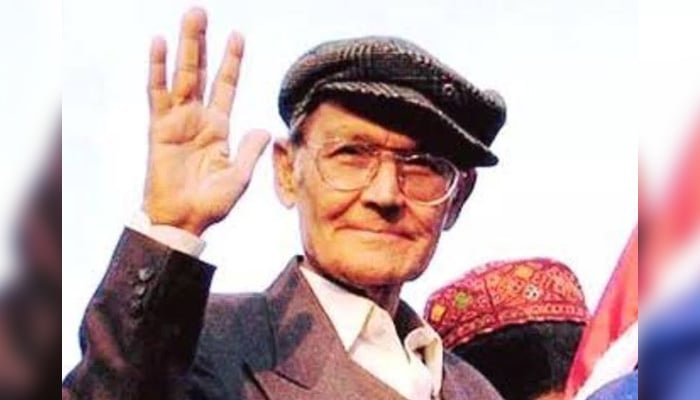
Today, admirers across Sindh will mark the death anniversary of Rasul Bakhsh Palijo, one of Pakistan’s most remarkable public intellectuals. Politicians come and go, parties rise and decline, and even celebrated writers often become prisoners of their own time. Palijo belonged to a rarer category.
He was simultaneously a political leader, a social reformer, a lawyer, a teacher, a literary critic and a prolific writer whose intellectual interests stretched far beyond the immediate demands of politics. Jami Chandio has consistently worked on Palijo by compiling and commenting on his Sindhi writings. A few days ago, my friend Zulfiqar Rajpar presented me with a copy of Nabeena Hakeem (The Blind Physician), the newly published Urdu translation of Palijo’s famous Sindhi work, first published in 1966. The translation by Pervez and its publication by Book Home have brought a classic of Sindhi intellectual history to a wider audience.
The original book was written in defence of progressive literature and emerged from the literary controversies of the 1960s, yet many of its arguments remain strikingly relevant today. As I began reading, I was transported back to an intellectual culture that now seems increasingly distant. There was a time when books mattered profoundly in public life. Literary debates influenced politics. Political arguments drew upon poetry. Students discussed philosophy in tea houses and bookshops. Intellectuals were expected not merely to comment on society but to help shape it. Sindh at the time produced figures such as Rasul Bakhsh Palijo and Jaam Saaqi.
The book itself is barely 150 pages long. Yet its intellectual range is astonishing. Within a few chapters, the reader encounters discussions of Amir Khusrau, Muhammad Quli Qutb Shah, Wali Dakhni, Insha Allah Khan Insha and Amir Minai. References to Persian poetry appear alongside detailed explorations of Shah Abdul Latif Bhittai. What initially appears to be a defence of progressive literature gradually reveals itself as something much larger: an exploration of the relationship between literature, culture, history and society. The title is especially intriguing. Why ‘The Blind Physician’?
For Palijo, a physician who cannot see his patient may possess medicines and medical knowledge but remains incapable of diagnosing the real illness. In the same way, writers and critics who ignore social realities become intellectually blind. Literature detached from human suffering, inequality and lived experience may display technical brilliance, but it loses its moral vision. While reading the book, I was reminded of another famous work that appeared two decades later: ‘The Blind Watchmaker’ by Richard Dawkins.
At first glance, the comparison seems absurd. Dawkins is a British evolutionary biologist concerned with natural selection and the origins of life. Palijo was a Sindhi political activist and literary critic engaged in debates about culture and society. One wrote about biology; the other wrote about literature. Yet both chose blindness as their central metaphor. For Dawkins, the blind watchmaker is nature itself. Evolution produces astonishing complexity, but it does so without conscious design or intention. The watchmaker is blind because there is no guiding intelligence directing the process. For Palijo, however, blindness belongs not to nature but to human beings. His blind physician possesses knowledge but lacks social vision. He can discuss literary forms and technical devices but fails to recognise the realities surrounding him.
Dawkins sought to explain how life emerges without purpose. Palijo sought to remind readers that human societies require purpose, responsibility and moral engagement. The similarities are nevertheless striking. Both books challenge orthodoxy. Both urge readers to abandon comforting illusions. Both ask difficult questions about how human beings understand reality. One examines nature through science; the other examines society through literature. Each, in its own way, demands intellectual honesty.
Yet their differences are equally revealing. Dawkins removes intention from the natural world; Palijo insists upon responsibility in the social world. Dawkins asks how humanity emerged; Palijo asks what humanity ought to become. That comparison may seem unusual, but it highlights the enduring relevance of ‘Nabeena Hakeem’. Like the most influential books, it is ultimately concerned not with providing answers but with teaching readers how to see. To understand the significance of the book, one must recall the Pakistan in which it was written. The mid-1960s were the years of Field Marshal Ayub Khan’s rule. Official narratives celebrated economic growth and modernisation. Yet beneath the surface lay widening inequalities, political repression and social tensions.
Across South Asia, intellectuals debated the purpose of literature. Progressive writers argued that literature should engage with social realities. Their opponents insisted that art should remain detached from politics and ideology. Palijo entered this debate with extraordinary confidence and erudition. What makes his intervention remarkable is that he never reduces literature to propaganda. Unlike many ideological writers, he demonstrates a genuine appreciation of literary complexity. His discussions of Shah Abdul Latif Bhittai are not political slogans disguised as criticism. They are serious attempts to understand how literature emerges from lived experience and acquires social meaning.
In recent years, while attending literary gatherings across Sindh, from the Sindh Literature Festival to Khanabadosh meetings and cultural events at the Arts Council, I have often heard concerns about the decline of serious reading. Public debates increasingly resemble exchanges of slogans. Social media rewards speed rather than reflection. Books are discussed more often than they are read. ‘Nabeena Hakeem’ is a reminder of what intellectual seriousness looks like. The breadth of Palijo’s reading is itself a lesson. He moved comfortably between Sindhi, Urdu and Persian traditions. He saw no contradiction between regional identity and universal intellectual curiosity. Deeply rooted in Sindh’s culture, he remained open to wider literary and philosophical influences. This intellectual openness also shaped his political career.
To many Pakistanis, Palijo is known primarily as the founder and leader of the Awami Tehreek. Yet his political significance extends beyond party politics. He belonged to a generation that regarded politics as part of a larger struggle for social transformation. He campaigned for democracy when authoritarianism dominated public life. He defended women’s rights when doing so was politically costly. He challenged feudal structures in a province where feudal power often appeared permanent. Throughout these struggles, he never abandoned scholarship.
Indeed, one of the most remarkable features of Palijo’s life was his role as a teacher. Thousands of young activists encountered history, philosophy, literature and political theory through his lectures and writings. His speeches often resembled seminars. His political meetings frequently became classrooms. As someone who has spent much of his professional life in education, I find this aspect of Palijo particularly compelling. Universities are supposed to cultivate critical thinking. Yet, increasingly, they produce graduates trained to pass examinations rather than to question assumptions. Palijo represented an older tradition in which education was inseparable from citizenship and public engagement. His books became alternative classrooms. This may explain why ‘Nabeena Hakeem’ still feels fresh 60 years after its publication. The issues it addresses have not disappeared. Censorship continues in new forms. Conformity remains powerful. Commercial pressures shape cultural production. Intellectual laziness still flourishes.
Palijo warned against all these tendencies. He believed that literature matters because it expands human consciousness. It teaches empathy. It challenges prejudice. It forces societies to confront uncomfortable truths. Writers, in his view, were not merely entertainers. They were participants in a larger moral and intellectual conversation. That conviction links the writer, the teacher, the political activist and the social reformer. It is the thread running through Palijo’s entire life. Today, Pakistan continues to produce politicians, academics and writers. Yet individuals capable of combining all three roles have become increasingly rare.
The writer is dean of the faculty of liberal arts at a private university in Karachi. He tweets/posts @NaazirMahmood and can be reached at: [email protected]