KARACHI: Pakistan’s top body representing traders and industrialists this week urged the government to slash taxes in the upcoming budget 2026-27, saying the move would help increase the country’s exports to $50-60 billion, Arab News reported.
Finance Minister Muhammad Aurangzeb will unveil the federal budget 2026-27 on June 10 in the National Assembly of Pakistan. The budget will project expected revenues and outline spending limits of the government for the next 12 months.
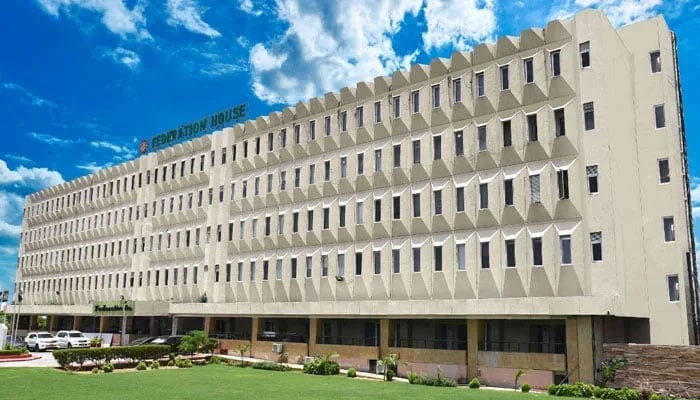
The Federation of Pakistan Chambers of Commerce and Industry (FPCCI) is a representative organization for Pakistan’s trade, industry and service sectors. The FPCCI says it has 303 trade bodies under its umbrella, including 82 chambers of commerce.
Speaking at a press conference in Karachi on Thursday, Saquib Fayyaz Magoo, the FPCCI’s senior vice president, urged Islamabad to abolish the super tax on the manufacturing sector and slash the corporate tax to 20 per cent in the new fiscal plan.“If it is implemented, I think that exports of $50 billion to $60 billion will be easily achievable,” he told Arab News, adding that Pakistan’s economy had a lot of potential to grow.
Pakistani corporations are paying a 29 per cent corporate tax and a 10 per cent super tax, according to Karachi-based brokerage research firm Topline Securities Limited.Economist Shankar Talreja, head of research at Topline Securities, said the government plans to impose additional taxes in the next fiscal year to meet the IMF’s performance targets that aim to broaden Pakistan’s tax base and improve its tax-to-GDP ratio.
At around 10 per cent, Pakistan’s tax-to-GDP ratio remains among the lowest in the world.“The government is almost targeting new tax measures close to around Rs860 billion ($3.09 billion),” Talreja told Arab News.
Adviser to the Finance Minister Khurram Schehzad did not respond to questions from Arab News about Paracha’s statement and Talreja’s claims about the imposition of new taxes.Talreja said half of the targeted taxes will be raised by the government by largely withdrawing exemptions granted to multiple sectors. He said the other half will be collected by provincial governments, probably by expanding the overall scope of the sales tax on services.
Magoo said it is ultimately the mases that shoulder the burden of taxes.“If tax is imposed on anything, then it is first imposed on the industrialists or the businessmen,” he said. “But ultimately, it has to be imposed on the consumer.”
If Pakistan’s government does impose additional taxes, it would further push inflation in the country higher. Pakistan’s consumer price index (CPI) inflation was recorded at 11.7 per cent in May.
The Middle East conflict involving the United States and Iran, has driven up global oil prices and disrupted energy and commodity supply chains, particularly the Strait of Hormuz trade route.
Magoo said unless the new budget is specifically designed to enhance exports, Pakistan’s economy would be unable to progress and the country would be unable to “get out of the IMF programme”.
‘FURTHER ECONOMIC CRISIS’
While Prime Minister Shehbaz Sharif’s government has attempted to forge closer economic ties, Pakistan’s exports have declined by 6.0 per cent to $27.9 billion this fiscal year till May. This has widened the trade deficit by 17.5 per cent to $38 billion, according to official data.
The FPCCI official said the government would need to find a way to present a budget that would support economic growth, help the country achieve its tax revenue targets and boost exports while staying within the IMF’s framework.
If the new budget does not live up to the FPCCI’s expectations, Magoo said the business body would try to convince the government to make changes. “Our exports have already decreased. If they don’t agree, then it will decrease further,” he noted. “We will be in an economic crisis further.”
FPCCI CALLS FOR GROWTH-FOCUSED BUDGET
In a statement on Friday, Atif Ikram Sheikh, president of the FPCCI, said the organisation’s comprehensive Shadow Budget for fiscal year 2026-27 reflects the collective
views of Pakistan’s business, industrial and trading community.
Sheikh said the FPCCI has urged the government to incorporate its policy recommendations to ensure that the upcoming budget is driven by the objective of economic growth rather than a traditional focus on revenue generation and economic stabilisation.
He said a growth-centred approach is the most viable way to address Pakistan’s macroeconomic challenges, reduce the widening trade deficit and provide relief to the industrial sector, which is facing high energy costs and elevated interest rates.
The FPCCI president said broadening the tax base remains the most important structural reform needed to reduce Pakistan’s reliance on inflationary indirect taxes and the over-taxation of the documented corporate sector. A sustainable expansion of the tax net should move beyond enforcement measures targeting existing taxpayers and instead focus on bringing new taxpayers into the formal economy through digitisation, data integration and targeted incentives, he added.
He noted that the total tax burden on industrialists can reach as high as 65 per cent when all taxes are taken into account. He proposed reducing this burden to between 35 per cent and 40 per cent in Budget 2026-27 to improve international competitiveness and support economic growth and export earnings.
Magoon added that the federal budget should shift its focus from aggressive revenue collection towards facilitating broad-based economic revival. He said sustainable growth requires strategic national investment in emerging technologies, including artificial intelligence, as well as the wider rollout of 5G technology to enhance the global competitiveness of Pakistani industries. views of Pakistan’s business, industrial and trading community.
Sheikh said the FPCCI has urged the government to incorporate its policy recommendations to ensure that the upcoming budget is driven by the objective of economic growth rather than a traditional focus on revenue generation and economic stabilisation.
He said a growth-centred approach is the most viable way to address Pakistan’s macroeconomic challenges, reduce the widening trade deficit and provide relief to the industrial sector, which is facing high energy costs and elevated interest rates.
The FPCCI president said broadening the tax base remains the most important structural reform needed to reduce Pakistan’s reliance on inflationary indirect taxes and the over-taxation of the documented corporate sector. A sustainable expansion of the tax net should move beyond enforcement measures targeting existing taxpayers and instead focus on bringing new taxpayers into the formal economy through digitisation, data integration and targeted incentives, he added.
He noted that the total tax burden on industrialists can reach as high as 65 per cent when all taxes are taken into account. He proposed reducing this burden to between 35 per cent and 40 per cent in Budget 2026-27 to improve international competitiveness and support economic growth and export earnings.
Magoon added that the federal budget should shift its focus from aggressive revenue collection towards facilitating broad-based economic revival. He said sustainable growth requires strategic national investment in emerging technologies, including artificial intelligence, as well as the wider rollout of 5G technology to enhance the global competitiveness of Pakistani industries.