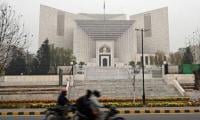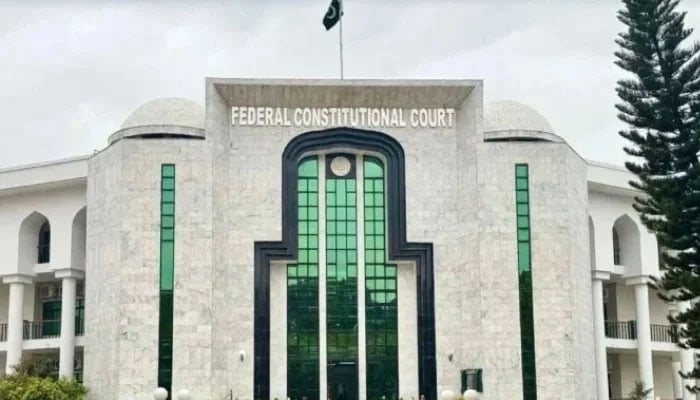
ISLAMABAD: The Federal Constitutional Court (FCC) on Thursday declared the bar associations or councils’ calls for strike as illegal and a violation of the right of access to justice of a litigant and his counsel.
A two-member bench of the court — comprising Justice Aamer Farooq and Justice Rozi Khan Barrech — issued a judgment in a case titled Peshawar High Court Bar Association verses Shabbir Hussain & another and Ali Azim Afridi, AHC and others.
The petitioner — Peshawar High Court Bar Association — had filed an appeal with the FCC against the PHC judgment passed on October 15, 2025, restoring the law practice licenses of respondents Shabbir Hussain Gigyani and Ali Azeem Afridi.
After hearing the arguments of both the parties, the FCC upheld the Peshawar High Court verdict, restoring the legal practice licenses of the respondents and dismissed the appeal of Peshawar High Court Bar Association.
“We are in agreement of the same and find no infirmity in the aforementioned reasoning of the Peshawar High Court,” says the 20-page judgment, authored by Justice Aamer Farooq.
“In light of our reasoning in Part A, B and C of this judgment, the instant petitions are dismissed, and we refuse leave to appeal and the impugned judgment is affirmed”, the court held.
The case concerns the murder of a young lawyer, following which an SHO was implicated and FIR No1277 was registered.
After public protests, the officer surrendered and engaged Shabbir Hussain Gigyani, Advocate Supreme Court, as counsel. In response, the KP Bar Council passed a resolution barring advocates from representing him. Separately, Ali Azim Afridi, Advocate High Court, had his license suspended for appearing during a strike.
The respondents challenged these actions in the Peshawar High Court, which allowed the writ petitions through a consolidated judgment.
In its judgment, the Federal Constitutional Court noted that the practice of calling strikes by bar associations or bar councils was common in the sub-continent adding that this practice was not only illegal but also in violation of the right of access to justice of a litigant and his counsel.
“When a strike call is made the lawyer bodies restrict lawyers from appearing before the courts, so in essence a litigant, on that day, is deprived of his right of legal practitioner to represent him, and the hearing in his case is adjourned without any progress in the cause,” says the judgment adding that this tantamount to denial of access to justice.
The court held that the country’s legal system was already over-burdened, the cause lists were hefty and litigants had to wait for years for the matter to culminate. In such state of affairs, the strike call on part of the lawyer bodies adds to the plight of litigant, the judgment said.
“Regardless of how noble the cause of the lawyers strike is, it is neither the solution nor the way to voice their concern, as it is done at the cost of a litigant waiting for redressal of his grievance or justice to be served,” the court held.
In truth, the court noted that no such interest was made out where advocates were restrained from discharging their professional function of appearing before the courts.
In both instances, the court noted that the lawyers were engaged in the pursuit of their legal profession adding that the Economic Freedom Clause extends its protection to the practice of such profession, and indeed, this is a classic case in which an individual’s right to pursue his profession stood violated.
“In the present case, we hold that preventing lawyers from representing their litigants, or from approaching or appearing before the courts, is wholly impermissible,” says the judgment.