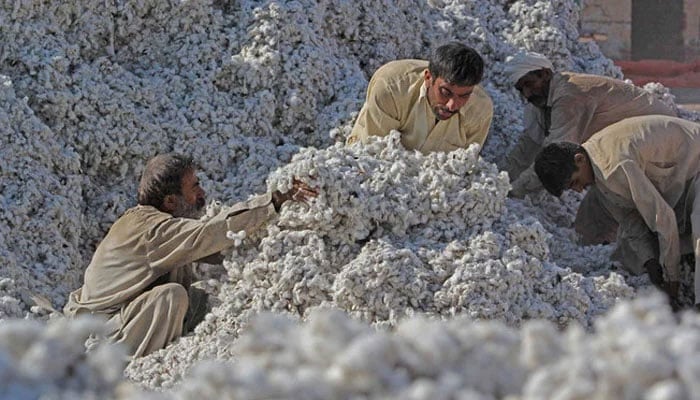
ISLAMABAD: Pakistan’s cotton sector, once celebrated as the country’s “white gold” and the backbone of its textile exports, has suffered a dramatic decline over the past decade and a half, forcing the country to spend billions of dollars annually on imports to feed its textile industry.
The deterioration has become so severe that the federal government has launched a comprehensive revival strategy, warning that restoring cotton production is critical for economic stability, exports and rural livelihoods.
Federal Minister for National Food Security and Research Rana Tanveer Hussain said the government is implementing a broad-based reform agenda to reverse years of declining production and productivity. According to the minister, a high-powered committee headed by DPM Ishaq Dar has formulated a comprehensive roadmap for the revival of the cotton sector in consultation with provincial governments, researchers, industry representatives and other stakeholders. He said strengthening Pakistan’s seed system and accelerating the adoption of modern technologies are among the government’s top priorities. He said the National Seed Development and Regulatory Authority (NSDRA) is addressing key regulatory and technical bottlenecks, while the approval of National Seed Policy and National Agricultural Biotechnology Policy marks major milestones that will promote innovation, attract private-sector investment and support climate-resilient, high-yield cotton varieties. He added that the government has allowed the import of hybrid cotton seed to improve productivity and access advanced genetics and has abolished the differential tax regime on seed cotton. Tanveer Hussain said institutional reforms are also under way under the Cabinet Committee on Cotton Revival. The Pakistan Central Cotton Committee (PCCC) has been integrated with the Pakistan Agricultural Research Council (PARC) to improve research coordination and resource efficiency, while an industry-led Cotton Board is being established to align growers, researchers and the textile sector. He added that legislative and regulatory reforms are being finalised, and the government is considering lowering tax rates on cottonseed and cottonseed cake in the upcoming budget to improve farmer profitability.
Despite these initiatives, official data shows that Pakistan’s cotton sector has experienced one of the most severe declines in its history. In 2011-12, cotton was cultivated on 2.861 million hectares across the country, producing 14.814 million bales of 170 kilograms each, with a national yield of 880 kilograms per hectare. By 2025-26, however, cotton acreage fell to 1.777 million hectares, reflecting a loss of more than 1.08 million hectares. The production dropped sharply to 5.301 million bales, representing a decline of nearly 64 per cent compared to 2011-12. The national yield also fell to 507 kilograms per hectare from 880 kilograms per hectare.
Punjab has suffered the most dramatic losses. Cotton cultivation declined from 2.534 million hectares in 2011-12 to 1.171 million hectares in 2025-26. Production collapsed from 12.132 million bales to only 2.540 million bales, a decline of nearly 79 per cent. Productivity also deteriorated significantly, with yield falling from 814 kilograms per hectare to just 368 kilograms per hectare. Sindh has emerged as the country’s leading cotton-producing province against Punjab. Cotton acreage in Sindh increased from 286,000 hectares in 2011-12 to 606,000 hectares in 2025-26, while production rose from 2.682 million bales to 2.893 million bales. Sindh’s yield remained comparatively strong at 811 kilograms per hectare during 2025-26 while it reached a peak of 914 kilograms per hectare in 2023-24.
The long-term production trend illustrates the depth of the crisis. National cotton production fell from 14.814 million bales in 2011-12 to only 5.301 million bales in 2025-26. Agricultural experts attribute much of the decline to the steady shift of farmers towards sugarcane cultivation. While domestic yields have declined to around 507-590 kilograms per hectare, China achieved yields exceeding 2,200 kilograms per hectare. The consequences have been particularly severe for Pakistan’s textile sector. The shortfall in domestic cotton production forced manufacturers to increasingly rely on imported cotton. During FY25, Pakistan imported 8.6 million bales worth $2.63 billion. In the first 11 months of FY26 alone, imports had already exceeded $1 billion and are projected to reach around 7 million bales by the end of the fiscal year. International cotton prices rose from 55 to 88 cents per pound, pushing Pakistan’s import bill towards $3 billion and increasing pressure on foreign exchange reserves and external account stability. The government attempted to address the crisis in October 2025 when the Cabinet Committee on Special Crops and Cotton, chaired by Deputy Prime Minister Ishaq Dar, approved a Cotton Revival Plan. The plan proposes restructuring the Pakistan Central Cotton Committee into the Pakistan Cotton Advisory Council, shifting cotton cess collection to the Federal Board of Revenue, allocating 70% of cess revenue to research and development, and introducing industry-led governance reforms. However, implementation is reportedly slow.