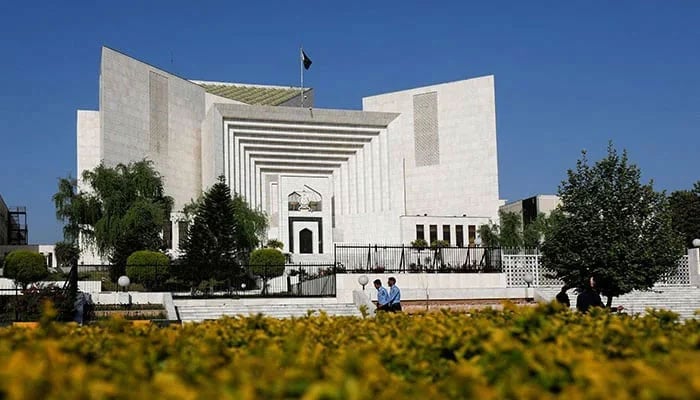
ISLAMABAD: The Supreme Court ruled that an individual who voluntarily intoxicates themselves and subsequently commits an offense cannot claim any exemption or leniency on the grounds of intoxication.
The apex court held that such a legal defence is strictly available only if the person was forcibly intoxicated or administered intoxicants without their knowledge. A three-member bench, headed by Justice Muhammad Hashim Khan Kakar and comprising Justice Salahuddin Panhwar and Justice Ishtiaq Ibrahim, upheld the death sentence of Sunny Masih, who was convicted of raping and murdering a five-year-old girl.
The court had reserved its judgment on April 20, 2026, after hearing the appeal filed against the High Court’s decision. In a three-page judgment authored by Justice Kakar, the court observed that the convict had brutally murdered an innocent child. The case dates back to January 22, 2014, when a criminal case was registered at a police station in Sibi, following the rape and murder of the five-year-old girl.
After the prosecution successfully proved the charges, the trial court sentenced Sunny Masih to death, and the verdict was later upheld by the Balochistan High Court.
The convict subsequently appealed to the Supreme Court of Pakistan. During the proceedings, his counsel argued that the appellant was heavily under the influence of alcohol at the time of the offense, requesting that the death sentence be commuted to life imprisonment.
However, the Supreme Court rejected this argument, clarifying a crucial principle of law. The court acknowledged that a person cannot generally be punished for an act committed without conscious intent. Nevertheless, it emphasized that voluntary intoxication cannot be utilized as a shield against criminal liability. Since the convict himself admitted that he had consumed alcohol of his own free will, he could not seek immunity from the consequences of his actions. Accordingly, the court dismissed the appeal and upheld the death sentence imposed by the trial court.