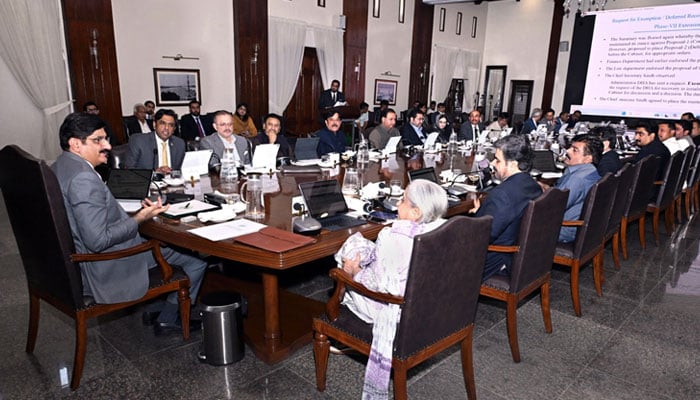
Sindh Chief Minister Syed Murad Ali Shah on Tuesday presided over a meeting of the provincial cabinet, which approved a wide-ranging package of financial, infrastructure, energy, health, security and education initiatives, including Rs8.825 billion in additional funds for water and drainage schemes across the province, and Rs11.198 billion worth of major infrastructure projects for Karachi.
The meeting, held at the CM House, was attended by provincial ministers, advisers, special assistants, the chief secretary and other senior officers. Under the recommendations of the Cabinet Committee on Finance, presented by Minister for Local Government Syed Nasir Shah, the cabinet approved Rs8.824 billion in additional funds for 16 Annual Development Programme (ADP) schemes in the water supply and drainage sector for the financial year 2025-26. Of this amount, Rs6.206 billion will be reappropriated from the ADP block allocation, while Rs2.618 billion will come from another development allocation.
The CM directed the relevant administrative departments to ensure that all payments are made within the current financial year after the completion of the required codal formalities. In another major decision, the cabinet approved 11 non-ADP infrastructure schemes under the Karachi Mega Project which will be financed through the allocation for the New Development Initiatives of the ADP 2025-26. These projects carry a cumulative estimated cost of Rs11.198 billion.
The schemes include the improvement and rehabilitation of important roads and transport corridors in Karachi, such as Haji Ibrahim Essa Road, Haji Camp Road, Korangi Link Road, the Clifton roads connecting Marine Drive, Mehran and Pajero roads in Scheme-33, Korangi Creek Airbase Road, the extension of Jinnah Avenue in Gulzar-e-Hijri, and the Baldia Stadium Road project linking Shahrah-e-Orangi to Hub River Road.
The cabinet also approved the construction of two major bridges at Power House Chowrangi in North Karachi and 4-K Chowrangi in Surjani Town to improve traffic flow and urban connectivity. To kick-start these schemes, the cabinet sanctioned Rs560 million (around five per cent of the total estimated cost) from the ADP during the current financial year.
Separately, the cabinet approved a non-ADP scheme titled “Rehabilitation and Uplifting of Dargah Qalandar Lal Shahbaz, Lal Bagh and Civic Centre, Sehwan” for Rs485 million. The project aims at improving facilities and infrastructure around the shrine of Hazrat Lal Shahbaz Qalandar and adjacent public spaces. An initial allocation of Rs24.25 million, equivalent to five per cent of the project cost, has been sanctioned for the current financial year.
CM Shah reiterated the provincial government’s commitment to improving urban infrastructure, enhancing public services and ensuring transparent utilisation of public funds. The cabinet also approved the introduction of a new framework to receive the province’s constitutionally mandated 12.5 percent natural gas royalty in kind, instead of entirely in cash, on a field-to-field basis.
The proposal, aligned with Article 161(1)(a) of the Constitution, the Petroleum Act, 1949, and applicable Petroleum Exploration & Production Policies and Rules, envisages a hybrid model under which selected gas fields will shift to an in-kind royalty system while the existing cash mechanism continues for remaining fields.
The CM said his government expects the arrangement to enhance revenue generation, improve energy security, support local industry and enable monetisation of royalty gas at market-linked prices. Estimates presented to the cabinet suggest that the new mechanism can generate an additional annual financial benefit of over Rs26 billion for Sindh through improved value realisation of its gas resources.
The CM approved forming an inter-departmental committee headed by the energy secretary to prepare a comprehensive policy framework for aggregation, allocation, commercialisation, disposal and monetisation of royalty gas. The committee has been tasked with finalising its recommendations within 30 days for submission to the cabinet.
The cabinet also approved the release of Rs395.019 million to Integrated Health Services (IHS) to settle outstanding liabilities arising from the management of 111 outsourced healthcare facilities, including 105 Rural Health Centres (RHCs) and six Taluka Headquarters (THQ) hospitals, under a public-private partnership (PPP) arrangement from March 2016 to October 2021.
The decision follows the recommendations of a committee formed to scrutinise the remaining liability claim. After a detailed review, the committee assessed the admissible liability at Rs395.019 million, deducting Rs3.264 million related to 11 unverified employees.
The cabinet was informed that Rs425.713 million had already been released following the cabinet’s approval in November 2024. With the latest approval, the remaining verified liability claim of the IHS will be settled.
The CM directed the IHS to submit complete records of the released and current liabilities to the audit director general for verification and record purposes. In the health sector, the cabinet approved the Sindh Nursing Workforce Strategic Policy 2026-2040, a long-term framework designed to strengthen the province’s nursing workforce, in view of the growing healthcare demands, population growth, emerging diseases and the expansion of health services.
The policy aims to address workforce shortages, faculty gaps, uneven distribution of nurses, infrastructure deficiencies and governance issues. It outlines measures for standardised admissions, enhanced clinical training, faculty development, clear career progression pathways, licensing reforms, and the creation of advanced and specialised nursing streams.
Health Minister Dr Azra Fazal informed the cabinet that Sindh currently has 34,817 registered nurses, midwives and lady health visitors, including around 23,000 nurses, with a nurse density of just 0.63 per 1,000 population compared to the World Health Organisation benchmark of 3.33.
The policy also envisages establishing modern nursing colleges, simulation laboratories, student hostels, a nursing workforce information system and stronger coordination among the relevant institutions. Its phased implementation will range from immediate reforms in admissions and curriculum to long-term investments in infrastructure and workforce expansion.
The CM said the initiative is expected to increase the production of qualified nurses, improve healthcare service delivery, strengthen workforce planning and enhance the overall quality of patient care across Sindh. Responding to the evolving security needs, the cabinet approved a revised procurement plan for the Counter Terrorism Department (CTD) for Rs857.024 million.