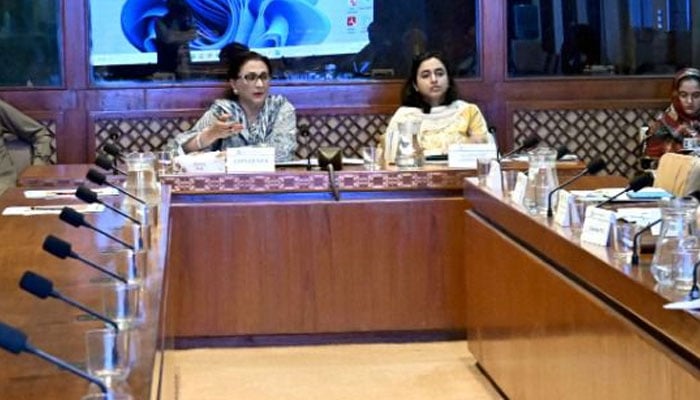
KARACHI: A sub-committee of the Senate Standing Committee on Information Technology and Telecommunications has raised concerns over rising infrastructure theft, power instability and their combined impact on internet quality across Pakistan, according to proceedings held at the Parliament House on June 1, 2026.
The meeting, chaired by Senator Sadia Abbasi and attended by Senators Kamran Murtaza and Dr Afnan Ullah Khan, and senior officials from the Ministry of IT and Telecom, reviewed vulnerabilities affecting nationwide telecom infrastructure and service continuity.
The committee was informed that more than 9,200 incidents of theft and vandalism were reported over an 11-month period, affecting around 16 per cent of the country’s cellular infrastructure.
Sindh recorded the highest number of cases at 3,938 across 31 districts, followed by Punjab with 2,827 incidents across 38 districts, Khyber Pakhtunkhwa with 1,668 incidents across 25 districts, and Balochistan with 716 incidents across 26 districts.
Officials from the Pakistan Telecommunication Authority (PTA) briefed the committee that ongoing power load-shedding continues to undermine service continuity by rapidly draining backup batteries and overburdening generator systems. To address the issue, the regulator said it is working with the National Electric Power Regulatory Authority (Nepra) and the Power Division to secure priority power feeders and deploy smart transformers for critical telecom sites.
The Universal Service Fund (USF) also reported progress on infrastructure development in Balochistan, noting that while around 80 per cent of target areas have been identified through competitive bidding, security challenges and diesel theft continue to hinder rollout efforts.
In response, the committee directed relevant authorities to identify high-theft hotspots and instructed provincial and district administrations to address complaints under the law and strengthen preventive measures to protect telecom installations.
The panel also reviewed telecom sector modernisation efforts, including a recent spectrum auction adding 480 MHz of bandwidth and the issuance of 5G commercial licences in March 2026. Planned upgrades include raising average 4G speeds from 4 Mbps to 20 Mbps, rolling out 1,000 new sites annually, and introducing Voice over LTE (VoLTE) and Voice over WiFi (VoWiFi) services.
The regulator has also set stricter service quality benchmarks, requiring operators to keep network downtime within defined limits at different administrative levels. The committee reiterated that internet access should be treated as an essential service and urged operators to strengthen safeguards against fuel theft and infrastructure damage to ensure uninterrupted connectivity nationwide.