LAHORE: Pakistan is one of the most water-stressed nations globally, yet it treats its water as an infinite, disposable resource. We reached this stage due to catastrophic management and a systemic failure to look at water as reusable resource.
Globally, Pakistan is the fourth-largest consumer of water after India, China and the United States, withdrawing an estimated 183 billion cubic meters annually. Yet the country is rapidly approaching absolute water scarcity. According to recent assessments, per capita water availability has fallen below 1,000 cubic meters in recent years, placing Pakistan among the world’s water-scarce nations.
The tragedy is not merely that Pakistan uses too much water. The greater problem is that water becomes progressively more polluted as it travels through the system. Untreated municipal sewage, industrial effluents, textile dyes, chemicals and agricultural runoff contaminate rivers, canals and groundwater. Instead of retaining the value of water through repeated use, purification and recycling, we convert a valuable national asset into a polluted stream that is often unfit for future use. The economic and health costs are ultimately borne by society as a whole.
Studies indicate that only 1-2 per cent of wastewater is treated before being discharged into the environment. Major urban centres continue to release untreated sewage into rivers and drainage systems, contaminating freshwater supplies and contributing to the spread of waterborne diseases.
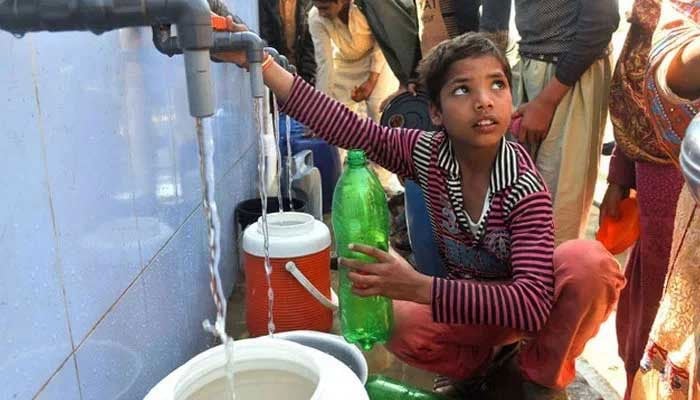
The Asian Development Bank recently warned that more than 80 per cent of Pakistan’s population lacks access to safe drinking water. Groundwater depletion, arsenic contamination, aging infrastructure and untreated wastewater are placing severe stress on the Indus Basin system, the country’s lifeline.
Pakistan needs to adopt the principles of a circular water economy. Just as industries seek to maximise the life of raw materials and products, water should be reused repeatedly before being discharged. Freshwater, grey water and industrial water should be managed separately wherever possible. Water fit for drinking should never be mixed with toxic industrial chemicals, hormones, dyes or hazardous waste.
Agriculture, which consumes roughly 90-93 per cent of Pakistan’s freshwater resources, remains at the heart of the problem. Irrigation efficiency is estimated at only around 40 per cent. On average, around 35 million acre-feet of water reaches the Arabian Sea annually, while the mangrove ecosystem in Sindh requires only about 4-5 million acre-feet for ecological sustainability. Yet the larger issue is not merely the quantity reaching the sea but the enormous losses and pollution occurring before the water completes its natural cycle.
Rivers need environmental flows to sustain deltas, fisheries and coastal ecosystems. The real challenge is improving storage, efficiency and recycling rather than viewing every drop reaching the sea as a loss.
The future of Pakistan’s water security depends on one fundamental realisation: water is not a disposable commodity. It is both a consumable resource and a reusable economic asset. Every drop that is purified, recycled and reused reduces pressure on rivers, aquifers and reservoirs.
Singapore’s advanced membrane technologies now produce recycled water of extremely high purity. Developed economies increasingly recover energy, nutrients and valuable chemicals from wastewater. Thermal hydrolysis systems generate electricity from sewage sludge, while industrial facilities recover acids, alkalis and other chemicals that would otherwise become pollutants.
Pakistan can benefit from similar innovations. Membrane treatment systems, wastewater recycling plants, industrial water recovery units and decentralised treatment facilities can significantly reduce freshwater demand. Drip irrigation, laser land levelling, irrigation scheduling and water-efficient industrial technologies can dramatically improve productivity per drop of water used.
Water pricing must encourage conservation while protecting poor households through targeted support. Energy subsidies that encourage excessive groundwater pumping should gradually be replaced with smarter incentives for efficient water use. Industries that pollute rivers should face strict enforcement, while businesses investing in recycling technologies should receive incentives.
The country must move from a culture of extraction and disposal to one of conservation, recovery and reuse. Only then can water become part of a true circular economy rather than Pakistan’s cheapest and most dangerous waste product.