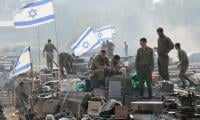
A close look at the recent developments in the Middle East, especially Israeli attacks on Gaza and Lebanon, and the US/Israeli attacks on Iran, reveals an ongoing contest for supremacy between the existing order marked by the US hegemony supported by Israel and some other regional governments and the resistance forces which pose a direct challenge to the US domination of the region.
Iran leads the forces in the region opposed to the US hegemony and its all-out support to Israel in the subjugation of the Palestinians and the denial of their legitimate national rights.
The US hegemony in the Middle East can be traced to the withdrawal of the UK and France from their imperial role in the region in the aftermath of World War II. The Suez Canal crisis of 1956 reflected the growing US political and security role in the region, which gradually enabled it to establish a stranglehold on the region’s energy resources and to exercise a preponderant influence over the policies of the various regional governments.
The US has exploited political and sectarian faultlines between the regional states, especially between Iran and the Gulf Arab states, and within these states in pursuance of the classic imperial policy of divide-and-rule. It has not desisted from launching covert operations to overthrow legitimately elected governments, as in the case of Prime Minister Mossadegh of Iran in 1953.
In 1980, the US encouraged Iraq under Saddam Hussein to attack Iran in the hope of overthrowing its Islamic revolutionary government, which led to an eight-year-long war between the two countries. Despite the support of the US and other Western states, the attack failed to dislodge the Islamic revolutionary government in Iran. But it did succeed in weakening both Iran and Iraq and paved the way for the US attack on Iraq in 2003 in violation of the UN Charter. The US has also continued its policy of support to Israel at the expense of the legitimate national rights of the Palestinian people and the UN-approved goal of a two-state solution, which would allow Israel and a Palestinian state to live side by side peacefully.
The normalisation of Israel’s relations with Arab countries through the Abraham Accords signed in September 2020 between Israel, the UAE and Bahrain remains an important plank of the US policy to strengthen Israel’s security and further consolidate its own hold on the region. Later, Morocco and Sudan also agreed to normalise relations with Israel.
The second Trump administration has been seeking to encourage Saudi Arabia and other regional states to join the grouping. Several other Western projects, such as the India-Middle East-Europe Economic Corridor (IMEC) and I2U2, also aim to strengthen Israel’s security and the US/Western hold on the region, while countering China’s Belt and Road Initiative (BRI).
The US-Israeli attacks on Iran in June 2025 and February 2026 need to be seen in the context of the foregoing analysis. Undoubtedly, the US views Islamic revolutionary Iran as a major obstacle in the maintenance of its hegemony in the Middle East, the exploitation of the energy resources of the region, and the strengthening of Israel’s security. It is not surprising, therefore, that Iran’s nuclear programme, its missile capabilities and its relations with Hezbollah, Hamas and Houthis are viewed with great concern by both the US and Israel.
Iran, despite the martyrdom of its top leadership and the enormous destruction of its civilian, nuclear and military infrastructure, has stood its ground and in the process exposed the limitations of American power in the pursuit of its hegemonic designs at global and regional levels.
Hopefully, the ongoing negotiations between the US and Iran with the mediation of Pakistan and the support of other governments will lead to an agreement in the best interests of Iran, other regional countries, and the rest of the world which has been badly affected by the disruption of oil, gas and other vital supplies because of the closure of Strait of Hormuz by Iran and the US naval blockade of Iranian ports. Such an agreement in the long run should ideally allow Iran to continue its nuclear programme for peaceful purposes under necessary safeguards to prevent the development of nuclear weapons, resolve the issue of freedom of navigation through the Strait of Hormuz, lift sanctions against Iran, and unfreeze Iran’s assets.
Latest reports indicate continued serious differences between Iran and the US in the way of an Iran-US deal. The recent US insistence that the remaining regional countries also sign the Abraham Accords as part of the Iran-US deal has only compounded the complexity of an already explosive situation.
These negotiations are taking place against the backdrop of the existing US-dominated security order in the Middle East which is likely to face growing serious challenges in the years to come because of America’s all-out support to Israel despite its continued denial of the national rights of the Palestinian people and programme of expansionism in the region, Washington’s blatant interference in the internal affairs of the regional states to control their policies and instal regimes friendly towards it, and America’s exploitation of the region’s oil and gas resources for serving its own interests through various means such as the petro-dollar arrangement.
A recent interesting article by Amos Yaldin, a former head of Israel’s Defence Intelligence, and Avner Golov, a former senior director in Israel’s National Security Council, titled ‘The Iran Imperative – How America and Israel Can Shape a New Middle East’, in the Foreign Affairs issue of May-June 2026 elaborates a plan to exploit the divisions in the Middle East and strengthen further the US hegemony in the region with the support of Israel. The plan would also allow Israel to exercise continued security control in Gaza and the West Bank, even if they become independent.
The plan proposed above would, in fact, result in the virtual colonisation of the Middle East by the US with the active support of Israel. It is in the interest of the countries of the region on both sides of the Persian Gulf, as well as Pakistan, Turkiye and Egypt, to recognise the dangers inherent in such plans and enter into serious negotiations to evolve a new Middle East order to ensure regional security and promote common prosperity.
The proposed new Middle East order should be based on the principles of respect for the sovereignty and territorial integrity of states, non-interference in their internal affairs, peaceful settlement of disputes, joint resistance to non-regional security threats and mutually beneficial cooperation in the economic, technical and commercial fields.
It is inevitable that the US, the current hegemon in the ME, and its allies like the UK, France and Israel will fiercely resist any attempt by regional states to stand on their own feet and manage their affairs. So, the progress towards that goal would be difficult and slow. However, the failure of the regional states to agree to a new Middle East order will consign them to continued exploitation and subjugation by powerful non-regional states.
The writer is a retired ambassador and author of ‘Pakistan and a World in Disorder – A Grand Strategy for the Twenty-First Century’. He can be reached at: [email protected]