US President Donald Trump’s two-day visit to China came at a defining moment in global geopolitics. The international system is simultaneously confronting the consequences of the US-Iran war, disruptions in global energy markets, rising tensions in the Indo-Pacific and intensifying strategic competition between Washington and Beijing.
Against this backdrop, the summit between Trump and President Xi Jinping represented less a breakthrough in bilateral relations than a carefully calibrated attempt to prevent global instability from spiraling further out of control.
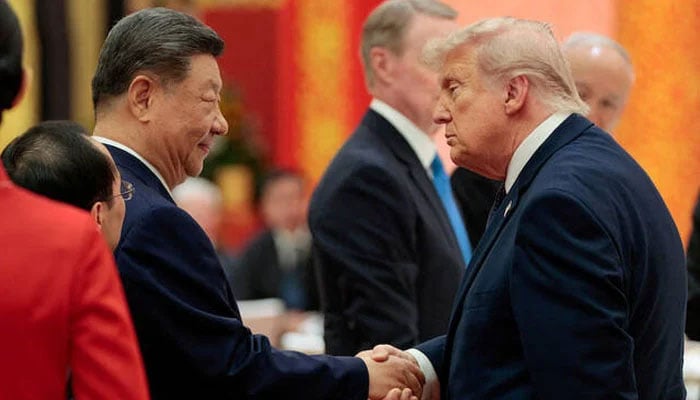
The optics of the summit were striking. After years of trade wars, sanctions, technological rivalry and military tensions over Taiwan, both leaders projected an image of warmth and restraint. Trump described Xi as a “great leader” and “friend”, while Xi referred to the visit as a “milestone” in establishing “constructive strategic stability” between the two countries. This shift in tone reflected a growing realisation in both capitals that uncontrolled confrontation between the world’s two largest powers would carry devastating economic and geopolitical consequences.
Although trade and Taiwan remained central to the discussions, the most urgent issue overshadowing the summit was the escalating crisis in the Strait of Hormuz arising from the ongoing US-Iran war. Increasingly, the Strait has become not only the epicentre of regional instability but also the focal point of great-power diplomacy.
The Strait of Hormuz is among the world’s most strategically vital waterways, carrying nearly one-fifth of global oil and gas supplies. Since the outbreak of direct conflict between the US, Israel and Iran earlier this year, Tehran has effectively tightened its control over the Strait, disrupting shipping, escalating insurance costs and rattling global energy markets.
Iran’s strategy has been clear: leverage its geographical dominance over the Strait to impose political and economic costs on its adversaries. The closure or partial restriction of Hormuz immediately affects global oil prices, shipping routes and the energy security of major economies – particularly those in Asia.
This explains why the Strait of Hormuz emerged as a major subject during the Trump-Xi summit. According to the White House, both leaders agreed that the Strait “must remain open to support the free flow of energy”. Xi reportedly also expressed opposition to the militarisation of the Strait and rejected any effort to impose tolls on maritime passage.
China today is the world’s largest importer of crude oil, and a substantial portion of its energy imports passes through the Gulf region. Beijing also remains the largest purchaser of Iranian oil despite US sanctions. Consequently, China possesses unique leverage with Tehran that few other global powers can match.
President Trump claimed that Xi assured him China would not provide military assistance to Iran and even offered to help reopen the Strait of Hormuz. While Chinese officials have remained more cautious publicly, Beijing’s position increasingly reflects concern that prolonged instability in the Gulf could undermine global growth and China’s economic recovery.
China’s role in the crisis is therefore becoming increasingly important. Unlike the US, China maintains working relations with all major regional actors – Iran, Saudi Arabia, the Gulf states and even Israel. Beijing’s diplomatic approach has traditionally emphasised de-escalation, economic connectivity and strategic balance rather than military intervention.
Importantly, China has little interest in seeing Iran militarily defeated or strategically isolated. Tehran remains central to China’s long-term Eurasian strategy and energy security calculations. However, China equally does not want a prolonged conflict that destabilises energy flows, undermines trade and threatens Chinese shipping routes. This creates an opportunity for Beijing to play a stabilising role.
China’s leverage over Iran is primarily economic. Iranian oil exports to China provide Tehran with a critical financial lifeline amid Western sanctions. Beijing therefore possesses the ability to quietly counsel Iran towards moderation, particularly regarding freedom of navigation through Hormuz.
Recent developments suggest China may already be exercising such influence. Iran’s Revolutionary Guards announced this week that Chinese vessels were permitted to transit through the Strait under agreed “management protocols”. This arrangement indicates that Tehran recognises the importance of maintaining Chinese goodwill even amid confrontation with Washington.
At the same time, Beijing appears to be encouraging restraint without directly aligning itself with American military pressure. China has repeatedly called for a ceasefire, the reopening of shipping lanes and a diplomatic resolution of the crisis.
Yet China’s role remains carefully balanced. Beijing does not want to appear as part of an American-led coalition against Iran. Nor does it wish to inherit responsibility for policing Gulf security. Chinese policymakers remain deeply cautious about becoming militarily entangled in Middle Eastern conflicts.
Instead, Beijing prefers a limited diplomatic role focused on crisis management and economic stabilisation. In many ways, China’s ideal outcome is a controlled de-escalation that preserves Iranian stability, restores maritime traffic and prevents broader regional war without requiring direct Chinese military involvement.
The US, meanwhile, increasingly appears to recognise that China’s cooperation may be indispensable. Senior American officials, including Secretary of State Marco Rubio, have openly urged Beijing to play a more active role in persuading Iran to reopen Hormuz. Washington understands that China’s economic leverage over Tehran may succeed where coercive pressure alone has failed.
Nevertheless, the summit also revealed the limits of US-China cooperation. Fundamental strategic tensions remain unresolved. Beijing’s principal red line remained intact. Meanwhile, competition over artificial intelligence, technology exports, military influence and global leadership continues to shape the broader relationship.
Yet despite these tensions, the Beijing summit demonstrated an important reality: both Washington and Beijing currently prefer managed competition over uncontrolled confrontation. The global economic costs of simultaneous crises – in the Indo-Pacific, the Middle East and global trade – have created strong incentives for strategic restraint.
In this sense, the Strait of Hormuz has become more than a regional security issue. It has emerged as a test case for whether the United States and China can cooperate selectively despite deepening rivalry. Both powers recognise that a prolonged closure of Hormuz would destabilise the global economy, intensify inflationary pressures and deepen international insecurity.
The Trump-Xi summit, therefore, reflected a broader geopolitical truth. Strategic rivalry between the US and China remains real and enduring, but it is increasingly being tempered by shared vulnerabilities and economic interdependence.
Whether Beijing can genuinely help stabilise the Iran crisis remains uncertain. However, China’s unique relationships, economic leverage and preference for de-escalation position it as perhaps the only major power capable of quietly influencing all sides without becoming directly embroiled in the conflict.
For now, that may be the most important outcome of Trump’s visit to Beijing: not the resolution of rivalry, but the recognition that in an increasingly fragmented world, even competing powers must occasionally cooperate to prevent global disorder from becoming unmanageable.