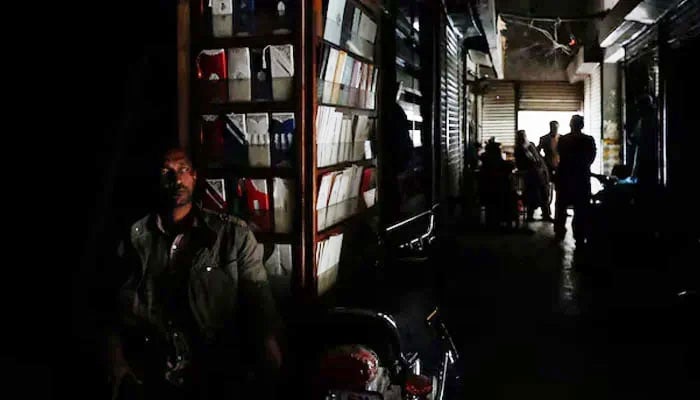
In sweltering pre-monsoon Karachi, residents have been struggling with persistent blackouts for weeks according to Bloomberg.
With no end in sight to the war that has upended Pakistan’s energy supplies, many are seeking their own solutions — and a network of grey-market providers is helping to fill the gap.
Mohammad Mazhar, a tailor in a densely populated residential district of Pakistan’s business capital, pays a monthly fee to tap a nearby generator when his main supply cuts out. Outages are becoming more frequent after nearly three months of disruption in the Persian Gulf, Mazhar said, and at least five similar micro-utilities have popped up around the neighbourhood.
“The connection is a lifeline for my business,” said Mazhar, declining to provide more detail on his fallback supplier as most operate informally, out of reach of authorities and government oversight. “We don’t consume much power, but without this we have to wait for the lights to come back before we can iron clothes for customers. The generator next door is helping us to make ends meet.”
Already grappling with fragile state finances and a distracting conflict with neighbouring Afghanistan even before strikes began in Iran, Pakistan was one of the first nations to impose austerity measures to cope with the fallout of that war. The country imports much of its oil and gas, most of it from the Middle East, leaving it particularly exposed to rising prices and interrupted shipments. Qatar, for example, supplied virtually all of its liquefied natural gas, meaning that with the Strait of Hormuz effectively closed, gas-fired power plants are unable to operate at capacity.
In the sultry, sweltering weeks before the rains begin, May temperatures have already crossed 44C (over 111F) and both businesses and households are struggling to cope. The evenings are particularly strained, as power consumption peaks and the impact of a rapid expansion in rooftop solar panels begins to fade with the light. As the gap between supply and demand widens, blackouts, exacerbated by electricity theft, can last for hours at a stretch.
Alternative power sources were tapped by more affluent consumers in Pakistan well before the war. But interviews with more than two dozen residents and shopkeepers in Karachi suggest many more residents are now opting for a budget version of the autonomy long enjoyed by the wealthy. Unable to buy or run their own hardware, they are turning to small-scale suppliers who run diesel generators at home, creating a loose, parallel power network that is keeping a few lights on and fans spinning across the port city — all for a small fee.
Government officials say Pakistan has succeeded in producing more electricity from local sources, limiting war-related energy shortages that caused blackouts. Earlier this month, Power Minister Awais Leghari declared an end to load-shedding caused by supply disruption — though he has also said theft and other causes mean outages continue.
On the ground, the reality is bleak, and consumers have few options — even if economists warn that backstreet diesel generators can create long-term problems, feeding inflation and draining precious foreign-exchange reserves as more of the fuel has to be bought. Relentless blackouts are already pushing customers to find more permanent off-grid solutions, leaving only fewer, poorer citizens to pay off the state utility’s debt.
“Persistent power outages place a limit on Pakistan’s economic growth,” said Gareth Leather, senior Asia economist at Capital Economics. “The crisis hits both ends of the economy. It hurts domestic consumption because sky-high electricity bills and fuel costs leave households with less money to spend, and it threatens exports, because key sectors like textiles cannot guarantee steady production or meet international deadlines.”
Fiscal pressures remain intense for Pakistan, even after Saudi Arabia pledged $3 billion in financial support. The country’s trade deficit has increased to a four-year high and the picture could deteriorate further if energy shortages force factories to cut output or delay shipments.
The operator of one generator, Sheikh Salman, who provides his services to those in his neighbourhood, says people have no alternative when blackouts can last for 16 hours a day. He is now able to live solely off the proceeds of small sales to households and businesses — a few thousand rupees a month, roughly $30 at the low end, for just enough to run a fan or a few lights.
“There is no electricity for hours at a stretch. Just think about how elderly and children are suffering in such high temperatures,” Salman said. “We are providing a service for people.”
In other cases, businesses have cobbled together their own solutions. The president of one local market in Karachi’s industrial Korangi district, Shahzad Alam Rajput, oversees two large diesel generators supplying electricity to hundreds of shops.
“How will these people run these businesses if there is no electricity?” asked Rajput. “We are here because there is demand. If the grid was providing uninterrupted supply, we wouldn’t be doing this.”
There are about 600 shops in the market. Some owners have installed solar panels — part of a nationwide boom thanks to cheap Chinese products — but many still depend on Rajput’s generators to keep fans running and customers coming. He only begins charging users when the load shedding starts, and he says much of that goes to straight to pay for the diesel.
“You can see how hot it is — we would have no customer if fans are not working,” said Mohammad Adil, who works at a women’s accessories shop in the market. Other shopkeepers nearby concur the market simply cannot survive without its own backup system.
The good news for citizens like Adil is that some temporary relief may be on the way, even without a reopening of Hormuz.
Pakistan imported two LNG shipments from the Persian Gulf in a week, in the latest illustration of how the country has used its geopolitical influence in the region to help ease a historic energy crisis. The latest cargo arrived on Friday after negotiations with Iran — a rare feat, even if the country is still far short of its pre-war levels and has limited funds to buy replacement cargoes on the spot market.
But absent a return to normal flows, the risks from a prolonged crisis remain, including demand destruction. Generators cannot fix every situation, especially for users who need a lot of power, and for many homes and businesses they remain too costly even as a shared resource.
Some will simply down tools.
Abdul Sattar, a worker at an iron and aluminium welding shop, said operations already effectively grind to a halt when load-shedding stretches to eight hours a day. He has no viable backup: small-scale generator providers can help stores and homes keep energy-efficient LED lights on, but they lack the capacity to power heavy equipment like welding machines.
Turning to ‘jugaad’, a term widely used across the subcontinent for improvised fixes, is not enough for everyone. Even for those lucky enough to muddle through, there are challenging weeks and months ahead.
“Don’t ask me how to estimate how many hours the blackouts last,” said Rajput, speaking in his market office a few feet from a curbside generator. “It’s easier to ask how long the power stays on — that’s the smaller number these days.”