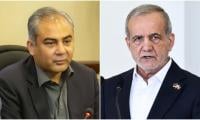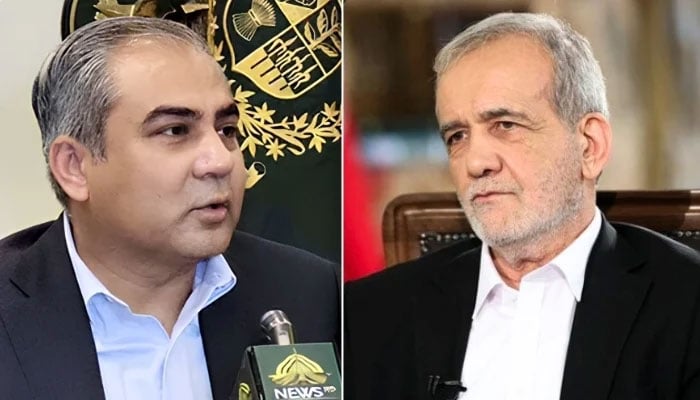
TEHRAN/ISLAMABAD: Interior Minister Mohsin Naqvi and Iran’s President Masoud Pezeshkian discussed Pakistan’s mediation efforts for peace in the Middle East, Iranian state media reported on Sunday amid Islamabad’s efforts to keep the US-Iran dialogue going.
Naqvi held a 90-minute meeting with the Iranian president, discussing bilateral ties and Islamabad’s mediation efforts, according to reports.
During the meeting, President Pezeshkian said that the US-Israeli attacks on Iran were aimed at spreading insecurity inside the country. However, the plans failed due to regional countries’ refusal to allow use of their soil for the attacks, he added.
The Iranian president thanked Pakistan, Iraq and Afghanistan for not allowing their territory to be used for military action against Tehran.
The interior minister also held a separate meeting with Iran’s parliament speaker Mohammad Bagher Ghalibaf, who was a part of Tehran’s delegation in the Islamabad talks.
During the meeting, Naqvi and Ghalibaf exchanged views on key matters, according to Iranian media reports. Ghalibaf praised Islamabad’s stance during the recent conflict, stressing expanded economic, cultural and security cooperation between the two nations.
The presence of US forces in the region is causing insecurity and opening the way for further security damage, he said, adding that regional countries should strengthen trust and cooperation to advance political and security collaboration.
Naqvi recalled Ghalibaf’s efforts in the Islamabad talks, saying Islamabad stood witness to the Iranian leadership’s efforts to protect Tehran’s interests.
The interior minister said that both countries were witnessing growing closeness between their peoples and reiterated Pakistan’s goodwill towards Iran’s leadership and public.
Naqvi arrived in Tehran a day earlier “to facilitate” peace talks between the two sides, Iranian media reported.
Meanwhile, Prime Minister Shehbaz Sharif has said Pakistan’s international image has “completely changed” through its role in mediating between Iran and the United States after the conflict erupted following a coordinated US-Israeli attack on Iran in February.
“It’s one of the shining moments in our history,” the PM told The Sunday Times in his first interview since the conflict began, describing Pakistan as an “honest mediator” trusted by global leadership and crediting Islamabad with helping secure an extended ceasefire that remains in place.
The premier said Pakistan remained hopeful of another round of face-to-face talks in Islamabad, which he said could help achieve long-lasting peace between Tehran and Washington.
“Peace is never won easily,” PM Shehbaz said. “You have to have patience, sagacity and ability to move things despite the most difficult challenges.”
He said Pakistan was continuing efforts to ensure the peace process achieved “long-lasting peace” through another session in Islamabad.
“As we speak, we’re still doing our best to ensure that this peace effort achieves a long-lasting peace through another session here in Islamabad, and we are hopeful that will happen,” he said.
PM Shehbaz said both Iran and the US administration trusted Pakistan’s role in the mediation process. “Fortunately, Iran trusts Pakistan as does the US administration — and also the Gulf states,” he said, adding that he was grateful to US President Donald Trump and Iranian President Masoud Pezeshkian for accepting Pakistan’s invitation for talks.
The prime minister credited the country’s political and military leadership for the diplomatic engagement, particularly praising Field Marshal Asim Munir and Foreign Minister Ishaq Dar.
“What we are seeing is team efforts of the political and military leadership. I must acknowledge that the field marshal has played a critical role, which will be recorded in history,” the prime minister said.
He also lauded Dar’s diplomatic outreach, saying the foreign minister had been “engaging his counterparts and making untiring efforts”.
PM Shehbaz said Pakistan had been placed in a “prestigious position” through a “stroke of good luck”. He added: “Our international image has completely changed through this partnership of our political and military hierarchy.”
The prime minister also thanked Trump for previously helping negotiate a ceasefire between Pakistan and India. “Had he not intervened, the world may have witnessed a major catastrophe in South Asia,” PM Shehbaz said.
Discussing regional security, the premier defended Pakistan’s actions against militant groups operating from Afghanistan, saying Islamabad had repeatedly conveyed peaceful messages to Kabul. “With Afghanistan, we had no other choice but kinetic action against terrorist hideouts and support infrastructure,” he said. “Our only demand was they commit not to let those terrorist outfits operate from Kabul,” PM Shehbaz added.
Meanwhile, Prime Minister Shehbaz Sharif on Sunday held a telephonic conversation with his Qatari counterpart, Sheikh Mohammed bin Abdulrahman bin Jassim Al Thani, and thanked Qatar’s leadership for its “strong endorsement and support of Pakistan-led peace efforts”.
According to a statement shared on X by the prime minister’s spokesperson for foreign media, Mosharraf Zaidi, the two leaders held a “warm and cordial conversation” and exchanged views on the evolving regional and international situation.
“The prime minister thanked the leadership of Qatar for its strong endorsement and support of Pakistan-led peace efforts aimed at de-escalation and promoting regional peace and stability,” the statement said. It added that PM Shehbaz expressed his “deep appreciation for Qatar’s constructive role in regional diplomacy and for building a consensus in support of ongoing mediation efforts”.
Both leaders agreed on the need for continued close coordination and dialogue among all stakeholders to address shared challenges.
The statement said PM Shehbaz also conveyed his warm greetings and best wishes to the Qatari prime minister and expressed his eagerness to welcome him to Pakistan on an official visit soon.
The two sides agreed to maintain regular high-level contacts to follow up on the outcomes of the conversation.
Later, PM Shehbaz confirmed the call in a post on X, saying the two leaders had reaffirmed their shared commitment to peace, dialogue and regional stability.
“I deeply appreciated Qatar’s constructive diplomatic role and conveyed my gratitude to His Highness Sheikh Tamim bin Hamad Al Thani, Amir of the State of Qatar, for Qatar’s strong support for Pakistan-led peace efforts aimed at de-escalation,” the premier wrote.
He added that Pakistan and Qatar would continue to work closely together for peace and stability “in the region and beyond”.
Separately, Deputy Prime Minister/Foreign Minister Ishaq Dar on Sunday held a telephonic conversation with Egyptian Foreign Minister Badr Abdelatty to discuss the evolving regional situation and matters related to multilateral diplomacy.
According to the Foreign Office spokesperson, the two leaders exchanged views on regional developments and ongoing diplomatic engagements. During the conversation, Foreign Minister Abdelatty appreciated Pakistan’s sincere efforts aimed at promoting regional peace and stability.
The two sides also discussed issues related to the regional consultative forum comprising the foreign ministers of Pakistan, Saudi Arabia, Türkiye and Egypt.
The discussion further covered ongoing engagements at the United Nations Security Council and broader multilateral diplomatic developments.
Foreign Minister Abdelatty also commended Pakistan’s successful humanitarian facilitation in the repatriation of 20 Iranian and 11 Pakistani seafarers via Singapore, who had been aboard vessels seized by the United States. Both leaders agreed to remain in close contact and continue consultations on regional and international developments.
During the conversation, the Egyptian foreign minister reiterated his invitation to Deputy Prime Minister Ishaq Dar to visit Egypt for bilateral consultations at the earliest opportunity.
Muhammad Saleh Zaafir adds: No fresh exchange of proposals has taken place between Iran and the United States following the visit of Interior Minister Mohsin Naqvi to Tehran, although Iranian authorities have informally conveyed their position regarding a set of five-point proposals recently received from Washington.
Senator Mohsin Naqvi, who travelled to Tehran on Saturday as a special envoy of the government, has since returned to Islamabad. Diplomatic sources said the unscheduled visit was aimed at helping stabilise a deteriorating ceasefire situation and reviving efforts to restart the Iran-US peace process.
Sources told The News on Sunday night that Naqvi is expected to brief the country’s leadership today (Monday) on the outcome of his meetings in Tehran and outline the next steps in Pakistan’s evolving peace strategy.
Pakistan has intensified its diplomatic outreach for the resumption of talks and Washington, as well as key Gulf Cooperation Council (GCC) capitals are likely to be taken into confidence regarding the renewed efforts this week.
Both Iran and the United States, according to diplomatic observers, continue to acknowledge Pakistan’s role as a mediator in the process. Officials also noted that attempts by unnamed “spoilers” to undermine Islamabad’s facilitation role had failed, and Pakistan continues to retain its position in the ongoing diplomatic engagement.