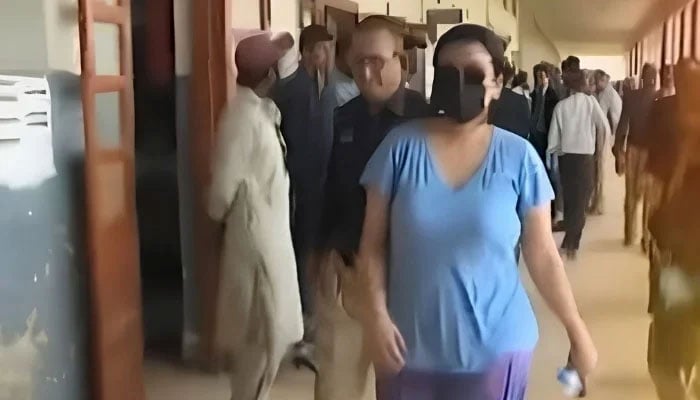
On Tuesday, Pakistan’s news channels dropped a bombshell with visuals of a woman strolling through the corridors of the City Courts in Karachi, dressed in casual attire. And that is how a ‘drug baroness’, named Anmol aka Pinky, landed on the consciousness of this country.
Though the focus has mostly been on the story’s sensational ingredients, I think this woman deserves more serious attention. The hype created in the mainstream and on social media, as reflected in excited conversations across all circles, would gradually fade.
But some people somewhere, perhaps in the seminars of our liberal arts colleges, should look closely at Pinky’s journey of life and explore some aspects of what is happening to us as a society. Yes, there are some thoughtful interpretations that relates to the drug mafia of Pakistan. There is also this popular perception, very firmly held, that justice will finally not be done, like in similar scandals of the past.
Actually, it is hard to reject this cynicism. What would have happened if those visuals were not there? Most probably, nothing. We would have to be content with the usual, dull reportage in the media. But that scene that we saw was really amazing. Arrested in a drug case, a woman was seen walking freely in the corridors and led by a police official into a magistrate’s court with a show of respect.
The media talked about ‘protocol’ for an alleged criminal. The obvious inference was that some police officials were sympathetic towards a drug dealer who had risen to become the ‘cocaine queen’. In any case, any drug business cannot be carried out without the connivance of some law enforcement personnel. What was remarkable here, though, was Pinky’s confident and relaxed demeanour.
Even more daunting was the audio clip of Pinky that was included in Tuesday’s reporting. We heard her berating the police for their inability to nab her. It was so boastful, delivered in a theatrical flourish. In it, she proclaimed herself as a ‘brand’. That is how her top-quality packets were labelled.
After they lost face on Tuesday, the police went into action with a show of authority. A number of policemen have been suspended and details are being released of what had happened in Pinky’s previous encounters with the police. She had been arrested in nine cases and was acquitted in six. She was declared a proclaimed offender in three cases and an absconder in an Anti-Narcotics Force (ANF) case.
On Friday, Additional Inspector General (AIG) of Sindh Police Azad Khan held a press conference in Karachi to say that the drug network of the alleged ‘cocaine queen’ was transnational. He said that, according to information gathered by the police, some African nationals in Lahore are involved in this network. Also involved are about 20 women based in Lahore.
But the real story is how Pinky, who is only 31 years old, has allegedly managed this drug network from Lahore and Karachi, resorting to innovative devices to continue operations under changing circumstances. Daughter of a taxi-driver, she first wanted to be a model and strayed into the drug business in her struggle to rise in life.
Her story, in its graphic details, is a mirror of Pakistani society, with specific reference to the challenges women face. I wonder what she could have become if she had been born in a privileged family, with social status and access to a good education. She could have been a great entrepreneur. Pinky, you can see, has talent as well as ambition.
This is merely a conjecture. I have made it because I see little scope for social mobility for the underprivileged in our society. But look at the skill with which this woman drug dealer has worked within the system and the conventional wisdom suggests that she will still be able to survive.
How corrupt we are as a society is what we all know. I have been a journalist for more than half a century and am privy to innumerable stories of corruption, fraud, misgovernance and outright criminal behaviour by a few who have exercised authority. Our conversations in private, in the presence of well-informed dignitaries, cannot be reported because names are named and concrete examples are cited. The problem, however, is to survive in this system and also protect your dignity and sense of values.
Sometimes, of course, things become public. At times, diligent and honest functionaries can make their moves. But the ultimate outcomes of how the system functions are generally not reassuring. It is in this context that people are cynical about the prospect of convictions in Pinky’s alleged network case.
There are many, but two examples come readily to mind. Supermodel Ayyan Ali was arrested in March 2915 for attempting to smuggle over $500,000 dollars to Dubai from Islamabad. She was able to leave the country after spending four months in jail. This case also involved the murder of a key customs inspector.
More recently, there was the Armaghan case, which began with the murder of 23-year-old Mustafa Amir, whose charred body was found in a car in the Hub area of Balochistan in the first week of January last year. The details that emerged were shocking and drug trafficking was part of the story. A case in the Anti-Terrorism Court is continuing in Karachi. Will justice be done and will it be seen to be done?
P.S. My column last week, ‘Memories of May’, listed major events that have happened in Pakistan in this month. A reader, who I suspect is one of a small number, emailed to complain that I had not included the Ahmadi massacre that took place in Lahore on May 28, 2010. I should have remembered it, also because I was always aware of it.
TTP terrorists had attacked two Ahmadi places of worship almost simultaneously on that day with guns and grenades, killing 94 and injuring 120 persons. It was verily a national tragedy.
The writer is a senior journalist. He can be reached at: [email protected]