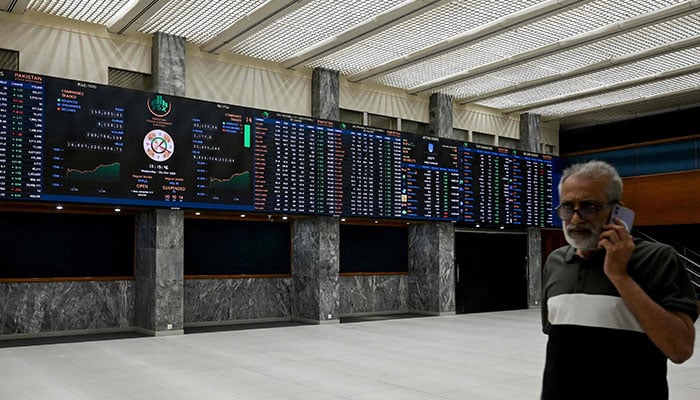
KARACHI: The Pakistan Stock Exchange (PSX) is expected to remain sensitive to geopolitical developments next week, particularly the outcome of Iran-US negotiations and movement in international oil prices.
Analysts said easing tensions around the Strait of Hormuz could help restore investor confidence, while clarity on the upcoming federal budget may also guide market direction. Despite recent volatility, analysts noted that market valuations remain attractive.
According to AKD Research, investor sentiment remained under pressure during the outgoing week due to rising Middle East tensions and fears of disruption in global oil supplies. The brokerage said improving external financing indicators, including the International Monetary Fund’s latest disbursement and Pakistan’s successful panda bond launch, continued to support the broader macroeconomic outlook.
The KSE-100 Index fell by 5,520 points, or 3.23 per cent week-on-week (WoW), to close at 166,596 points on Friday. Average daily traded volume declined by 6.3 per cent to 1.1 billion shares. Analysts attributed the decline mainly to uncertainty surrounding the Iran-US conflict, which kept Brent crude prices near $106 per barrel during most of the week.
US President Donald Trump described Iran’s response to Washington’s proposal as “unacceptable”, although market sentiment improved slightly towards the weekend after US Vice President JD Vance indicated progress in negotiations. Pakistan’s diplomatic engagement also received support from both the US and China.
During the week, Pakistan received a $1.3 billion disbursement from the IMF under the Extended Fund Facility and Resilience and Sustainability Facility after completion of the third review programme. Finance Minister Muhammad Aurangzeb also continued budget discussions with the visiting IMF mission ahead of the FY27 budget announcement.
Syed Danyal Hussain, an analyst at JS Research, said the market remained under pressure due to geopolitical uncertainty despite encouraging macroeconomic developments. He noted that Pakistan posted its lowest fiscal deficit in nearly three decades during the first nine months of FY26, supported by stronger petroleum levy collections and lower debt servicing costs.
Pakistan’s fiscal deficit narrowed to 0.7 per cent of GDP, or Rs856 billion, during 9MFY26 compared with 2.6 per cent a year earlier. The primary surplus increased 18 per cent year-on-year (YoY) to Rs4.1 trillion. Petroleum levy collections rose 45 per cent to Rs1.2 trillion.
The government also successfully launched its inaugural $250 million panda bond in China’s onshore market at a financing rate of 2.5 per cent. The issue was oversubscribed more than five times. Analysts viewed the development as a positive signal for Pakistan’s external financing position.
Economic indicators released during the week also remained encouraging. Provisional GDP growth for FY26 stood at 3.7 per cent against the official target of 4.2 per cent. Third-quarter GDP growth was recorded at 3.99 per cent, driven mainly by industrial growth of 4.7 per cent. Per capita income rose to a record $1,901, while the economy’s size reached $452.1 billion.
Workers’ remittances increased 11.4 per cent year-on-year (YoY) to $3.5 billion in April 2026, taking total inflows during 10MFY26 to $33.9 billion. State Bank of Pakistan-held foreign exchange reserves increased slightly to $15.9 billion.
Auto sales remained one of the strongest performing sectors. Sales increased more than double YoY and 42 per cent month-on-month to 22,015 units in April 2026. Total sales during 10MFY26 rose nearly 50 per cent compared with the same period last year.
Nabeel Haroon, vice president international equity sales at Topline Securities, said elevated oil prices and the lack of progress in Iran-US peace talks weighed heavily on investor participation. He noted that average daily traded value dropped sharply to Rs25 billion during the week, reflecting cautious investor activity.
In the Treasury bill auction held during the week, the government raised Rs949.8 billion against a target of Rs1 trillion. Yields on three-month, six-month and 12-month papers increased by up to 40 basis points, indicating market expectations of a possible interest rate hike in the upcoming monetary policy meeting.
Sector-wise, leasing companies, leather and tanneries, and sugar stocks posted the strongest gains during the week. Textile weaving, textile composite and synthetic and rayon sectors remained the worst performers.
Among individual stocks, Gadoon Textile Mills gained 24.3 per cent, followed by TRG Pakistan, which rose 14.3 per cent. Pakistan General Insurance, K-Electric and Service Industries also ended higher. On the losing side, Kohinoor Textile Mills, Pioneer Cement, Adamjee Insurance, United Bank and FHAM recorded sharp declines.
Flow data showed that mutual funds and companies remained major sellers during the week, while individual investors emerged as the main buyers. Analysts said retail participation continued to provide some support to the market despite institutional selling pressure.
According to AHL Research, Pakistan outperformed the MSCI Frontier Markets Index by 4.1 per cent in FY26 to date. The brokerage also highlighted Pakistan’s expected weight of around 5.8 per cent in the MSCI Frontier Markets Standard Index after the latest MSCI review becomes effective on May 29, 2026.