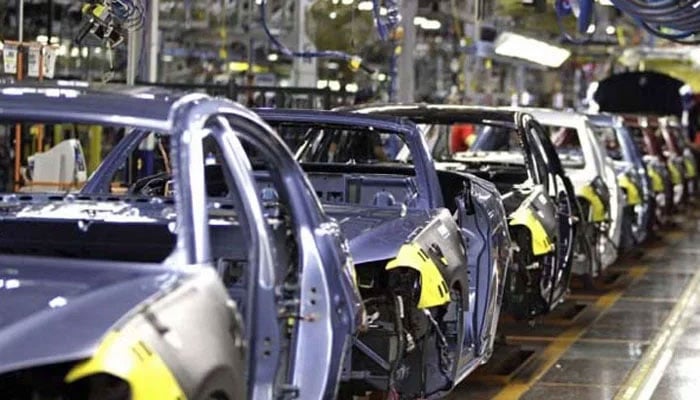
LAHORE: Pakistan’s automobile industry stands at a frustrating crossroads. The country assembles almost every segment of four-wheelers — passenger cars, SUVs, pickups, buses and trucks — yet remains insignificant in global production rankings.
Despite decades of protection, incentives and promises of localisation, the sector continues to move in cycles of boom and bust rather than achieving sustainable growth. The tragedy is not the absence of capability. The tragedy is Pakistan’s failure to convert potential into industrial scale.
Globally, nearly 87 million cars are sold annually, with Asia and Oceania accounting for almost 47 million units. Pakistan, however, struggles to sustain even a modest automobile market despite having a population exceeding 240 million. Pakistan, with an average annual market size of around 250,000 vehicles, competes against giant automotive economies and regional trade blocs.
More worrying is the comparison with regional economies. Between 2014 and 2025, Vietnam’s automobile market expanded by 180 per cent, the Philippines by 71 per cent and India by 60 per cent. Pakistan recorded only 15 per cent growth during the same period. Even the peaks achieved a decade ago have not been surpassed consistently.
The core problem is policy inconsistency. Pakistan’s automobile industry grows temporarily during periods of easy financing, stable exchange rates and relaxed imports. But whenever the economy faces pressure, the sector collapses under high interest rates, import restrictions and currency depreciation. Production slows, plants remain underutilized and consumers postpone purchases. No major manufacturing industry can flourish under such uncertainty.
Automobile manufacturing requires long-term planning, stable taxation, predictable tariffs and consistent localisation policies. Unfortunately, Pakistan changes industrial policies too frequently. Investors cannot plan years ahead when duties, taxes and import regulations are revised every few months.
As a result, Pakistan has developed more of an assembly industry than a genuine manufacturing ecosystem. Despite decades of localization claims, the sector still depends heavily on imported components and completely knocked-down kits. Whenever foreign exchange reserves decline, the industry immediately suffers because production relies on imported parts.
The comparison with ASEAN countries is particularly painful. ASEAN functions as a duty-free trade area that enables countries like Thailand, Indonesia and Vietnam to become major automobile production and export hubs. Pakistan, meanwhile, remains isolated and inward-looking while its domestic market is too small to achieve economies of scale.
Protection without performance has also hurt consumers. For years, buyers paid extremely high prices for limited choices and outdated models in the name of supporting local industry. Even today, delivery delays and “own money” premiums continue to distort the market. Small cars remain beyond the reach of much of the middle class.
More importantly, exports remain negligible. A successful automobile industry does not survive solely on domestic sales. It exports vehicles, components and engineering products. Pakistan has failed to enter global automotive supply chains in any meaningful way despite possessing engineering talent and a sizable vendor base.
The weakness of the automobile sector also reflects broader flaws in Pakistan’s industrial strategy. The country has never fully decided whether it wants a protected domestic market or a globally competitive export-oriented economy. Policies continue to oscillate between the two approaches.
Yet the automobile industry is too important to ignore. A strong automotive sector stimulates steel, plastics, rubber, electronics, glass, logistics and engineering industries while creating skilled employment and technological capabilities.
Pakistan still has the demographic potential to become a sizable automobile market. But this requires long-term policy stability, genuine localisation, support for vendor industries and regional trade integration. Above all, the country needs macroeconomic stability because no automobile industry can grow in an economy repeatedly facing currency and import crises.
Pakistan has protected its automobile sector for decades. The time has now come to ask an uncomfortable but necessary question: after so many years of support, why has the industry still failed to become globally competitive?