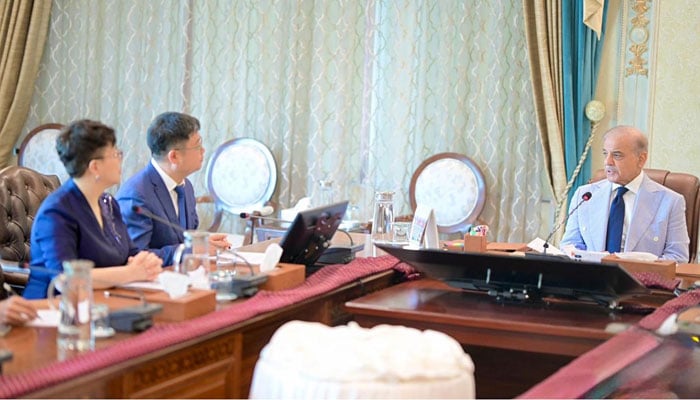
ISLAMABAD: Prime Minister Shehbaz Sharif on Friday appreciated IBI Group’s decision to establish its Pakistan Digital Economy Headquarters in Pakistan and expressed satisfaction at the expanding business-to-business (B2B) cooperation between Pakistan and China.
He was talking to a high-level 11-member Chinese business delegation led by Qian Xiaojun, Founder, President and Controlling Shareholder of IBI Beijing United Technology which called on him at the PM House.
While welcoming the delegation to Pakistan, the prime minister said that Pakistan and China enjoyed historic ties and the two countries were All-Weather Strategic Cooperative Partners.
He lauded the remarkable progress made by China under the visionary leadership of President Xi Jinping and said that he was looking forward to his visit to China later this month. He said it was particularly encouraging that the IBI would promote digital economy cooperation, investment facilitation and industrial collaboration. Expressing confidence in Pakistan’s economy, Qian Xiaojun said IBI hoped to help build digital backbone for digital transformation of Pakistan’s economy. He said establishment of IBI’s Digital Economy Headquarters in Pakistan would be a command centre for this transformation and shall provide massive opportunities for small and medium-sized enterprises (SMEs) in Pakistan by offering a gateway for them to a vast Chinese market.
The delegation was visiting Pakistan as a follow-up to the Pakistan-China B2B Investment Conference held in Beijing in September 2025 during the prime minister’s visit.
Meanwhile, in his message on ‘International Day of Living Together in Peace’ (May 16), the prime minister said the day highlights the importance of building peaceful, harmonious and united societies at both the national and international levels. At the national level, fostering a social environment that promotes peace is not only part of our visionary heritage but also a constitutional responsibility.
He quoted the Father of the Nation, Quaid-i-Azam Muhammad Ali Jinnah, clearly articulating Pakistan’s national priorities: “We believe in the principle of honesty and fair play in both national and international dealings and are prepared to make our utmost contributions to the promotion of peace and prosperity within and without.”
According to a press release issue here by the PM Office, the prime minister said these principles are the foundation of our proud national identity and continue to guide our national efforts towards creating a more harmonious and united national and global society.
The Government of Pakistan remains firmly committed to take practical measures for the establishment of a peaceful, tolerant and cohesive society where every citizen, regardless of race, ethnicity, or religion, can live with dignity. The Constitution of Pakistan also provides safeguards against all forms of discrimination, including any provincial, ethnic, sectarian and regional prejudices, Shehbaz said. “Pakistan is home to diverse languages, cultures, schools of thought and rich civilisational traditions. This social and cultural diversity is a source of our national strength. Positive national narratives, such as Paigham-e-Pakistan, aim to eliminate ideological and practical extremism while promoting national unity and social harmony, he said. The prime minister said that alongside constitutional guarantees for human rights, effective policy and practical interventions remain indispensable. In this regard, the government has formulated the “National Action Plan on Human Rights,” aimed at women’s empowerment, child protection and the promotion of the rights of vulnerable and marginalised groups.
Implementation of Pakistan’s first “National Action Plan on Business and Human Rights” is also underway to promote responsible business conduct, protection of labour rights, elimination of discrimination and effective remedies for human rights violations linked to business activities.
These policy measures lay the foundation for a just, inclusive and equitable society.
Through the “Human Rights Awareness Programme,” the government is further promoting the values of tolerance, unity and social cohesion.
The prime minister said that the government has played a key role in strengthening institutional mechanisms through the establishment and operationalisation of the National Commission for Human Rights. At the provincial level, District Human Rights Committees have also been established to promote social harmony at the grassroots level. These initiatives are being further reinforced through the “National Strategy on Prevention of Technology-Facilitated Gender-Based Violence” and the Minority Welfare Fund.
In the same spirit, the government has introduced important legal reforms aimed at eliminating harmful social practices and violence. These include the “ICT Domestic Violence Prevention and Protection Act 2026,” the “ICT Child Marriage Restraint Act 2025,” and the “National Commission for Minority Rights Act 2025,” which has been passed by Parliament, while the ministry is completing the process for establishing the commission.