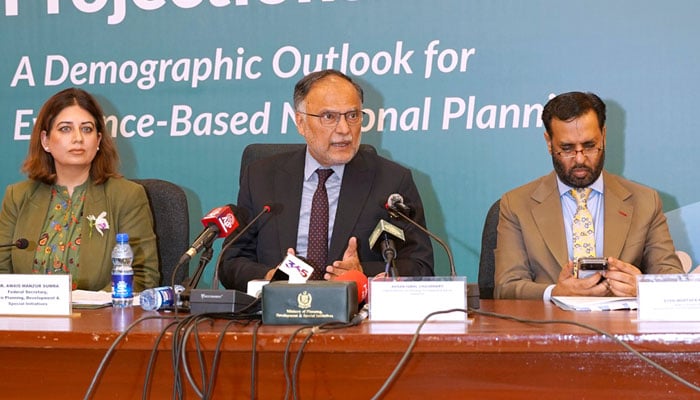
ISLAMABAD: Federal Minister for Planning, Development and Special Initiatives Ahsan Iqbal on Tuesday proposed incentives for the provinces in the NFC Award that successfully controlled their population growth, emphasizing that encouraging a balanced population growth was essential for Pakistan’s sustainable development and economic stability.
Addressing the launching ceremony of the National and Provincial Population Projections 2023-2050 here, he said uncontrolled population growth had become a major challenge for sustainable development, economic progress, and effective utilisation of national resources.
He warned that if the current growth rate continued, Pakistan’s population could reach between 370 to 400 million by 2050, placing immense pressure on health, education, employment, water, food, and other basic services.
The minister stressed that 82 percent of resource distribution under the NFC Award was linked to population share; therefore, reforms were needed in the system to encourage provinces to adopt responsible population management policies.
Currently, there is no effective incentive for provinces to reduce the population growth rates, he said, adding that the provinces demonstrating improvement in population management should be rewarded with additional incentives and recognition. Ahsan said Pakistan was planning its future for the first time on the basis of a digital population census, and the newly launched population projections would serve as a vital milestone for national policymaking, equitable resource distribution, and future development planning.
He remarked that population was not merely a statistical issue but a core national concern directly linked with economic growth, human development, education, healthcare, employment, and national security.
He warned that if the population growth continued to outpace resources, the country’s available resources would become increasingly strained, directly affecting the quality of life of citizens.
Expressing concern, he noted that Pakistan’s population growth rate was now being compared with some of the world’s least developed countries, which was alarming for a nuclear state.
He added that while the government previously believed population growth was slowing, the 2023 census revealed a far more alarming situation.
Ahsan emphasised that Pakistan must focus not merely on increasing population numbers but on developing an educated, skilled, healthy, and productive human capital base.
He said nearly 40 percent of children in Pakistan suffered from malnutrition and stunted growth because many parents lacked resources to provide adequate care.
He termed the situation a “national emergency” and stressed the urgent need to restore balance between population growth and available resources.
He further stated that by 2050, Pakistan’s population under the age of 18 could increase from 117 million to 140 million, while the working-age population may rise from 135 million to 255 million.
He emphasized that if provided with quality education, skills, healthcare, and employment opportunities, this growing youth population could become a major demographic dividend for Pakistan.