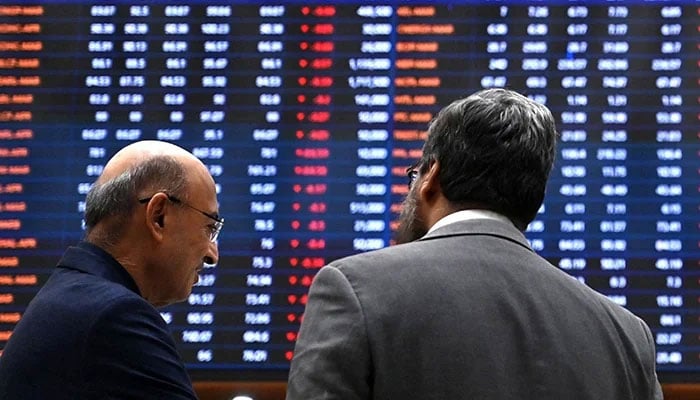
KARACHI: The stock market is likely to remain sensitive to developments around the International Monetary Fund’s approval of a $1.2 billion tranche and ongoing Iran-US negotiations in the coming week, analysts said. Softer global oil prices may continue to support investor sentiment if regional tensions ease further.
Analysts at AKD Securities said the market still trades at attractive valuations with a price-to-earnings ratio of 7.5 times, while forecasting the benchmark KSE-100 Index to reach 263,800 points by December 2026. The benchmark index ended the outgoing week at 171,116 points after gaining 8,122 points, or 5.0 per cent, on a week-on-week (WoW) basis.
According to a report by AKD Securities, investor sentiment remained upbeat throughout the week as signs of easing tensions between Iran and the United States pushed international oil prices lower. The brokerage noted that both countries appeared to move closer to a short-term understanding aimed at reducing conflict, helping Brent crude prices decline sharply during the week.
The report also highlighted expectations surrounding the IMF Executive Board meeting, which is considering approval of Pakistan’s next tranche under the Extended Fund Facility and Resilience and Sustainability Facility programmes. AKD Research added that the State Bank of Pakistan’s foreign exchange reserves are projected to reach $17 billion by the end of June 2026.
The market also drew support from improving economic indicators. Pakistan’s large-scale manufacturing sector expanded 11.1 per cent year-on-year in March 2026, taking growth during the first nine months of FY26 to 6.5 per cent. Cement dispatches increased 11 per cent year-on-year (YoY) in April to 3.9 million tonnes, supported by stronger local demand. However, the country’s external account remained under pressure as the trade deficit widened 4 per cent year-on-year to $4.1 billion in April, bringing the cumulative deficit during the first 10 months of FY26 to $32 billion. State Bank reserves increased by $23 million during the week to $15.85 billion as of April 30.
Syed Danyal Hussain, an analyst at JS Research, said the market gained 5.0 per cent during the week on improving diplomatic signals between the US and Iran. He said inflation accelerated to 10.9 per cent in April 2026, marking the highest level in nearly two years, mainly because of higher fuel prices. Hussain noted that exports grew 14 per cent YoY, though the trade deficit still widened due to stronger imports.
He also pointed to a shortfall in Federal Board of Revenue (FBR) collections, which missed the monthly target by Rs73 billion and pushed the cumulative gap to Rs683 billion during the first 10 months of FY26. He added that investors remained focused on the IMF board meeting and macroeconomic stability despite continued Middle East tensions.
Nabeel Haroon, vice president for international equity sales at Topline Securities, said the recovery in the KSE-100 Index reflected optimism that progress had been made towards a peace agreement between the US and Iran. He said declining oil prices improved investor confidence during the week. Haroon added that the April trade deficit rose because of higher imports, while manufacturing data remained encouraging despite a monthly slowdown. He said mutual funds emerged as major buyers during the week with net equity purchases of $6.3 million, while insurance companies and individual investors remained net sellers.
Average daily traded volume declined 9.7 per cent WoW to 1.1 billion shares. On the main board, cement, technology and investment companies led gains, rising 9.1 per cent, 8.2 per cent and 8 per cent, respectively. Textile weaving, leasing companies and synthetic and rayon sectors lagged behind. Among individual stocks, Pioneer Cement, Javedan Corporation, Pakistan International Bulk Terminal, Sui Southern Gas Company and Ghandhara Automobiles posted strong gains. Indus Motor Company, Ibrahim Fibres, Mehmood Textile Mills, Thal and Attock Refinery remained among the major laggards.
Other major developments during the week included the government’s plan to issue $250 million panda bonds, a decision to end untargeted electricity subsidies, relief of Rs1.75 per unit for power consumers under quarterly tariff adjustments, restrictions on high-speed diesel imports by private oil marketing companies and the rejection of the lowest spot liquefied natural gas bids by Pakistan.