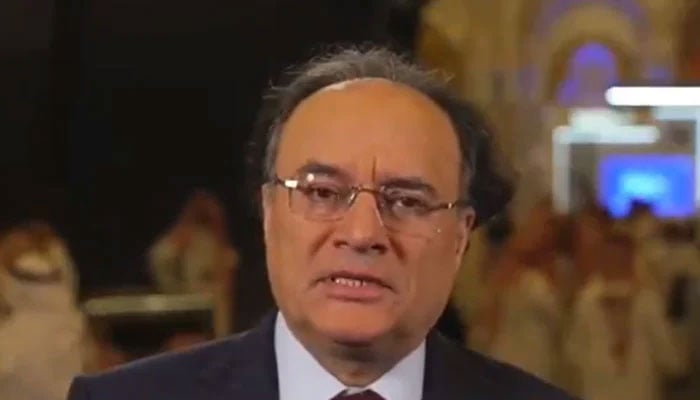
ISLAMABAD: Minister for Finance Muhammad Aurangzeb said on Thursday that Pakistan’s macroeconomic indicators were broadly on track despite a regional war and external pressures, expressing the hope that IMF’s Executive Board would approve the next loan tranche of $1.2 billion on Friday (today).
This was the crux of Aurangzeb’s statement while briefing the National Assembly’s Standing Committee on Finance and Revenue at the Parliament House. Syed Naveed Qamar chaired the committee meeting.
Governor State Bank of Pakistan (SBP) Jameel Ahmed informed the committee that the central bank had purchased $27 billion from the market in the last three years and repaid almost $5 billion last month but hoped that the foreign exchange reserves would touch $17 billion mark by the end of June 2026.
Aurangzeb briefed the committee in detail on financing the housing sector. He was of the view that Pakistan would stick to the prudent fiscal policies, improve external account performance, and undertake structural reforms to achieve macroeconomic stability on a sustained basis and enhancing investor confidence.
He briefed the committee on increased remittance inflows through Roshan Digital Accounts, improved access to international capital markets through Eurobond issuances and progress on the approval process for Panda Bonds in the coming days.
The committee was informed that the IMF’s Executive Board was scheduled to meet on Friday (today) in Washington, DC, to consider approval for the next tranche worth $1.2 billion for Pakistan, expressing confidence that there would be no obstacle in securing approval of the upcoming tranche.
Aurangzeb said exports had posted growth on both monthly and annual bases, Aurangzeb’s statement while briefing the National Assembly’s Standing Committee on Finance and Revenue at the Parliament House. Syed Naveed Qamar chaired the committee meeting.
Governor State Bank of Pakistan (SBP) Jameel Ahmed informed the committee that the central bank had purchased $27 billion from the market in the last three years and repaid almost $5 billion last month but hoped that the foreign exchange reserves would touch $17 billion mark by the end of June 2026.
Aurangzeb briefed the committee in detail on financing the housing sector. He was of the view that Pakistan would stick to the prudent fiscal policies, improve external account performance, and undertake structural reforms to achieve macroeconomic stability on a sustained basis and enhancing investor confidence.
He briefed the committee on increased remittance inflows through Roshan Digital Accounts, improved access to international capital markets through Eurobond issuances and progress on the approval process for Panda Bonds in the coming days.
The committee was informed that the IMF’s Executive Board was scheduled to meet on Friday (today) in Washington, DC, to consider approval for the next tranche worth $1.2 billion for Pakistan, expressing confidence that there would be no obstacle in securing approval of the upcoming tranche.
Aurangzeb said exports had posted growth on both monthly and annual bases, while remittances and IT exports were also rising. He added that the country was expected to remain in a current account surplus, and foreign exchange reserves were projected to reach the equivalent of three months of imports by June.
Aurangzeb said despite a difficult global and regional environment, Pakistan successfully issued $750 million in bonds and was also planning to launch a $250 million Panda Bond this year. He further revealed that inflows under the Roshan Digital Account (RDA) scheme had increased significantly, with $260 million received in March and expectations of further inflows in April. He acknowledged that petroleum imports had increased the import bill, while inflation remained a major challenge for ordinary citizens. However, he maintained that the government had taken measures to control inflation and preserve macroeconomic stability during the crisis. He also said economic growth for the current fiscal year was expected to remain between 3.7% and 4%.
Later, speaking to journalists outside the Parliament House, Aurangzeb declined to comment on whether electricity prices would increase or decrease in the coming months. He said Prime Minister Shehbaz Sharif and the energy minister were working extensively on reforms in the power sector and that details regarding electricity pricing would be shared later by the Ministry of Energy. State Bank Governor Jameel Ahmed told the committee that Pakistan’s economic growth was expected to improve during the current fiscal year, pointing to an increase in large-scale manufacturing output as a key indicator of recovery. He said inflation had declined to 7% in February and was moving in line with official targets before geopolitical tensions disrupted the outlook. He noted that the rising energy costs and higher food prices had pushed core inflation to 8.2%, adding that inflationary pressures were expected to ease once regional tensions subside.
Jameel Ahmad told lawmakers that monetary policy decisions were based on inflation projections for the next eight quarters. He said energy price increases had pushed up core inflation, forcing the central bank to maintain a higher interest rate environment. However, he stressed that imports were not being restricted despite concerns raised by committee members, noting that Pakistan made external payments of $4.5 billion in April without imposing import controls. Naveed Qamar said the economy still needed support and criticised the high-interest-rate environment. He also pointed to difficulties in exports to Central Asia due to disruptions in the Afghanistan route, particularly affecting Pakistan’s pharmaceutical sector.