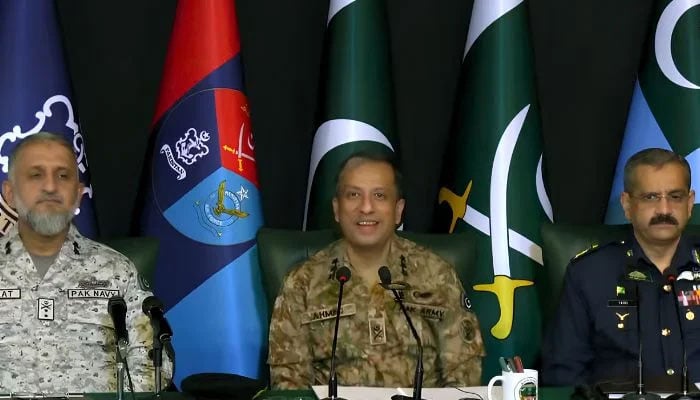
RAWALPINDI: Inter-Services Public Relations (ISPR) Director General Lt General Ahmad Sharif Chaudhry on Thursday said that ‘Marka-e-Haq’ buried the Indian narrative of painting Pakistan as a source of terrorism and at the same time consolidated Pakistan’s status as a net stabiliser in the region.
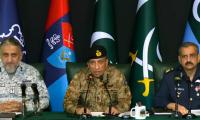
Briefing newspersons on the eve of the first anniversary of ‘Marka-e-Haq’, the ISPR DG said the country’s armed forces rose to the nation’s expectations and defeated a much larger — rather five times larger — enemy with multi-domain operations. Deputy Chief of Air Staff (Projects) Air Vice Marshal Tariq Ghazi and Deputy Chief of Naval Staff Rear Admiral Shifaat Ali Khan were also present on the occasion.
The ISPR DG said in the Battle of Truth (‘Marka-e-Haq’), with Allah’s grace, Pakistan defeated the enemy and what the world witnessed in that war was only 10 to 15 percent of our total power potential. “This is known not only to Pakistani children but also to Indian children — it’s just that they don’t admit it. In the ‘Marka-e-Haq’, Pakistan clearly established deterrence and changed the angle of warfare. If anyone has any doubt, we have just shown one episode. We were ready then, and we are ready now.”
He said that India very cunningly crafted a narrative that Pakistan is involved in terrorism, but the reality is that India itself is involved in terrorism. The world is not ready to listen to India’s fabricated claims. “Whatever Rajnath and Modi say — those who claimed during the war to have captured Lahore’s port — they have portrayed themselves as ten feet tall to the world and to their own people. We have just shown a small glimpse of multi-domain capabilities. The nation will see another small glimpse of this on August 14.”
The DG ISPR said, “This time, we will start our reckoning from the back — from where their beginning originates. When we level them from that point, they will hesitate to even take Karachi’s name in the future. If anyone has any misconception, it is a matter of minutes for us to disabuse them. We have been fighting their proxies for decades.” He added, “If they take Karachi’s name with a filthy tongue, then let’s see what the people of Karachi do to them.”
The ISPR DG said ‘Marka-e-Haq’ also proved Pakistan’s potential and resilience to combat multifaceted challenges, and that there was no space for war between two geographically contiguous nuclear states. “It also proved that Pakistan was recognised as a geopolitically significant and responsible middle power, and that there was unshakable synergy between the people, the government and the armed forces.” Chaudhry said he would not dwell a lot on what happened; rather, would talk about the period from May 2025 to 2026. He said they would place before the nation “10 strategic consequences” of the conflict. The first strategic consequence is that the Indian narrative of painting Pakistan as a source of terrorism stood buried forever. “The international community, as a consequence of ‘Marka-e-Haq’, came to know and now fully understands that Pakistan — as alleged by Indians over a period of time — is not a perpetrator but a victim of Indian-sponsored terrorism,” he noted.
Chaudhry noted that India attempted to portray, without evidence, that Pakistan had perpetrated terrorism in India. “It has been one year since the Pahalgam incident, yet the questions that Pakistan asked remain unanswered,” he said. “How come an FIR was registered within 15 minutes of the incident? Where is the evidence? The whole world, including sensible Indians, is asking who is behind the attack. Nobody buys this… You are the biggest terrorist. Nobody listens to them, nobody believes them,” he added.
Moving on to the second consequence, he said that the ‘Marka-e-Haq’ consolidated Pakistan as the net security stabiliser in the region “as per the vision of the founding father,” and the vision was “peace within and without.” He said ‘Marka-e-Haq’ showed who was controlling and dominating the escalation, adding that India escalated the conflict based on a “lie and fabricated drama” and how maturely Pakistan and its armed forces handled that. “The biggest ambassador of stability in the region was Pakistan and its leadership,” he added.
Referring to the third strategic consequence, Lt Gen Chaudhry said it was related to “our eastern neighbour,” saying it was the “politicisation of Indian military leadership and militarisation of Indian political leadership.” “You heard their air chief marshal a few months after the ‘Marka-e-Haq’ saying, ‘I got to know today that even we downed some planes.’ That politicisation of the military leadership… Why are you trying to make jokers out of your admirals, generals and air marshals? Don’t do that.” On the other hand, he said: “We have placed the facts as they are.” He criticised Indian politicians for appearing like “war mongers” and giving statements based on hatred. The ISPR DG noted that the politicisation of the military and militarisation of politics was “dangerous.”
Ahmad Sharif Chaudhry said the fourth strategic consequence was the global acknowledgement of Indian efforts to externalise its internal problems and internalise its external problems while using terrorism as a “state tool.” He pointed out that India’s internal problems included the repression of minorities and Kashmiris. “This comes from a false sense of entitlement and this hubristic attitude. You do not want to resolve your internal problems, and you externalise them by leveling allegations that Pakistan was behind terrorism in the neighbouring country. You need to address them politically and internally,” he added. He pointed out that Kashmir is not India’s internal problem, but an internationally recognised dispute. “It’s not your internal problem for you to make demographic changes there… you cannot do that.” He further said that Indians were even behind terrorism in their own country and would then accuse others. However, he said, the ‘Marka-e-Haq’ changed how the world recognised their operations.
Moving on to the fifth strategic consequence, the ISPR DG said ‘Marka-e-Haq’ exposed the “true face of the Indian media and its discredited information operations.” He criticised Indian authorities for “shutting down Pakistani media and social media” during ‘Marka-e-Haq’, a practice still going on. “It cannot solve the problem… There is only one advice to India, which is to speak the truth. That’s what Pakistan did… The only thing that can survive in today’s information domain is truth. Tell people the truth. But somehow the Indians think they can work their way around lies. It doesn’t work anymore,” he added.
He said the sixth consequence was the “transformed character of warfare,” noting that this covered multi-domain operations, non-contact warfare, synergy, proxies and information. He explained that warfare is not limited to borders anymore, adding that it is fought on land, at sea, in the air, in cyberspace, and it is cognitive as well. “By the blessings of Almighty Allah, Pakistan’s armed forces were prepared to fight against India during the ‘Marka-e-Haq’ in all those domains. We were prepared back then, and we are prepared today as well,” he added.
Furthermore, Chaudhry said the seventh consequence was Pakistan’s proven potential and resilience to combat multifaceted challenges. “That is another very important consequence that the nation has gone through… in simple words, it is the belief in ourselves,” he said.
Coming to the next, the ISPR DG said the eighth was the loud and clear establishment of deterrence, reaffirming that there is no space for war between two geographically contiguous nuclear states. “Anyone who thinks there is space for war between two nuclear neighbours is crazy. That is madness. Only a madman can think about it. If you want to do it, then there should be no doubt about our resolve,” he said.
The ninth consequence was the recognition of Pakistan as a “geopolitically significant and responsible middle power” on the global stage. “The politico-military leadership, politico-military diplomacy and respect are the strategic consequences of the ‘Marka-e-Haq’,” he added.
He said the last, but most important, consequence was the unshakable synergy between the people, the government, and the armed forces — “which we call the Bunyan-um-Marsoos effect.”
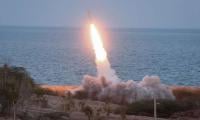
He recalled that during a press conference on May 11, 2025, he had stated that Pakistan’s military capability seen during the ‘Marka-e-Haq’ was just 10 percent of the armed forces’ power potential. “We are prepared; if anyone wishes to test us, they are more than welcome,” he said after a video showing the armed forces’ prowess played on the screen. He added that the clips displayed Pakistan’s indigenous military capabilities. “This is homegrown.” These included surface-to-air missiles; cruise missiles; the establishment of Army Rocket Force Command; main battle tanks; long-range artillery; ship-launched anti-ship missiles; UAVs, quadcopters, and drones; short-, medium- and long-range anti-drone systems; loitering munitions, electro-optical satellites and an integrated artillery fire control system.
The military spokesperson highlighted the significance of security in the world today, adding that “when we say that the armed forces, with the support of the people of Pakistan, will defend Pakistan’s territorial integrity and sovereignty at all costs, we mean it. And we will do it, come what may.” However, he added, this operational preparedness, military capability and technical prowess would not be meaningful if not backed by the resolve and strategic clarity of the leadership. Highlighting Pakistan’s emergence as a regional player and net security provider, he said, “We are not seeking conflict, we are not seeking war. But we know how to defend ourselves with honour and dignity.”
During the press conference, he also presented figures on counterterrorist efforts post-Marka-e-Haq. He said India was given a “lesson of their life” and they fell back on their default option, which was terrorist proxies. He said that in October, Pakistan struck terrorist support infrastructures in neighbouring Afghanistan, adding that the number of incidents subsequently went down. He reiterated that terrorism in Pakistan was being carried out by India, and Afghanistan was being used as a base of operations.
Responding to a question about operation ‘Ghazab Lil Haq’, he said Pakistan has nothing against Afghanistan and the Afghan people and has demonstrated brotherhood with them. It is part of the national response against terrorism, and they want Afghanistan not to allow use of its soil against its neighbouring country; every kind of terrorism is present there, which is not acceptable.
The ISPR DG highlighted Islamabad’s role in facilitating US-Iran talks aimed at ending the Middle East war, describing Pakistan as a “rational state” while contrasting it with Afghanistan’s conduct. “Afghanistan does not act as a rational player or function like a state,” he said.
To another question, he reiterated that the armed forces are not stakeholders in Pakistan’s politics; it is the political parties that are to talk to each other. “We do not represent any particular creed, sect, linguistic group, or political thought and come from the people of Pakistan. They resolve issues on their own and it is none of our business,” he said.
He said that civil and military leadership work day and night on how to get the right of self-determination for Kashmiris through diplomatic, political and legal means. “Pakistan does not believe in what Indians are doing: oppression, aggression and all sorts of nonsensical actions across the region,” he said.
He said that if one gives one reason for India’s aggression last year, it was the hubristic, militarised mindset of its civil and military leadership, which is also defining their future humiliation if they do not understand. He said India wrongly believed that higher defence spending and technological superiority would guarantee victory.
He said the enemy could try Pakistan’s armed forces as many times as they want and could also launch their proxies. He said Pakistan is not an ordinary country; it is a country of consequences which came into being in the name of Almighty Allah. “We are absolutely not impressed by India, whatever they may amass and gather. People have trust in their armed forces, and the armed forces have trust in their people.”
To a question, he said relations between Pakistan and Saudi Arabia are deep-rooted in multiple domains. “This Strategic Mutual Defence Agreement is a manifestation of those decades-old relations of multiple domains, and being custodian of Harmain Al Sharifain is an honour for every Pakistani,” he said. He said the security of both countries is mutual, and whatever the manifestations of that are not part of this agreement. “Pakistan and Saudi Arabia’s relations are very deep and multidimensional. Any threat to Saudi Arabia is also a threat to us,” he added.
To a question, the ISPR DG said the ultimate future of the six rivers belongs to Pakistan, saying Kashmir one day would become Pakistan.
Addressing the presser, Deputy Chief of Naval Staff (Operations) Rear Admiral Shifaat Ali Khan described ‘Marka-e-Haq’ as a “historic and memorable” conflict, saying India had long projected itself as a major naval power with a large defence budget and blue-water navy ambitions. He questioned why the Indian Navy failed to confront Pakistan directly during the conflict. He said India attempted to deploy naval vessels in the northern Arabian Sea to target Pakistan’s naval assets and disrupt maritime trade. However, he added that the Pakistan Navy’s strategy ensured ports, installations and sea routes remained fully operational. Rear Admiral Khan recalled that the Pakistan Navy and PAF were prepared to target India’s aircraft carrier Vikrant.
Deputy Chief of Air Staff (Projects) Air Vice Marshal Tariq Ghazi said Pakistan Air Force (PAF) leadership was already preparing for the next war, aggressively pursuing capability enhancement to retain its qualitative edge whenever it is put to test next time. “This is not our last war, and the next would not be on the similar options. That is why, with passion and focus, the PAF chief is preparing PAF of the future.”
AVM Tariq said the PAF leadership is already on the drawing board, defining parameters of the next war, and indigenisation is an enduring priority and will remain so in the future as well.
Right now, he said that 160 projects are under development, and many of them are near completion and very soon would be contributing to the war-fighting capabilities of the PAF in particular and the armed forces of Pakistan in general. “We have also laid the foundation for acquiring advanced capabilities including long-range weapons, next-generation platforms, additional J-10C aircraft, and much upgraded JF-17 platforms,” he said, adding that PAF’s capabilities across space are being substantially enhanced, and it all reflects accelerated institutional modernisation going on since May 6, 2025.
He went on to say that PAF’s integrated air defence system with newly acquired full-spectrum surveillance and response capabilities has also been operationalised, and it includes multi-domain fusion which is integrated into a layered air defence system and will provide comprehensive air defence across targets. “I can tell more details, but let us keep something for future surprise,” he said. He maintained that PAF’s pursuit for excellence is continuing, and our resolve to uphold aerial sovereignty is constant, and there should be no doubt about that.
“If the adversary opts for any misadventure, they would find the defence forces of Pakistan ready, united in command, steadfast in resolve and always decisive in response,” he said.
Air Vice Marshal Tariq Ghazi gave a brief of the ‘Marka-e-Haq’ to refresh memories, ridiculing the “adversary” for changing the storyline as “they are trying to understand what has happened.”
He said that the PAF claimed an 8–0 outcome in its engagement against the Indian Air Force, adding that multiple Indian aircraft were downed during the confrontation. Giving details, he said that four Rafale jets, one Su-30, one MiG-29, one Mirage 2000, and one “expensive” multi-role unmanned aerial system had been shot down. He said that several other aircraft were also damaged to such an extent that they could not be repaired. “PAF Chief Air Chief Marshal Zaheer Ahmed Baber Sidhu spearheaded the formulation and later led the execution of PAF’s operational response,” he said.
He pointed out that the air force had to immediately maintain a “defensive and strong posture” alongside the highest level of alert with full-spectrum monitoring that included the enemy’s communications. “We adopted a strong air defence posture to thwart any hostile adventure through combat air patrols, scrambles and eyes on the sky all the time,” he said, adding that the PAF, for the first time in warfare, integrated and operationalised its multi-domain assets.
Shakeel Anjum adds: Federal Interior Minister Mohsin Naqvi declared on Thursday that Pakistan’s intelligence agencies and armed forces played a decisive role in the “Battle of Truth” during Operation Bunyan-um-Marsoos, asserting that divine support guided the nation to a historic success.
Speaking at a high-level press conference in the capital, the minister emphasised that the conflict brought immense pride to the country, highlighting the unwavering resolve of the military in defending national sovereignty against external aggression.
He detailed a robust military response to India, claiming that the presence of Pakistani drones over New Delhi instilled significant fear within the enemy ranks. He attributed the operation’s victory to a combination of spiritual strength and the unified support of the Pakistani people, who stood firmly behind their defenders.
He revealed that intelligence agencies had successfully anticipated India’s intended strike zones, allowing for a preemptive and effective defence. Furthermore, Naqvi confirmed that sophisticated cyberattacks launched by India during the height of the conflict were successfully identified and thwarted by national security experts.
Shifting focus to internal security, he highlighted the ongoing daily battle against terrorism in Balochistan and Khyber Pakhtunkhwa, where dozens of attacks are being foiled. He specifically cautioned that any evidence of Afghan involvement in domestic terrorism would trigger a strong and uncompromising response.
In his closing remarks, the interior minister lauded the bravery of the nation’s leadership, stating that the president and prime minister remained visible and engaged with the public rather than retreating during the crisis. He urged the public to maintain absolute trust in Field Marshal Asim Munir and the state’s joint leadership, promising results that would exceed national expectations.