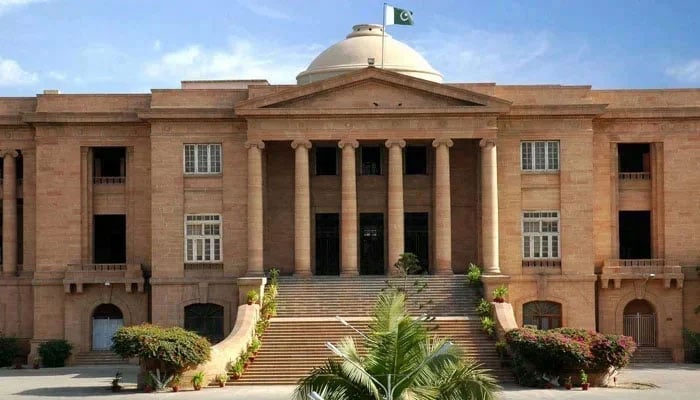
The Jamaat-e-Islami (JI) filed on Wednesday a constitutional petition in the Sindh High Court against the Sindh Solid Waste Management Board (SSWMB) over “grossly inadequate” garbage collection arrangements in the city.
Filing the petition, JI opposition leader in city council Saifuddin advocate and others submitted that waste management fell within the exclusive jurisdiction of local governments. They said that under schedule II, Part II, and schedule IV of the Sindh Local Government Act, 2013 (“SLGA 2013”), sanitation, removal, collection, and disposal of refuse are listed as compulsory functions of Town Municipal Corporations and Union Committees/Councils, respectively.
They said that town administrations managed the entire system, including sweepers, trucks, dumpers, loaders, and allied machinery, and sweepers were assigned to union committees and councils and worked under their direct supervision, ensuring effective monitoring at the grassroots level.
This system operated more efficiently and accountably than the current arrangement. Town administrations also managed the garbage transfer stations and coordinated with landfill sites. They said the provincial government established the SSWMB through legislation in 2014 which was subsequently repealed and re-enacted as the Sindh Solid Waste Management Board Act, 2021 (SSWMB Act).
They said the framework of the SSWMB had effectively overridden the role of local governments and is fundamentally inconsistent with the constitutional mandate as well as the spirit and letter of the local government system.
They said that under the current system, the board operates at the provincial/divisional level and outsources waste management services to private companies, which are contractually responsible for door-to-door collection, street sweeping, transportation of garbage to transfer stations, and onward disposal at landfill sites.
However, union committees and town administrations the primary grassroots institutions of governance have been completely excluded from this process. They said the performance of the private companies engaged by the board has been grossly unsatisfactory and in numerous instances, these companies further sub-contract their work to smaller contractors who employ unskilled, untrained labour, including children, women, and elderly persons, often at meagre daily wages.
They submitted that the workforce deployed is wholly insufficient; in areas where full staffing is required, only a small fraction of the necessary personnel is engaged. They said that laborers are typically hired on a daily-wage basis without proper training or familiarity with the localities to which they are assigned while many are physically incapable of performing the demands of the work.
They submitted that the SSWMB Act, by vesting exclusive control over a core municipal function solid waste management in a provincial/divisional body and thereby stripping elected town administrations and union committees of their compulsory statutory functions, is directly in conflict with Article 140-A of the Constitution.
They submitted that citizens of Karachi are suffering acutely, as garbage is neither regularly collected from households nor properly swept from streets and public spaces. They pointed out that garbage transfer stations, originally conceived as temporary holding points, have effectively been converted into permanent, open-air dumping grounds within residential areas, posing severe public health hazards.