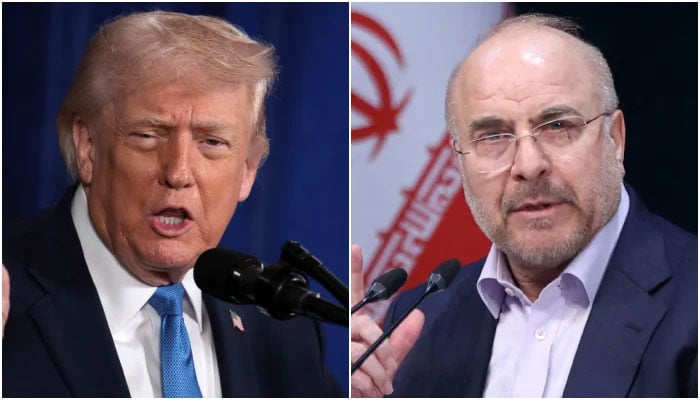
WASHINGTON: US President Donald Trump urged Iran Tuesday to “do the smart thing” and make a deal to end the war, saying even as a ceasefire teetered that he did not want to kill more Iranians.
“They should do the smart thing, because we don’t want to go in and kill people. Really don’t,” Trump told reporters in the Oval Office when asked about Iran. “I don’t want to, it’s too tough.”
Trump declined to say what Iran would have to do to formally violate the nearly month-long truce. “You’ll find out,” he said. “They know what to do. They know what not to do, more importantly, actually.”
The US leader also accused Iran of “playing games” with a deal to end the war -- an agreement which Trump says must ensure that Tehran cannot develop a nuclear weapon.
“What I don’t like about Iran is they’ll talk to me with such great respect, and then they’ll go on television, they’ll say, ‘We did not speak to the President,’” said Trump. “So they play games, but let me just tell you, they want to make a deal, and who wouldn’t? When your military is totally gone, we could do anything we want to them.”
The US president sought to minimize the war with Iran, calling it “a little skirmish.” “We’re in a little skirmish military. I call it a skirmish, because Iran has no chance. They never did. They know it,” Trump said during an Oval Office event on physical fitness among American kids.
Trump often touts the conflict as a resounding success, insisting for example that Iran’s navy has been destroyed. He sometimes openly calls it a war but more often tries to minimise it because the war is unpopular at home.
On Monday he called it a “mini-war.” And last month he described US military operations against Iran as “a little excursion.”
The US president dismissed Iran’s military capability and said Tehran “should wave the white flag of surrender” but is too proud to do so. He said that Iran’s military has been reduced to firing “peashooters” and that Tehran privately wants to make a deal despite its public sabre-rattling.
He heaped praise on the US blockade of Iranian ports in the region. “It’s like a piece of steel. Nobody’s going to challenge the blockade. And I think it’s working out very well,” he said. He said increase in fuel prices is small price to pay.
US Defense Secretary Pete Hegseth said the operation to protect commercial ships was temporary and the four-week-old truce was not over. “Right now the ceasefire certainly holds, but we’re going to be watching very, very closely,” he told a press conference.
Hegseth said the US was “not looking for a fight” in the strait but vowed that Iranian attacks would “face overwhelming and devastating American firepower.”
Shortly after Hegseth spoke on Tuesday, the UAE’s defence ministry said its air defences were again dealing with missile and drone attacks coming from Iran. “UAE air defence systems are actively engaging with missiles and UAV threats,” the defence ministry said in a statement on X, adding that they had “come from Iran”.
On Monday, an Iranian drone attack caused a fire, injuring three people at an energy installation in Fujairah, close to the blockaded Strait of Hormuz.
Iran’s Khatam al-Anbiya joint military command said it has not carried out attacks against the United Arab Emirates in recent days, yet warned of a “crushing response” if any action is carried out by the Gulf country against Iran.
Top US General Dan Caine said that Iran’s attacks on ships in the Strait of Hormuz have so far not met the threshold that would require the United States to restart combat operations. He told reporters that US Central Command “and the rest of the joint force remain ready to resume major combat operations against Iran if ordered to do so.”
Iran’s powerful chief negotiator warned the United States against any further escalation in the Strait of Hormuz, after a spate of attacks risked reigniting the Middle East war.
The US military said its Apache and Seahawk helicopters hit six Iranian boats threatening commercial shipping and its forces repelled missile and drones on Monday, while the UAE reported fresh Iranian attacks on its territory.
Iran’s latest warning followed President Trump announcing a plan to guide ships from neutral countries out of the Gulf, before the rivals traded fire as they vie for control of the waterway with duelling maritime blockades.
“We know full well that the continuation of the status quo is intolerable for America; whilst we have not even started yet,” Mohammad Bagher Ghalibaf, also the speaker in Iran’s parliament, wrote in a post on X.
Iran again sees a military buildup and threats by the US despite the path of dialogue being underway, Iran’s President Pezeshkian was cited by Iranian media as saying.
He said, “US pursues a policy of maximum pressure and wants Iran to come to the negotiating table and surrender to its unilateral demands, this is impossible.”
Iran’s president told Japanese Prime Minister Takaichi that Tehran is ready to resume the path of diplomacy once Washington changes its behaviour, Mehr News reported.
Pezeshkian said Gulf insecurity is caused by US and Israel. ‘American piracy’ against Iranian ships must be stopped and condemned, he added.
The war, which erupted more than two months ago with US-Israeli strikes on Iran, has spread throughout the Middle East and roiled the global economy, impacting hundreds of millions worldwide despite a weeks-long ceasefire.
Ghalibaf said the actions of the US and its allies had put shipping security at risk, but said their “malign presence will diminish”, with Tehran vowing not to surrender control of the Hormuz strait.
It denied any of its combat ships had been hit in US attacks but accused Washington of killing five civilian passengers on boats.
Iran has set up a new mechanism to manage the transit of vessels through the Strait of Hormuz, Iran’s Press TV reported on Tuesday. Iran has warned the US Navy to stay out of the Strait of Hormuz and that commercial vessels will need to coordinate any passage with its military. It also issued a new map of the strait with an expanded Iranian area of control.
Iran’s Revolutionary Guards warned that they would respond firmly to any ships that diverge from the Islamic republic’s approved route through the Strait of Hormuz.
The warning came on the second day of a US effort to facilitate the transit of commercial ships through the waterway, which Iran closed in response to the US-Israeli war against the Islamic republic.
Israel’s military chief Lieutenant General Eyal Zamir said that the country was prepared to respond “with force” to any attack by Iran. While Israel’s new air force chief Major General Omer Tischler said that the country was prepared to deploy its entire fleet of fighter jets against Iran if necessary.
European and US stocks advanced Tuesday as investors focused on first-quarter corporate earnings instead of uncertainty over the fragile US-Iran ceasefire.
Oil prices pulled back, even as the United Arab Emirates said it came under a second day of Iranian missile and drone attacks.
However markets appeared reassured by comments from US Defense Secretary Pete Hegseth that the US was “not looking for a fight” in the strait, even as he vowed that Iranian attacks would “face overwhelming and devastating American firepower.”
International oil benchmark Brent North Sea fell more than three percent to under $111 per barrel after sharp gains the previous day.
World leaders on Tuesday piled pressure on Tehran to stick to diplomacy to bring an end to the Middle East war. German Chancellor Friedrich Merz implored Tehran to “return to the negotiating table and stop holding the region and the world hostage”, echoing calls from French President Emmanuel Macron and British Prime Minister Keir Starmer.
Saudi Arabia, a key US ally whose energy infrastructure has been hit by Iran, joined the calls on Tuesday to de-escalate and called for “diplomatic efforts to reach a political solution”.
India condemned a drone strike on an energy facility in Fujairah in which three Indians were injured, urging uninterrupted access to the Strait of Hormuz, the foreign ministry said Tuesday.
South Korea said it will “review its position” on joining US operations in the Strait of Hormuz after President Donald Trump urged Seoul to take part following an apparent Iranian attack on one of its ships. An explosion and fire were reported on a South Korean cargo vessel on Monday in the key waterway. South Korea’s foreign ministry said Tuesday that all 24 crew members aboard the stricken HMM Namu -- including six South Korean nationals -- were unharmed.
Trump said the incident should prompt South Korea to join American efforts to guide stranded ships through the strait.
Portugal plans to levy a tax on windfall profits earned by energy companies due to surging prices caused by the conflict in the Middle East, the finance minister said Tuesday.
Activity in the US services sector cooled in April, survey data showed, as steeper energy costs from war in the Middle East filter through the global economy. Meanwhile, the employment index contracted for a second month in a row.
The Reserve Bank of Australia said it had lifted its cash rate 25 basis points to 4.35 percent, pointing to economic pressure stemming from turmoil in the Middle East.
Japan has taken delivery of its first shipment of oil from Russia since global supplies were choked off by the closure of the Strait of Hormuz at the start of the Iran war, reports said Tuesday. Ukrainian President Volodymyr Zelensky has offered a drone deal to Bahrain as he met with the king of the Gulf island state that has been attacked by Iran. “Ukraine is ready to share this security expertise with Bahrain and help strengthen the protection of life,” Zelensky said in a statement published online after meeting King Hamad bin Isa Al Khalifa.
UK police said they were investigating a new arson incident targeting London’s Jewish community, as Prime Minister Keir Starmer held talks on responding to a spate of antisemitic attacks.
In the latest incident, firefighters were called to a former synagogue in east London early on Tuesday, where a blaze caused minor damage, the capital’s Metropolitan Police said in a statement.
Iranian Foreign Minister Abbas Araghchi was travelling to Beijing on Tuesday for talks with his Chinese counterpart on bilateral ties and regional and international developments, his ministry said on its Telegram account.
French President Emmanuel Macron was to speak with his Iranian counterpart Masoud Pezeshkian later on Tuesday, as he pushed for Tehran to reopen the Strait of Hormuz. “I will be speaking with the Iranian president shortly,” Macron told reporters at a press conference in Yerevan, adding that France had long advocated for “the restoration of freedom of navigation” in the vital waterway.
UN Security Council members were set to begin talks later on Tuesday on a US- and Bahrain backed draft resolution that could lead to sanctions against Iran, and potentially authorise force, if Tehran fails to halt attacks and threats to commercial shipping in the Strait of Hormuz, three Western diplomats said.
Iraqi prime minister-designate told Iranian president that Baghdad can help contribute to a mediating role between Iran and the US, according to a post on X.
At least 10 people were hurt after a fire broke out in a shopping centre west of Tehran, Iranian media reported on Tuesday. Iran’s state broadcaster IRIB cited the fire department as saying that the fire had been “largely contained”. The cause of the incident remains unknown, the semi-official Fars news agency reported.
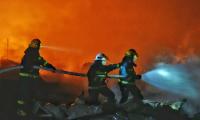
The United States is set to remove sanctions against Eritrea, according to an internal US government document seen by Reuters, a decision analysts linked to the African state’s strategic location on the Red Sea shipping route. A fire broke out on several commercial vessels at a dock in Iran’s southern port of Dayyer, semi-official Mehr news agency reported on Tuesday, adding that firefighters were working to contain the blaze and the cause of the incident was unknown.
Iranian media, citing military source, said US targeted two civilian boats carrying goods towards Iran on Monday, not IRGC speedboats, killing five civilians.
US Secretary of State Marco Rubio said that the United States has completed its offensive operations against Iran, echoing statements to Congress nearly a month into a fragile ceasefire. “The operation is over -- Epic Fury -- as the president notified Congress. We´re done with that stage of it,” Rubio told reporters at the White House.
He said that ten civilian sailors have died due to the ongoing conflict in the Strait of Hormuz, adding that the US would continue to deploy its assets to defend freedom of navigation in the key thoroughfare. “They’re isolated, they’re starving, they’re vulnerable and at least 10 sailors have died as a result, civilian sailors,” Rubio said, without providing additional details.
Rubio insisted the US was taking defensive action in enforcing its blockade of Iranian ports. The initial military operation against Iran was over, he said.
Rubio said it was time for Tehran to “accept the reality of the situation”, adding that US envoys Steve Witkoff and Jared Kushner were continuing to explore a diplomatic solution. That solution had to address any nuclear material that Iran still had buried “deep somewhere,” Rubio said.
He declined to provide details on what progress had been made and said the actual agreement would not need to be written out in one day. He said Iran must come to negotiating table and accept terms. He said that the United States had made some adjustments to a draft UN resolution on the Strait of Hormuz to try and avoid vetoes by China and Russia. The US Secretary of State said that peace between Israel and Lebanon was achievable but that the Lebanese militant group Hezbollah was a problem.
Russian Foreign Minister Sergei Lavrov and US Secretary of State Marco Rubio discussed the state of bilateral relations and international issues during a phone call, Russia’s Foreign Ministry said on Tuesday. It described the conversation as constructive and business-like.
Meanwhile, a high-level Trump administration official informed Iran on Sunday of the impending US operation to “guide” ships through the Strait of Hormuz and warned Tehran not to interfere, according to a US official and a source with knowledge, Axios reported.