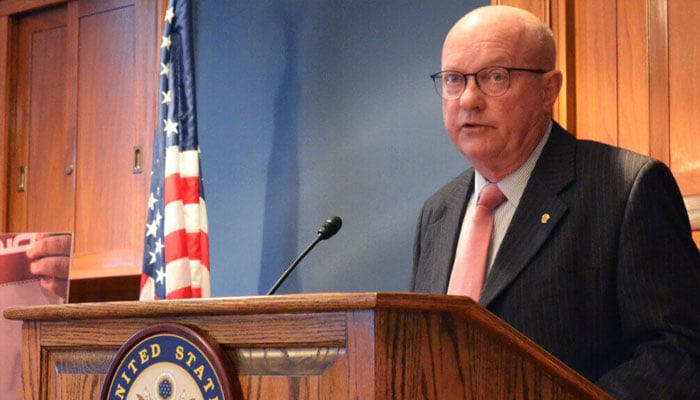
KARACHI: Colonel Lawrence Wilkerson, a veteran observer of American foreign and military policy, has described the ongoing war against Iran as a wider geostrategic conflict, warning that it extends far beyond the United States and Israel and is already directly affecting major global powers, particularly China.
In an interview, Wilkerson said China’s Belt and Road strategy, especially the railway network passing through Iran, has become an important but largely hidden target of the conflict. He said the consequences of the war could trigger major changes in global trade, the international financial system and broader balance of power. According to Wilkerson, China has not entered the conflict by choice but has instead been pushed into it by circumstances. He said Beijing did not anticipate a war of this nature. However, with its strategic infrastructure now under pressure, particularly the railway corridor linking China to Europe through Iran, he argued that it is becoming increasingly difficult for China to remain silent. He said Beijing views the situation not only as an economic challenge but as a direct geostrategic threat.
Wilkerson said the United States and Israel have in recent months repeatedly targeted this railway, which forms a central component of China’s Belt and Road Initiative. While he noted that completely destroying the route would be extremely difficult, he said the attacks carry a clear message that major economic and geopolitical interests lie behind the conflict, interests that remain largely un-recognised by the wider public and even by some senior political leaders.
He described the development as a potential turning point in the structure of global trade. According to Wilkerson, China is seeking to reduce dependence on maritime trade by expanding land-based commercial routes. Under this model, he said, Chinese goods could reach European markets far more quickly, reducing the strategic importance of the Suez Canal, the Strait of Hormuz and other key maritime chokepoints, while directly challenging American naval influence.
Wilkerson said the purpose of the attacks is not limited to damaging infrastructure. Rather, he argued, they are also intended to signal to China that the United States is prepared to obstruct its strategic advance. To underline the significance of the corridor, he referred to World War II, when the same land route was used to transport supplies to the Soviet Union and played an important role in shaping the outcome of the war. He said this historical example demonstrates the enduring strategic importance of the route.
Discussing China’s broader approach, Wilkerson said Beijing is seeking to secure technological, economic and financial superiority while avoiding direct military confrontation. He added that China is also working to expand the international role of its currency as an alternative to the US dollar, making the challenge to the existing global financial order one of its highest priorities.
He concluded that if the United States intensifies pressure on Chinese interests, particularly shipping routes and energy supplies, the conflict could reach a dangerous turning point. At that stage, he warned, China could openly enter the confrontation. According to Wilkerson, the world is now at a critical juncture where a regional war could rapidly expand into a wider confrontation among major powers, with consequences that would be unpredictable and potentially devastating.