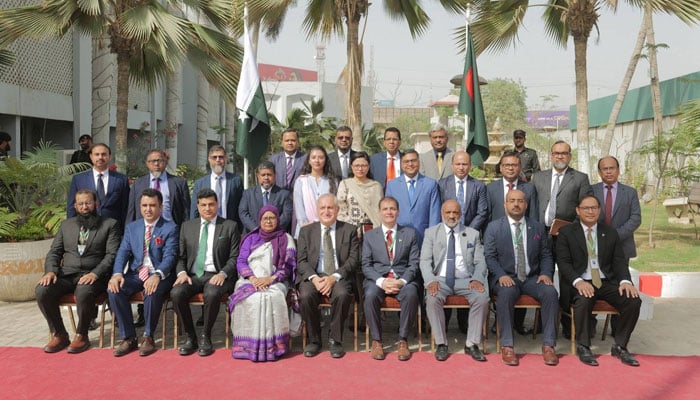
LAHORE: The National Institute of Public Administration (NIPA) Karachi on Monday hosted the first-ever visit of a Bangladesh Civil Service delegation, with senior officials from both sides terming the engagement a milestone in advancing cooperation in governance, policy innovation and capacity building.
The 12-member delegation of senior civil servants from Bangladesh, led by Joint Secretary at the Ministry of Public Administration Raihan Akhtar, was received by Director General NIPA Dr Syed Saif ur Rehman and Rector of the National School of Public Policy Farhan Aziz Khawaja. The visit forms part of a two-day engagement under the Executive Development Programme organised by the Civil Services Academy (CSA), Lahore, themed “Strategic Leadership, Governance Systems, and Policy Innovation.”
The visiting delegation comprised senior officers representing key ministries, including Salma Siddiqua Mahtab, Mohammed Mostofa Jamal Haider and Abu Rayhan Miah, besides other policymakers, reflecting a broad institutional representation aimed at fostering practical cooperation.
The programme commenced with a formal welcome ceremony at NIPA, where the national flags of Pakistan and Bangladesh were hoisted, followed by the playing of the national anthems of both countries. A tree plantation ceremony was also held, symbolising the commitment to enduring bilateral ties. The delegation was subsequently taken on an extensive tour of the institute’s facilities, including its library, Miyawaki forest, sports complex and training infrastructure.
During the visit, the delegation also viewed a commemorative plaque inscribed with the guiding principles of Quaid-i-Azam Mohammad Ali Jinnah regarding the conduct and responsibilities of civil servants, underscoring the ethical foundations of public administration in Pakistan. A documentary presentation was screened, providing an overview of NIPA Karachi’s role in training mid-career and senior civil servants and its contribution to strengthening governance systems.
In his address, DG NIPA Dr Rehman described the visit as a “historic milestone,” noting that it marked the first formal engagement of a Bangladesh Civil Service delegation with NIPA Karachi. He emphasised that the occasion went beyond ceremonial interaction, representing the beginning of a substantive and long-term partnership between the civil service institutions of the two countries.
Highlighting Bangladesh’s development trajectory, Dr Rehman acknowledged its achievements in community driven development, women’s empowerment, microfinance expansion, disaster preparedness and climate resilience. He observed that Pakistan could draw valuable lessons from these experiences, particularly in strengthening grassroots governance and adaptive policy responses.
At the same time, he noted that Pakistan’s public sector training frameworks, institutional capacity building models and structured career development programmes offered areas of potential learning for Bangladesh. He proposed expanding bilateral cooperation across multiple domains, including climate and environmental governance, public administration training, social enterprise development, cultural diplomacy and enhanced people-to-people connectivity.
He stressed that the success of such engagements would depend on continuity and follow through, calling for institutional mechanisms that could translate dialogue into actionable collaboration and long-term outcomes.
Speaking on behalf of the visiting delegation, Akhtar expressed appreciation for the hospitality extended by the government and people of Pakistan and described the visit as a meaningful opportunity to deepen institutional understanding. He underscored that the delegation consisted of career policymakers rather than political or diplomatic representatives reflecting the professional and technical nature of the exchange.
He commended NIPA Karachi’s facilities, training environment and institutional approach noting that the visit would contribute to building enduring professional linkages and facilitate knowledge sharing between the two countries’ civil service systems.
Rector National School of Public Policy and Director General Civil Services Academy Farhan Aziz Khawaja, in his remarks, highlighted the increasing importance of knowledge-driven governance in a rapidly evolving global environment. He elaborated on Pakistan’s civil service training architecture, particularly mid-career management and senior management programmes designed to equip officers with contemporary leadership, analytical and policy formulation skills.
He emphasised the role of immersive and experiential learning methodologies in modern public administration training, noting that such approaches were essential for preparing civil servants to address complex governance challenges. He expressed confidence that exchanges of this nature would help strengthen institutional partnerships and promote regional cooperation in public sector reform.
The formal proceedings concluded with the presentation of souvenirs to the visiting delegates as a gesture of goodwill and institutional camaraderie. The event also featured an address by Senator Javed Jabbar, followed by a special session centred on a book by Dr Ishrat Husain, former governor of the State Bank of Pakistan, offering the delegation deeper insights into Pakistan’s governance framework and economic thought leadership.
Officials on both sides expressed optimism that the visit would pave the way for sustained engagement, structured collaboration and the development of long term institutional partnerships aimed at enhancing governance outcomes in both countries.