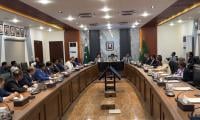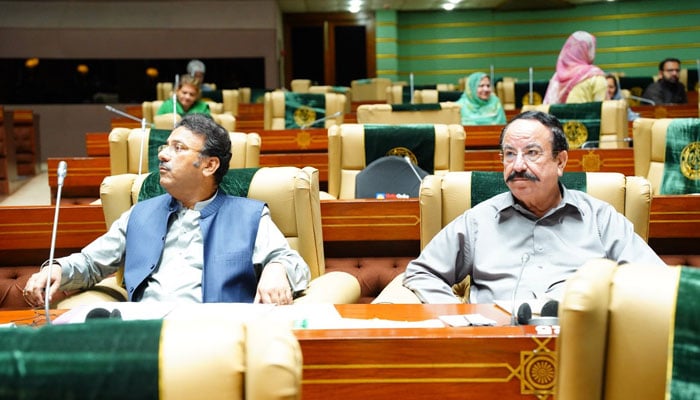
The Sindh Assembly commenced its new session on Monday under the chairmanship of Deputy Speaker Naveed Anthony with proceedings marked by sharp exchanges between treasury and opposition legislators over prolonged power outages, heatwave preparedness, and law and order.
At the outset, the house offered Fateha for the martyrs of the Pakistan Armed Forces and expressed condolences over several bereavements, including the deaths of close relatives of public figures and lawmakers.
The sitting was dominated by a heated debate following a call-attention notice moved by Muttahida Qaumi Movement-Pakistan (MQM-P) MPA Quratul Ain who questioned the Sindh government’s preparedness to tackle the ongoing heatwave in the province.
She criticised the absence of relief measures, remarking that “those sitting in air-conditioned rooms cannot understand the intensity of the heat,” and argued that merely setting up a few camps would not resolve the crisis.
She called for the establishment of proper medical camps and highlighted that load-shedding of up to 12–15 hours continued across parts of the province. Responding to the notice, Senior Minister for Information and Transport Sharjeel Inam Memon said the issue of power outages was not linked to climate change but was an administrative matter. He stated that while extreme weather was a recurring natural phenomenon, the provincial government had acted promptly upon alerts from the Provincial Disaster Management Authority, with Chief Minister Syed Murad Ali Shah ordering setting up of heatwave camps across all districts.
Memon, however, criticised the federal government and the MQM-P’s role in this regard questioning whether the party’s federal ministers and MNAs had ever raised the issue of loadshedding at the federal cabinet or in the National Assembly.
In a pointed remark, he accused
power distribution companies — including the Hyderabad Electric Supply Company (Hesco), Sukkur Electric Power Company (Sepco) and K-Electric (KE) — of subjecting consumers to collective punishment, calling the practice unconstitutional. He acknowledged that rural areas were facing outages of up to 18 hours.
The proceedings witnessed a brief disruption when MQM-P lawmakers protested against the exclusion of a motion by their member Adil Askari from the agenda. Law Minister Zia-ul-Hasan Lanjar rejected the objection, stating that the motion did not meet procedural requirements. The deputy speaker directed the assembly secretary to inform the member in writing of the reasons for its exclusion.
Another MQM-P lawmaker Dr Fauzia Hameed drew attention of the House to the rise in harassment cases in university campuses and hostels, claiming that at least 250 cases had come to her notice, with many more unreported.
In response, Minister for Universities and Boards Ismail Rahoo said harassment committees were functional in all public-sector universities and they took action where such incidents had occurred.
He noted that the Sindh government had already enacted legislation on harassment and institutional mechanisms were in place.
Jamaat-e-Islami member Muhammad Farooq highlighted poor waste management in the Shah Faisal Colony area of the city, alleging that billions of rupees had been paid to foreign firms while garbage remained uncollected.
He called for greater involvement of town administrations in waste collection. The parliamentary secretary for local government rejected the claim, stating that 41 vehicles and over 200 sanitation workers were deployed in the area and waste was being collected.
Honour killing debate
Separately, Sindh Home Minister Ziaul Hasan Lanjar informed the House that he had ordered immediate arrest of those involved in the alleged honour killing of a young woman, Rubina Chandio, in Tando Masti.
He said instructions to this effect had been issued to the Khairpur SSP in the early hours of the morning. Condemning the practice of so-called honour killings (karo-kari), Lanjar said there was no justification for such acts in Islam and called for nationwide legislation to eradicate the practice.
He emphasised that the state must take decisive action and expressed the Sindh government’s willingness to legislate further on the issue. The MQM-P’s Adil Askari, who raised the matter, termed such killings ‘murders in the name of dishonour’ and noted that such incidents were more prevalent in upper Sindh.
Key legislation passed
During the sitting, the House passed several important bills, including the Sindh Criminal Prosecution Services (Amendment) Bill and the Sindh Factories (Amendment) Bill 2026.
Presenting the prosecution services amendment bill, the law minister said it aligned provincial requirements with federal standards, including stipulations regarding judicial qualifications. The bill was passed by a majority vote.
The House also unanimously approved amendments to the Sindh Factories Act. Labour Minister Saeed Ghani clarified that the amendments were primarily administrative, aimed at updating legal frameworks across departments and facilitating digitisation rather than introducing major policy changes.
Meanwhile, a bill relating to the Benazir Institute of Urology and Transplantation, Nawabshah, along with a proposed law for the establishment of the Sindh Institute of Reproductive Health in Karachi, was referred to relevant standing committees for further consideration, with reports expected within a week. The session was later adjourned until Tuesday afternoon.