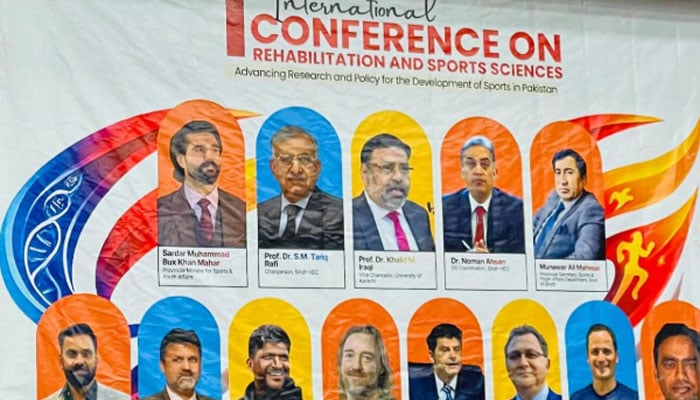
KARACHI: The Department of Health Physical Education and Sports Sciences of the University of Karachi organized the first international conference on rehabilitation and sport sciences: advancing research and policy for the development of sports in Pakistan. The inaugural session of the two daylong conference was held at the KU’s Chinese Teachers Memorial Auditorium on Sunday.
During the first day of the conference, the speakers observed that political interference in sports is one of the major causes of decline at the international level. They believed that the right people are not being picked for the jobs, and often talented players are overlooked to promote blue-eyed individuals.
According to them, lack of proper and durable policies, governance and management is also a matter of concern. They shed light on how a lack of funds is hampering sports, sportspersons, and sports activities in the country. The KU’s Vice Chancellor Professor Dr Khalid Mahmood Iraqi has stated that one of the reasons for the decline of sports in Pakistan is political interference. Despite the country’s large population, he emphasized that the shortage of truly talented individuals remains a major challenge. He called for a serious review of the causes behind the deterioration of sports in Pakistan, highlighting political involvement as a key factor.
Provincial Secretary of Sports and Youth Affairs Munawar Ali Mahesar underscored the importance of sports sciences, stating that collective efforts are essential for building a healthy society.
He added that despite limited resources, the Sindh government is taking practical steps to promote sports, including the establishment of youth centers in seven districts, which young people must utilize effectively.
Orthopedic consultant Dr Kazim Rahim highlighted the importance of sports medicine in Pakistan, particularly in Karachi. He explained that sports medicine is not confined to athletes but covers a wide range of injuries and conditions affecting the human body.
He pointed out that in Karachi, a city of nearly 30 million people, injuries are often complex and largely caused by traffic accidents. He noted that injuries commonly referred to as “sports injuries” in Western countries—such as ligament, meniscus, and bone injuries—are frequently the result of road accidents in Pakistan.
He emphasized that sports medicine is a highly specialized field requiring advanced expertise. International athletes expect to return to their previous performance levels after injury, which necessitates modern and effective treatment.
The KU’s Director of Evening Programs Professor Dr Syed Shabib Ul Hasan stressed the growing importance of physical and mental health in today’s world. He said that no country can progress unless its youth are physically and mentally strong, and no economy can thrive without prioritizing well-being. He expressed hope that the two-day conference would produce recommendations to guide future efforts.
Hockey Olympian Syed Sameer Hussain remarked that in Pakistan, talent emerges from streets and open grounds, unlike developed countries where structured talent-hunt programs identify and train athletes. He lamented that due to a lack of resources and timely medical facilities, valuable talent is being wasted.
Speaking online, former Test cricketer Muhammad Wasim emphasized the need for an effective sports system in Pakistan. He noted that in countries like the USA and Germany, sports sciences are an integral part of national policy.
Sports analyst Noman Niaz stated that sports in Pakistan are in decline because the sector has been consistently neglected. He stressed that while sports worldwide are being aligned with modern scientific standards, Pakistan has failed to give this sector the attention it deserves. He called for introducing scientific methods at the grassroots level to achieve global success.
Dr Syed Abid Mehdi Kazmi pointed out that society often equates success only with traditional education, leading to neglect of community-level sports talent. He emphasized the urgent need to raise awareness and educate communities about the importance of sports.
Former national cricket captain Mohammad Hafeez, in his online address, highlighted discipline as a fundamental principle in both sports and life. He noted that without clear policy and effective governance, success is impossible. He further observed that Pakistan has never treated sports as an industry, which is why the sector has failed to develop.