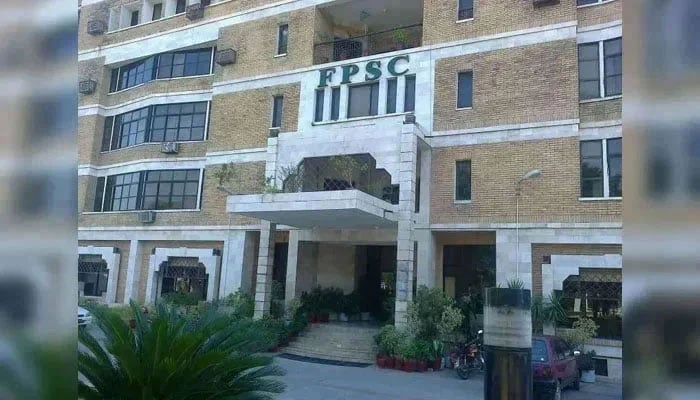
The Federal Public Service Commission (FPSC) recently announced the final results of the Central Superior Services (CSS) Examination, 2025. Of the total number of 12,792 candidates that appeared in the examination, only 342 – or 2.67 per cent – could qualify. Out of the 342 successful candidates, only 172 have been recommended for appointment on the basis of merit and constitutionally mandated regional and gender-based job quotas.
For the past several years, the number of qualified candidates has remained less than 3.0 per cent of those who appeared in the CSS examination. The question is why the once highly competitive race to fill vacancies in the federal bureaucracy, despite no change in the format, is running out of steam. Is the downswing in CSS results an index of our ‘precipitously declining’ education standards? Or have the examiners’ expectations suddenly skyrocketed? There may be an element of truth in both these explanations. However, the seedy CSS results need to be seen in a larger context as indicative of the cultural, economic and political changes society is undergoing.
As in the case of any other contest, the competitiveness of the CSS examination is chiefly a function of the value of the prize in the eyes of the contestants, both actual and potential. All else equal, if the pay-off is deemed high, competition will be fierce, attracting the best of the eligible lot. By contrast, if the pay-off is regarded as not worth a serious effort, the intensity of the competition will go down. The high or low pay-off is considered relative. While setting a value for a prize, contestants also take into account comparable prizes on which they can draw a bead.
The payoff of the CSS examination is a rewarding, lifelong career. It follows, therefore, that the competitiveness of the CSS examination depends, more than any other factor, on the prestige that the institution of civil service commands relative to other career choices open to the aspiring youth. That prestige, in turn, is a function of a set of political, economic, and cultural factors.
Max Weber, widely regarded as the father of the science of public administration, famously characterised the bureaucracy as the ‘legal-rational authority.’ The word ‘legal’ signifies that a civil servant’s discretion in dealing with the matter on hand is constrained by the relevant laws, rules and precedents. Rather than being arbitrary, the decision taken or the input provided for decision-making by a civil servant must stand the legal test.
The word ‘rational’ implies that every case is examined thoroughly and dispassionately and that the recommendation or decision rests upon the best available evidence. Neither prejudices nor biases, nor fear nor favour, should bear upon the disposal of cases.
Paradoxical though it may seem, it is in being legal and rational that the civil service’s both strength and weakness lie. While these characteristics enable civil servants to discharge their functions in a professional and merit-oriented manner, an excessive commitment to rules, decorum and precedent breeds excessive formalism, prescriptivism and a deep concern for observing hierarchy. This prevents civil servants from thinking outside the box, making decisions expeditiously, and adapting to the emerging norms of organisational behaviour in a rapidly changing milieu. In Pakistan, the tall organisational structure and concentration of authority at the top are still in vogue, which delays decision-making in an era when time is at a premium.
Over the years, the prestige of the civil service in Pakistan has gone downhill. An institution’s relative prestige depends mainly on three indicators: the authority it wields, the perks and privileges its members enjoy, and its perceived contribution to the social good. In the case of the civil service, all three indicators have registered a downturn.
The role of the state has shrunk under the influence of neo-liberalism, the most powerful contemporary socio-economic doctrine. In the neo-liberal worldview, the state is a necessary evil; therefore, its functions must be kept to a minimum. Instead, the private sector (corporations) and civil society assume a more important role.
In Pakistan, as well, several activities which were once regarded as among the core functions of the state – education, health, transport etc – have been transferred to businesses or the civil society. The government still runs schools and hospitals, but the quality and predictability of their services are questioned from time to time. The same goes for Pakistan Railways and, until recently, the national air carrier. The lack of quality services provided by public sector enterprises, together with their poor finances, lends credibility to the case for privatisation, which is seen as undermining bureaucratic authority.
As part of the opening up of the economy, the government is increasingly seen as a facilitator rather than a controller or organiser of economic activity. Such developments have curtailed the bureaucracy’s legitimate powers and the rent-seeking derived from them.
Some other related developments have also dented the bureaucracy’s relative prestige. The public sector no longer enjoys a monopoly over job creation. Over the past two decades, not only has the private sector expanded substantially but the job base has also widened considerably. As a result, young people today have a greater variety of jobs to choose from than their predecessors. Two, wealth has become the capital determinant of status and the principal instrument of power. In the past as well, civil servants earned less than other professionals; all the same, their position was regarded as prestigious in view of the authority that they wielded.
To top it all, the civil service has been heavily politicized and demoralized. Owing to the growing culture of political patronage and favouritism, the distinction between demonstrating accountability to a person and an institution and displaying loyalty to the public interest and a political party has eroded over the years. Against their call of duty, civil servants are expected by their political masters to remain loyal to a political party rather than the public interest and to remain obedient to the boss rather than the law. ‘My way or the highway’ is now the prevalent norm in public administration. From being a public service institution, the bureaucracy has been reduced to an agency of political patronage.
In the absence of any definite rule in respect of their term of office, civil servants find themselves in an insecure position. The sense of insecurity is one of the reasons – and, in many cases, the major one – that leads them to comply with the wishes, fair or foul, of influential quarters. Whereas as a rule, a politician gets several bites at the cherry; being on the wrong side of the law draws the curtain on a civil servant’s career and consigns him/her to ignominy once and for all.
The civil service is thus no longer the career of choice for top academic performers, who don’t want to be sucked into an unrewarding career, leaving the mediocre largely to compete for the once-coveted positions. The trend seems to be irreversible.
The writer is an Islamabad-based columnist. He tweets/posts @hussainhzaidi and can be reached at: