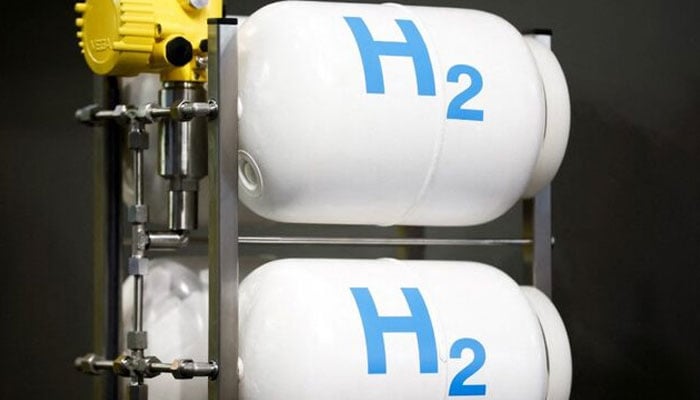
Pakistan’s hydrogen conversation is gradually shifting from aspiration to arithmetic. The question is no longer whether hydrogen fits into the energy transition narrative. The question is whether the numbers, the institutions, and the incentives align sufficiently to make it viable within Pakistan’s uniquely constrained political economy.
At the level of physics and engineering, the proposition is deceptively simple. Convert renewable electricity into hydrogen through electrolysis. Store it. Transport it. Use it. Yet the underlying system is far more demanding. A typical solar-driven configuration in Pakistan, for instance, requires a carefully calibrated solar-to-electrolyser ratio of roughly 1.7:1 to balance generation variability with electrolyser utilisation.
Even at this optimised ratio, a modest 1MW electrolyser produces approximately 58,000 kilograms of hydrogen annually, consuming nearly 0.58 million litres of water. These are not trivial input requirements. They define the scale at which hydrogen must be planned, financed and governed.
The economics follow a similarly unforgiving logic. Current levelized costs of hydrogen in Pakistan range between $3.7 and $4.3 per kilogram, with capital expenditure alone accounting for nearly 70 per cent of the total cost. Solar CAPEX in the range of $500 per kilowatt and electrolyser CAPEX approaching $900 per kilowatt dominate the cost structure. Even under optimistic projections, reducing total system CAPEX below $1,000 per kilowatt is a prerequisite for approaching competitiveness with grey hydrogen, which continues to hover near $2 per kilogram in regional markets.
These numbers matter because they immediately expose the limits of rhetoric. Hydrogen is not constrained by resource availability. Pakistan has sufficient solar irradiation, averaging close to 4.9 kWh per kWp per day in viable zones, and technically suitable land exceeding 8.0 per cent of the total territory. In fact, theoretical production potential approaches 69 million tons annually, far exceeding domestic demand, which, when converted from oil equivalents, lies closer to 30 million tons. The constraint is not potential. It is the ability to translate potential into bankable, coordinated and institutionally aligned projects.
This is where the political economy becomes decisive.
Pakistan’s energy governance is structurally fragmented. Power planning resides within the Ministry of Energy’s Power Division, which continues to operate under a paradigm shaped by capacity expansion, long-term power purchase agreements, and grid-centric thinking. Hydrogen policy, however, is being conceptualised within the Ministry of Planning, Development and Special Initiatives, where the lens is broader, often anchored in industrial policy, export potential, and long-term development planning.
Parallel to this, the Ministry of Climate Change is engaging with international partners, including the Global Green Growth Institute, to position hydrogen within climate finance and net-zero pathways.
This dispersion of authority is not merely administrative. It creates a fundamental misalignment of incentives.
The Power Division is grappling with an oversupplied grid, capacity payments exceeding Rs2 trillion annually and utilisation rates near 34 per cent. From its perspective, the priority is demand recovery and financial stabilisation. Hydrogen, particularly as a flexible load, could theoretically absorb excess generation. Yet without tariff reform and dispatch flexibility, the system has little incentive to redirect curtailed renewable energy toward electrolysers.
The planning ministry, on the other hand, views hydrogen as a strategic industrial opportunity. Its focus is on long-term positioning, export markets, and integration with initiatives such as CPEC industrial zones. However, without control over dispatch, tariffs, or grid access, it operates without the levers required to operationalise its vision.
Meanwhile, the Ministry of Climate Change, through engagements such as the GGGI-supported Global Clean Hydrogen Programme, is attempting to build institutional readiness, access climate finance, and develop MRV systems aligned with international standards. The programme’s global ambition, targeting approximately 2.3 million metric tons of CO2 in emissions reductions, reflects a climate-centric framing of hydrogen. Yet climate framing alone cannot resolve the commercial and infrastructural constraints that determine project viability.
The result is a classic coordination failure. Each institution is rational within its own mandate, but collectively they produce policy incoherence.
This fragmentation manifests in concrete ways. Consider site selection. Technical analysis shows that economically viable hydrogen clusters must exceed 4 square kilometres to support configurations such as 150MW solar plants coupled with 75MW electrolysers. These clusters are concentrated in southern Sindh and Balochistan, often near coastal zones that enable desalination and export logistics. Yet these same regions fall under overlapping jurisdictions involving provincial authorities, federal energy planners and climate-related initiatives. Without a unified spatial strategy, projects risk becoming administratively stranded before they are financially stranded.
Similarly, the question of water illustrates the political economy challenge. At approximately 10 litres per kilogram of hydrogen, large-scale production quickly scales into millions of cubic meters annually. Coastal desalination offers a solution, but it introduces additional capital costs and regulatory oversight. Inland production competes directly with agricultural water use, bringing provincial governments and irrigation authorities into the equation. Hydrogen policy, therefore, cannot be designed in isolation from water governance, yet institutional silos make such integration difficult.
The GGGI engagement offers a glimpse of both opportunity and risk. On the one hand, it introduces capacity-building, access to climate finance and institutional frameworks that Pakistan urgently needs. On the other hand, it reinforces a pattern where international partnerships anchor policy in climate narratives without fully integrating domestic energy market realities. The emphasis on MRV systems, private-sector engagement and innovation ecosystems is necessary but not sufficient. Without aligning these efforts with power sector reforms and industrial demand creation, hydrogen risks becoming another donor-driven initiative with limited systemic impact.
There is also a deeper political economy tension around risk allocation. Pakistan’s experience with IPPs has created a legacy of dollar-indexed guarantees and capacity payments that shifted risk to the public sector. Hydrogen projects, given their capital intensity, will inevitably seek similar assurances. If these are granted without reform, the country risks recreating a parallel circular debt structure, this time in the name of decarbonisation.
The alternative requires a fundamentally different approach. Competitive auctions, production-linked incentives, and demand-side mandates in sectors such as fertilisers can create a market without locking the state into long-term liabilities. The fertiliser sector alone, already consuming large volumes of hydrogen, offers an anchor demand that can absorb early production. At current scales, converting even a fraction of this demand to green hydrogen could offset significant RLNG imports while providing price stability to a sector critical for food security.
Hydrogen’s role in grid stabilisation also deserves emphasis. Electrolysers, unlike conventional loads, can operate flexibly. They can ramp up during periods of excess generation and shut down when the grid is constrained. In a system where curtailment and capacity payments coexist, this flexibility is quantifiable. It reduces the need for spinning reserves, improves plant utilization, and indirectly lowers system costs. Yet monetising this value requires regulatory recognition of flexibility services, something that Pakistan’s current tariff structures do not provide.
Ultimately, hydrogen is forcing Pakistan to confront an uncomfortable truth. The challenge is not technological adoption. It is institutional coordination. The numbers are clear. The resources exist. The cost trajectories are improving, albeit gradually. The missing link lies in governance.
If the Power Division continues to plan in isolation from industrial policy, if the planning ministry continues to design strategies without operational control, and if climate initiatives remain detached from market realities, hydrogen will remain a well-articulated but poorly implemented ambition.
If, however, these silos can be bridged, hydrogen offers something far more consequential than a new fuel. It offers a pathway to rewire Pakistan’s energy economy itself, converting stranded electrons into productive molecules, and aligning economic growth with resource efficiency.
The turbines in Jhimpir and the solar fields in Balochistan are already generating inputs. The question is whether Pakistan’s institutions can finally coordinate to convert those inputs into outcomes.
The writer has a doctorate in energy economics and serves as a research fellow at the Sustainable Development Policy Institute (SDPI).
Twitter/X: @Khalidwaleed_
Email: [email protected]