TEHRAN/ WASHINGTON: Iran said on Thursday it would respond with “long and painful strikes” on US positions if Washington renewed attacks, and also reasserted its control over the Strait of Hormuz, complicating US plans for a coalition to reopen the waterway.
While Iran's supreme leader declared that the United States had suffered a shameful defeat, defiantly rejecting a warning from President Donald Trump that an economically punishing US naval blockade could be enforced for months to come.
Oil prices hit a four-year high, then fell back slightly, before Mojtaba Khamenei issued a written message read out on state television declaring that Iran was now in the driver’s seat in the crisis.
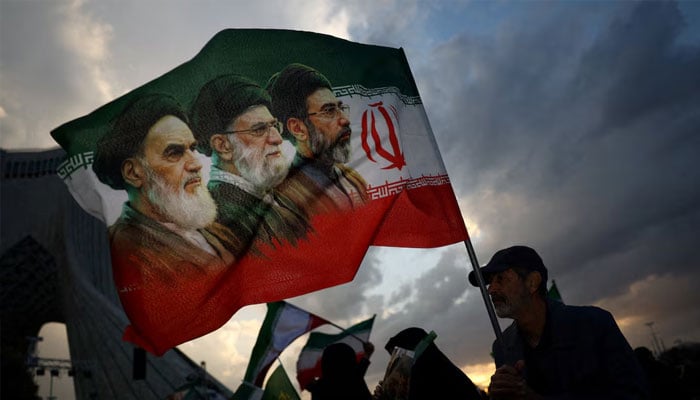
“Today, two months after the largest military deployment and aggression by the world’s bullies in the region, and the United States’ disgraceful defeat in its plans, a new chapter is unfolding for the Persian Gulf and the Strait of Hormuz,” he said, hailing Iran’s control over shipping in the strait.
He went on to predict a bright future for the Gulf without the United States, saying those who interfere in the region from afar “have no place there except at the bottom of its waters”.
Khamenei was wounded in the initial US-Israeli strikes that killed his father Ali Khamenei, and has not been seen in public since being named his successor as supreme leader last month.
The United States imposed a blockade on Iran’s ports two weeks ago, while the Islamic republic has maintained its stranglehold over the strategic Strait of Hormuz since the start of the Middle East war at the end of February.
Now Washington is seeking to set up an international coalition comprising allied states and shipping firms to coordinate safe passage through Hormuz, a State Department official told AFP—while maintaining its blockade of ships serving Iran.
And Iran’s parliament speaker Mohammad Bagher Ghalibaf said control of Hormuz would allow Tehran to “provide itself and its neighbours with the precious blessing of a future free from American presence and interference”.
Trump was expected to receive a briefing later on Thursday on new plans for potential military action in Iran from Admiral Brad Cooper, the head of US Central Command, two sources with knowledge of US planning told news site Axios.
Any US attack on Iran, even if limited, will usher in “long and painful strikes” on US regional positions, a senior Revolutionary Guards official was quoted by state media as saying on Thursday.
“We’ve seen what happened to your regional bases, we will see the same thing happen to your warships,” Aerospace Force Commander Majid Mousavi added, according to the Student News Network. He was responding to an Axios report saying that the US military has prepared a plan for a “short and powerful” wave of strikes on Iran.
Israeli Defence Minister Israel Katz warned, meanwhile, that it was “possible that we may soon have to act again” against Iran to achieve the war’s objectives.
But the commander of the Iranian Revolutionary Guards aerospace force, Majid Mousavi, said that even a “short and tactical” enemy operation would be met with “with painful, prolonged, and extensive strikes”. “We have already seen the fate of your bases in the region; we will also see your warships” face the same, he added, speaking to state TV.
This week Trump has reportedly told oil executives and national security officials to prepare for a long US blockade designed to force Tehran to surrender its nuclear programme, and, speaking to Axios, said: “They are choking like a stuffed pig.”
US Central Command said Wednesday in a social media post that it had reached a “significant milestone after successfully redirecting the 42nd commercial vessel attempting to violate the blockade”.
Iranian President Masoud Pezeshkian called the US blockade “a disruption to lasting stability” in the Gulf that was “doomed to fail”.
Pezeshkian said US naval blockade was effectively an “extension of military operations” by Washington, in spite of an ongoing ceasefire between the two sides. “The world has witnessed Iran’s tolerance and conciliation. What is being done under the guise of a naval blockade is an extension of military operations against a nation paying the price for its resistance and independence,” he said on X. “Continuation of this oppressive approach is intolerable.”
The Iranian president said that US naval blockade of Iranian ports would deepen disruptions in the Gulf and fail to achieve its objectives. “Any attempt to impose a maritime blockade or restrictions is contrary to international law... and is doomed to fail,” Pezeshkian said in a statement. He added that such measures would “not only fail to enhance regional security, but are in fact a source of tension and a disruption to lasting stability in the Persian Gulf”.
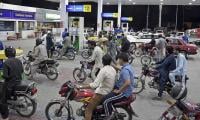
Oil prices struck a four-year high on worries about a resumption of hostilities in the Middle East, before slumping later in the session. International benchmark Brent crude soared more than seven percent to $126 a barrel but then eased and turned lower to trade around $110. That’s still almost double its price before the United States and Israel attacked Iran.
Markets were jolted after President Donald Trump warned the US blockade of Iranian ports could last months, and by a report that he would be briefed on potential fresh military strikes.
UN chief Antonio Guterres said the closure of Hormuz was “strangling the global economy” and International Energy Agency chief Fatih Birol told a meeting at his Paris headquarters: “The world is facing the biggest energy crisis in history.”
Trump faces domestic political pressure to end the war, which is unpopular even with much of his base, and has increased costs for American consumers and unnerved US allies. Iran’s economy is also suffering and the rial has fallen to historic lows against the dollar.
Iran proposed easing its chokehold over the Strait of Hormuz if Washington lifted its blockade and broader negotiations took place. But the Trump administration has insisted that Iran’s nuclear programme be on the table. Violence has continued on the war’s Lebanese front, despite a recently extended ceasefire between Israel and Hezbollah.
US President Donald Trump faces a deadline on Friday (today) to end the Iran war or make the case to Congress for extending it, but the date is most likely to pass without altering the course of a conflict that has lapsed into a standoff over shipping routes. Ending the war appears highly unlikely.
Instead, analysts and congressional aides said they expect Trump to either notify Congress that he plans a 30-day extension or disregard the deadline, with his administration arguing that a current ceasefire with Tehran marked an end to the conflict.
Like most policies in a bitterly divided Congress, war powers have become deeply partisan, with opposition Democrats calling for Congress to reassert its constitutional right to declare war and Republicans accusing Democrats of trying to use War Powers law to weaken Trump.
The European Central Bank held interest rates steady on Thursday but signalled a possible increase ahead as it warned of growing risks to the growth and inflation outlook due to the war in the Middle East. “The increase in energy prices will keep inflation well above two percent in the near term,” ECB president Christine Lagarde said at a press conference.
Sri Lanka’s inflation more than doubled to 5.4 percent in April, mainly because of higher energy prices linked to the ongoing Middle East conflict, official data showed on Thursday. Higher fuel and electricity tariffs pushed up transport costs as well as food prices, according to the Department of Census and Statistics.
Britain raised its national terrorism threat level to “severe” from “substantial” on Thursday, a day after an antisemitic stabbing attack in north London as Prime Minister Keir Starmer said Jewish people were living in fear and vowed stronger action to protect them.
The increase to the second-highest threat level out of five means a terrorist attack within the next six months is highly likely, following Wednesday’s stabbing of two Jewish men in the Golders Green area, the government said. It was decided independently by the Joint Terrorism Analysis Centre.
Interior Minister Shabana Mahmood said the assessment reflected the latest intelligence and a longer-term rise in extremist threats, and was not made solely in response to the Golders Green attack.
US President Donald Trump on Thursday told reporters that “I’m OK” with Iran playing in the FIFA soccer World Cup, which will be held in North America in June and July. FIFA President Gianni Infantino reiterated that Iran will play at this year’s World Cup on Thursday as he addressed the global football governing body’s Congress in Vancouver.
”Let me start by the outset, confirming straightaway that of course Iran will be participating at the FIFA World Cup 2026,” Infantino said as he opened his address to delegates. “And of course, Iran will play the United States of America.”
A US naval blockade of Iranian ports has shrunk Tehran’s oil exports, stranding a growing stockpile of crude on tankers as Iranian storage sites run out of space, shipping data showed and analysts said.
With some vessels switching off tracking systems and US forces turning back Iranian tankers, how much crude Iran is delivering to customers, particularly main customer China, is impossible to measure.
Just a handful of carriers carrying Iranian crude have left the Gulf of Oman between April 13-25, oil analytics firm Vortexa said. That’s down over 80 per cent from a comparable period in March, when Iran exported 23.4 million barrels, LSEG data shows.
Some of Tehran’s vessels have been intercepted by the U.S. after leaving Iranian ports, along with sanctioned container ships and Iranian tankers in Asian waters. The US Department of Energy is soliciting an exchange of up to 92,500,000 barrels from the strategic petroleum reserve, according to a request for proposals released on Thursday.
The Trump administration is talking to oil companies and considering measures to increase production in the United States “really soon” to ease the impact of the Iran war on energy supplies, White House economic adviser Kevin Hassett said on Thursday.
Iran’s air defences were engaging small drones and surveillance UAVs over parts of the capital Tehran late Thursday, with air defence fire continuing to be heard in western, central and southeastern areas of the city, the semi-official Tasnim news agency reported.
The United Arab Emirates has banned its citizens from travelling to Iran, Lebanon and Iraq, and urged Emiratis currently in those countries to leave immediately and return home, citing regional developments, the foreign ministry said on Thursday.
President Trump said “probably” when asked whether he would consider pulling US troops out of Italy and Spain, a day after announcing that Washington was looking at reducing the number of military personnel in Germany. Trump has harshly criticised Nato allies for not sending their navies to help open the Strait of Hormuz.
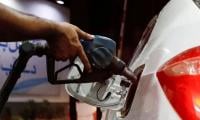
Trump told reporters that gas prices would “drop like a rock” as soon as the Iran war ended.