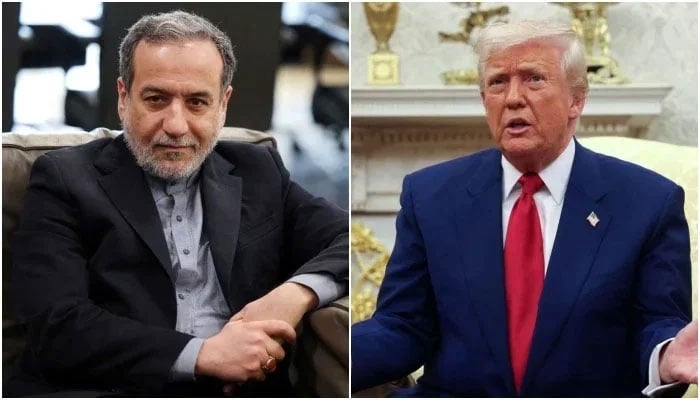
ISLAMABAD: US President Donald Trump Saturday said Iranian negotiators could call Washington anytime they want as the cancellation of US envoys’ planned trip to Pakistan for peace talks with Iran did not mean an immediate resumption of the US-Israeli war against the Islamic republic.
“They can call us anytime they want,” he told Fox News, while adding in a Truth Social post shortly afterward that if the Iranians “want to talk, all they have to do is call!!!”
“We have all the cards. They can call us anytime they want, but you’re not going to be making any more 18-hour flights to sit around talking about nothing,” the president said he had told his team.
Trump said it was unclear who was running Iran. “There is tremendous infighting and confusion within their ‘leadership.’ Nobody knows who is in charge, including them,” Trump said on his Truth Social platform.
Even before Trump’s announcement, the prospect of new talks had been uncertain, with Iranian state television saying Araghchi had no plans to meet with the Americans, and that Islamabad would serve as a bridge to “convey” Iranian proposals.
Iran’s military warned on Saturday it would respond if the United States maintained its blockade of Iranian ports, calling it “banditry” and “piracy”, as Revolutionary Guards said controlling the Strait of Hormuz was Tehran’s “definitive strategy” in its conflict with the United States.
Iran’s defence ministry said the United States was seeking a “face-saving” way to exit the war. “Our military power today is a dominant force, and the enemy is looking for a face-saving way to escape the war quagmire it has become trapped in,” media outlet ISNA quoted a ministry spokesperson as saying.
In a defiant statement carried by state media, Iran military’s central command Khatam Al-Anbiya said if “the invading US military continues blockading, banditry, and piracy in the region, they should be certain that they will face a response from Iran’s powerful armed forces”. “We are ready and determined, while monitoring the behaviour and movements of enemies,” it added. The urgency of striking a deal to permanently end the war has mounted as the Strait of Hormuz, a vital conduit for the world’s oil and gas supplies, has remained closed. But Iran’s powerful Revolutionary Guards said on Saturday that they had no intention of ending their effective blockade of the waterway, which has thrown energy markets into turmoil.
”Controlling the Strait of Hormuz and maintaining the shadow of its deterrent effects over America and the White House’s supporters in the region is the definitive strategy of Islamic Iran,” the Guards said on their official Telegram channel. The US has imposed a blockade of its own on Iranian ports in retaliation.
Since the first and only round of US-Iran talks, also hosted by Pakistan, efforts to bring the two sides back to the table have hit an impasse, with Iran refusing to participate as long as the US naval blockade remains in place. Iran, meanwhile, has allowed only a trickle of ships to pass through the Strait of Hormuz.
European Council President Antonio Costa said the waterway “must immediately reopen without restrictions and without tolling”. “This is vital for the entire world,” Costa said.
Iranian President Masoud Pezeshkian has called on his people to conserve electricity, warning that while there were no shortages at present, the US and Israel aimed to sow “dissatisfaction” among the Iranian people.
“We have asked our dear people, who are now ready and present on the ground, a simple request. And that is to reduce their own electricity and energy consumption,” the president said on state TV.
”We do not need people to sacrifice for the time being, but we do need to control consumption. Instead of 10 lights, two lights should be turned on in the house—what is wrong with that?” he added.
Despite the US-Israeli bombing campaign against Iran, there have been no reported power cuts in Tehran in recent days.
Pezeshkian accused Iran’s enemies of hitting infrastructure and imposing a blockade “so that the current satisfaction turns into dissatisfaction”.
US President Donald Trump has repeatedly threatened to wipe out Iran’s power infrastructure, but has so far not followed through. Even before the current war with the United States and Israel, however, Iran suffered frequent power outages during the winter and summer peaks in demand. According to the International Energy Agency, Iran generates nearly four-fifths of its electricity from burning natural gas, a resource in which it is self-sufficient thanks to vast gas fields.
Iranian Haj pilgrims have arrived in Saudi Arabia, Riyadh-based broadcaster Al Arabiya reported Saturday, despite a deterioration in ties between the Gulf kingdom and the Islamic republic during the Middle East war.
Saudi Arabia’s Haj ministry informed Al Arabiya that the first Iranians had arrived this year by air for the annual holy Muslim pilgrimage, the channel reported in a post on X. Iran bombarded its Gulf neighbours, including Saudi Arabia, with missiles and drones for over a month in response to US and Israeli attacks on the Islamic republic beginning on February 28.
Tehran’s aerial campaign halted earlier this month when the US and Iran announced a fragile ceasefire.
The admission of Iranians for Haj has been a barometer for relations between Iran and Saudi Arabia after no Iranian pilgrims were allowed into Makkah for seven years from 2016 to 2023.
Germany will soon send a minesweeper to the Mediterranean for a possible mission in the Strait of Hormuz after the end of the US-Iran war, a defence ministry spokeswoman told AFP Saturday.
Several countries have said they are ready to take part in a “neutral” mission to secure the Strait of Hormuz, which the United States said last week it was in the process of de-mining together with Tehran, although this has not been confirmed by Iran. The German navy’s “Fulda” will be deployed “in the coming days”, the spokeswoman said.
The Trump administration said it had imposed sanctions on an independent “teapot” refinery in China for buying billions of dollars’ worth of Iranian oil.
The Treasury Department targeted Hengli Petrochemical (Dalian) Refinery, which it said is one of Iran’s largest customers of crude oil and petroleum products. The department’s Office of Foreign Assets Control said it also imposed sanctions on about 40 shipping companies and vessels that operate as part of Iran’s shadow fleet. China has said it opposes “illegal” unilateral sanctions. US Treasury Secretary Scott Bessent has ruled out renewal of Washington’s waivers for Iranian and Russian oil, he told the Associated Press in an interview.
Speaking Saturday afternoon on the tarmac at Palm Beach airport in Florida, Trump said the Iranians “gave us a paper that should have been better, and interestingly, immediately when I cancelled it -- within 10 minutes -- we got a new paper that was much better.”
When asked by a journalist what was in the new document, he said: “We talked about they will not have a nuclear weapon, very simple.”