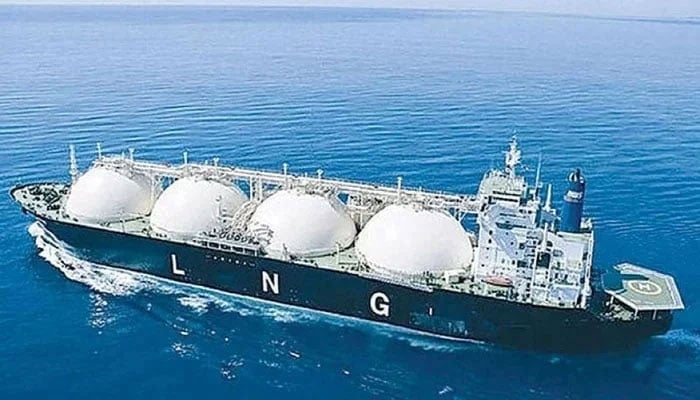
Pakistan’s RLNG system rests on two Floating Storage and Regasification Units (FSRUs). Pakistan LNG Limited (PLL) and Sui Southern Gas Company (SSGC) contracted and operate these terminals under long-term agreements.
Five structural flaws define these contracts.
First: Pay for capacity, not for gas. Pakistan pays about $538,535 a day in fixed capacity charges even when LNG does not arrive. This is a ship-on-standby model: cashflows are guaranteed; supply is not.
Second: Dollar liability without dollar income. PLL and SSGC pay in dollars. Their revenues are in rupees. Every depreciation of the rupee raises the burden automatically. This is a built-in balance-of-payments pressure point.
Third: No demand flexibility. The contracts are take-or-pay. Pakistan pays regardless of utilisation. Energy demand is volatile. The contracts are not.
Fourth: Asymmetric risk. Pakistan carries supply risk, demand risk and price risk. Operator risk is near zero. This is not a partnership. It is one-way risk transfer.
Fifth: A disconnected system. Procurement (PLL), terminal capacity (FSRUs), and power dispatch operate in silos. LNG arrives when not needed. LNG does not arrive when needed. Payments continue regardless.
Now the arithmetic. At $538,535 a day, Pakistan is paying about $16.2 million a month and about $196.6 million a year. Over 10 years, that is $1.97 billion. Over 11 years, that is $2.16 billion.
Red alert: Pakistan pays once for capacity. Pakistan pays again for replacement energy.
This is a double penalty.
For years, the cost remained hidden because gas was flowing. The moment gas stopped, the contracts were exposed. Imagine: Pakistan is not paying for gas — Pakistan is paying for the absence of gas.
Pakistan has already paid roughly $2 billion. Payments continue at nearly $200 million a year. These are dollar outflows without dollar inflows. These are fixed payments without guaranteed supply. The contracts were designed for shortage. They are bleeding in disruption.
The meter is still running.
Intriguingly, the two FSRUs together are worth about $400-500 million. At roughly $200 million a year in capacity payments, Pakistan pays the equivalent of both FSRUs in just over two years. Over a decade, Pakistan pays for both ships four to five times over — without owning either.
Red alert: Pakistan has paid for the ships. The ships are not Pakistan’s.
The writer is an Islamabad-based columnist.