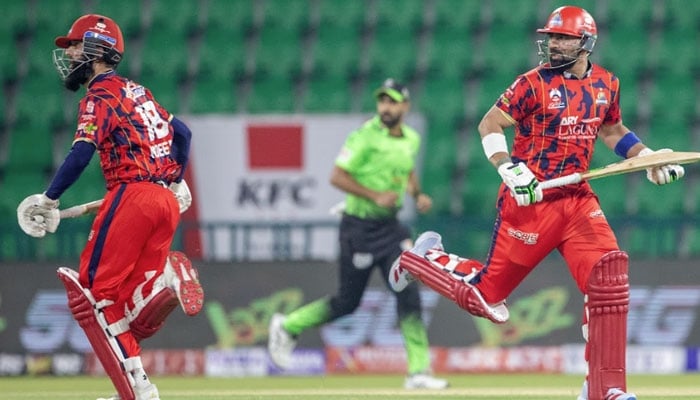
LAHORE: As the Pakistan Super League moves into its fifth leg, the tournament narrative has shifted from early experimentation to high-stakes consolidation. With matches now split between Gaddafi Stadium and National Stadium Karachi, the competition enters a decisive stretch where momentum, squad depth, and tactical clarity will determine the final playoff picture.
The previous phase, comprising seven matches in Karachi, offered a miniature of the tournament’s evolving dynamics. What stood out most was not just the diversity of winners—Peshawar Zalmi, Hyderabad Kingsmen, Islamabad United, Quetta Gladiators, Lahore Qalandars, and Multan Sultans—but the manner in which matches were controlled. Increasingly, outcomes have been dictated by teams that dominate key phases rather than those relying on isolated brilliance.
No team embodies this better than Peshawar Zalmi, whose commanding position at the top of the table reflects both consistency and adaptability. Their emphatic 118-run demolition of Quetta Gladiators in Match 29 was not just a victory but a statement of structural superiority. With a formidable top order led by Kusal Mendis and Babar Azam, complemented by a potent bowling attack spearheaded by Sufiyan Muqeem, Zalmi have set the benchmark. Their net run rate of +2.911 is not merely statistical dominance—it reflects their ability to win matches decisively rather than narrowly.
Multan Sultans, positioned second, represent a different kind of contender. Their recent 11-run win over Karachi Kings highlighted both their strengths and vulnerabilities. While their batting depth and finishing ability remain elite, their occasional lapses—particularly in middle and death overs with the ball—continue to leave margins thinner than necessary. Still, their ability to consistently cross the 180–200 threshold makes them a dangerous opponent in any scenario.
Islamabad United have quietly built one of the most compelling campaigns. Their victory over Karachi Kings, achieved with clinical efficiency, reinforced their identity as the tournament’s most reliable chasing side. With a strong net run rate and a balanced squad, United’s primary challenge lies in tightening their bowling discipline, especially when defending totals—a recurring issue that could prove decisive in knockout scenarios.
The middle tier of the table presents the most intriguing battle. Quetta Gladiators, Lahore Qalandars, Hyderabad Kingsmen, and Karachi Kings are separated not just by points but by consistency. Quetta’s contrasting performances—convincing wins followed by heavy defeats—highlight a side struggling for equilibrium. Their batting has shown promise, but the inability to sustain pressure with the ball has repeatedly undermined their efforts. Lahore Qalandars, meanwhile, continue to swing between brilliance and breakdown. Their dominant win over Rawalpindiz showcased their potential, particularly in posting imposing totals, yet their overall campaign has been hampered by an inability to string together consistent performances. This inconsistency is mirrored in their net run rate, which remains a significant handicap in a tightly contested table.
Hyderabad Kingsmen emerge as a wildcard. Their recent victory over Rawalpindiz demonstrated resilience, but their overall inconsistency limits their playoff certainty. They possess the capability to disrupt stronger teams, yet their margin for error is now virtually nonexistent.
Karachi Kings perhaps represent the most complex case. Their narrow defeat to Multan Sultans encapsulated their season—competitive yet flawed. Despite possessing match-winners and the ability to chase challenging totals, their negative net run rate (-1.368) underscores deeper issues in execution, particularly in bowling and middle-order stability. Their upcoming fixtures will require not just wins but convincing performances to remain in contention.
At the bottom, Rawalpindiz’s campaign has effectively transitioned from competition to disruption. Winless and struggling across departments, their role in the remaining matches could be that of spoilers, influencing the playoff race by unsettling higher-ranked teams. From an individual standpoint, the tournament has been defined by standout performers. Kusal Mendis and Babar Azam dominate the batting charts, combining consistency with impact, while Sufiyan Muqeem’s wicket-taking ability has made him a central figure in Zalmi’s dominance. These performances are not merely statistical highlights but integral to their teams’ structural success.
Looking ahead to the next leg, several factors will shape outcomes. The dual-venue format introduces variability in conditions, demanding tactical flexibility from teams. Lahore’s traditionally batting-friendly surfaces contrast with Karachi’s more balanced pitches, requiring teams to adapt strategies accordingly. Squad rotation and workload management will also become critical, particularly for teams with congested schedules. Most importantly, the psychological dimension of the tournament intensifies. For teams like Zalmi and Multan, the focus shifts to maintaining momentum and securing top-two finishes. For those in the mid-table cluster, every match becomes a virtual knockout. The pressure to deliver under these conditions often exposes underlying weaknesses—be it fragile batting lineups, inconsistent bowling, or tactical indecision.