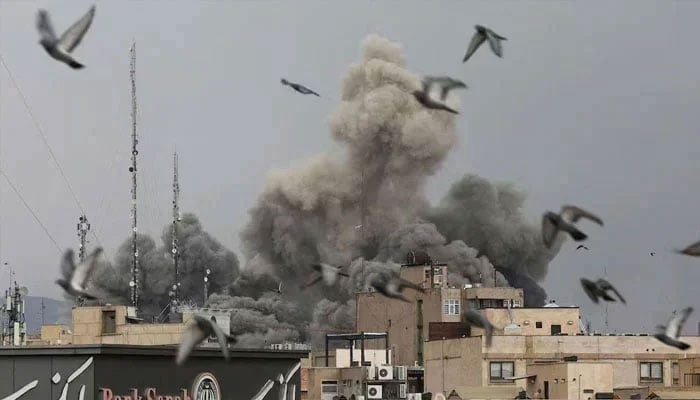
Ever since it began on February 28, the Iran war has bewildered the world with its many wonders. New revelations have continued to emerge out of what is proverbially described as the fog of war. We can be sure it will find its place in history as a momentous event that initiated an epochal transformation.
What the new world order would eventually be is something we are struggling to decipher. There are so many lessons to learn and so many consequences to confront, not just by the contenders but also by nations across the globe.
At the time of this writing, when the two-week ceasefire is to conclude in a few days, Pakistan’s high-profile diplomacy has raised expectations for a final agreement between the US and Iran. US President Donald Trump has claimed that a deal is almost complete. A second round of talks is set to be held soon in Islamabad.
Meanwhile, Israel and Lebanon have agreed to a 10-day ceasefire. This was announced by President Trump on Thursday. On Friday, Iranian Foreign Minister Abbas Araqchi said that following the ceasefire in Lebanon, the Strait of Hormuz was open and will remain so for the “remaining period of ceasefire”.
Iran’s decision to open the strait, vital for global trade in oil and other commodities, was promptly welcomed by President Trump. On his Truth Social platform, he said: “Thank you”. But he insisted that the American blockade on Iran that he had announced after the inconclusive Islamabad talks last weekend will remain in full force until his deal with Iran.
What happens now may finally resolve some important questions of our time, particularly regarding the United States of America and the Islamic Republic of Iran. Thanks to Pakistan’s extraordinary exploits in the diplomatic arena, the stage is set for the second round of Islamabad talks and possible agreement for lasting peace. But, against the backdrop of how America and Israel had started this war, it will not be easy for President Trump to earn Iran’s trust.
And so, waiting with bated breath for coming developments, we have an occasion to look at some developments of the week that have a bearing on how this war is being conducted. I have suggested that we have many different perspectives on this war and what has gained the most attention is, in a sense, the enigma of President Donald Trump.
Consider the predicament of the commander-in-chief of the mightiest military power ever when he is unable to win the surrender of a relatively battered country even after heavy bombardments and the ultimate threat of annihilating it along with, inconceivably, its civilisation. Would not this be seen as a sign of desperation on the part of a man who sees himself as invincible?
This week, Trump invoked religion in his favour. In fact, this was to be expected because of his pretensions to be divinely guided. Besides, his pugnacious and boastful Secretary of Defence Pete Hegseth had previously been exhorting the American citizens to pray for America’s victory in the war with Iran. Such an impassioned show of religiosity had never been an attribute of the American administration.
What is really interesting is that Trump this week sought to project himself in the image of Jesus Christ and, at the same time, picked a fight with Pope Leo XIV. It should be noted that this is the first Pope born in America.
In a lengthy social media post, Trump assailed Pope Leo as too liberal and ‘weak on crime’. Then he posted an image depicting himself as Jesus. Expectedly, there was swift criticism of what appeared to be an act of blasphemy. He deleted the image and told reporters he believed he was shown as a doctor in the AI-generated image.
In a homily during a Mass before Easter, the Pope said that the Christian mission had often been “distorted by a desire for domination”. In late March, he warned against invoking the name of Jesus for battle, saying in a Sunday homily that “Jesus does not listen to the prayers of those who wage war, but rejects them”. Since the war began, the Pope has consistently called for an end to violence and a return to dialogue to resolve the conflict.
On Thursday, during his tour of Africa, he delivered a forceful appeal for peace in a speech in Cameroon. He condemned “a handful of tyrants” who are ravaging the world and also those “who manipulate religion in the very name of God for their own military, economic or political gains, dragging that which is sacred into darkness and filth”.
Incidentally, in the early days of war, Defence Secretary Hegseth had asked the American people to pray, “every day, on bended knee” for a military victory in the Middle-East “in the name of Jesus Christ”. In his news conference on Thursday, he again cast the war in explicitly Christian terms. He compared the rescue of two downed F-15 crew members from inside Iran to biblical miracles.
Investing religion in public affairs, one would say, is not so surprising. We know that Islam is a great motivating force in Iran and in a number of other Muslim countries, including Pakistan. But America, constitutionally, is a secular country and, more significantly, the Trump administration is at odds with the Pope who is the visible head of the worldwide Roman Catholic Church and is accepted as the final authority on matters of faith and morality.
The US constitution mandates a separation of church and state, primarily through the First Amendment, which prohibits Congress from establishing a religion or prohibiting the free exercise of one.
Still, President Trump has posted another illustration of himself with Jesus Christ. This was followed by a post: “The Radical Left Lunatics might not like this but I think it is quite nice !!!”.
Would this too be an example of how the world is changing?
The writer is a senior journalist. He can be reached at: [email protected]