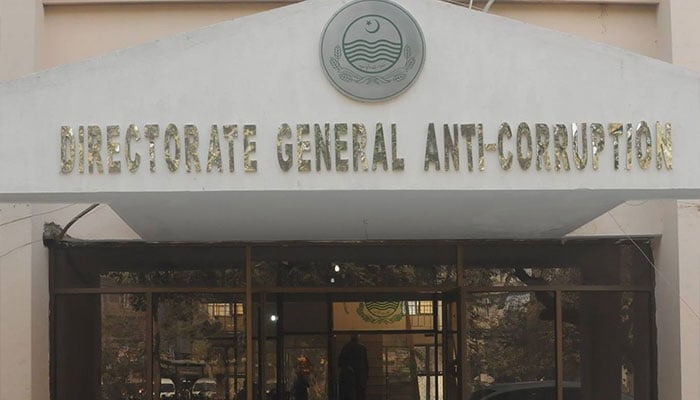
LAHORE: The Director General of the Punjab Anti Corruption Establishment, Sohail Zafar Chatha, has proposed an extensive set of structural reforms to Chief Minister Maryam Nawaz, aimed at addressing entrenched corruption and improving administrative efficiency across key provincial departments.
Senior officials told Daily Jang that the recommendations submitted sought by the the provincial government constitute a comprehensive roadmap for transitioning from discretionary, paper-based systems to transparent, technology-driven governance models. The anti-corruption body, which typically confines its role to investigation and enforcement, has seldom issued such wide-ranging policy prescriptions, lending significance to the initiative.
In the revenue sector, long regarded as one of the most corruption prone areas of governance, the proposals focus on minimising human discretion and strengthening verification mechanisms. The DG has recommended a time-bound, location-specific and device-restricted login system for registry branches to prevent unauthorised access and manipulation of land records. Integration with the Federal Board of Revenue has also been proposed to enable real-time verification of tax status including filer, non filer and late filer categories along with authentication of Computerised Payment Receipts and Payment Slip IDs.
The recommendations further call for abolishing the practice of appointing local commissions, which officials say has often been misused to influence land-related proceedings. The elimination of private intermediaries, or munshis, from patwar offices has also been proposed to curb informal rent-seeking practices. In addition, the issuance of land ownership documents (fard) has been linked to mandatory site visits with clearly defined measurements, while disputed land records (khewats) are proposed to be blocked at Arazi Record Centres to prevent fraudulent transactions.
Turning to policing, the DG has pointed to structural deficiencies, particularly the low allocation of investigation costs per case, which he noted undermines effective law enforcement and creates incentives for malpractice. To address this, the report recommends expanding digital service delivery to reduce direct public interaction, alongside instituting strict accountability mechanisms with swift and consistent penalties for corrupt conduct. The introduction of body worn and vehicle mounted cameras for traffic police has also been suggested as a deterrent against bribery and abuse of authority.
In the communication and works and local government departments, the focus of reforms is on procurement transparency. The proposals include the digital generation of call deposit receipts and their integration with designated banks through the e-procurement system to ensure automatic verification. The DG has recommended eliminating contractors’ physical presence during bid openings, shifting tender evaluation and comparative statements entirely to digital platforms, and enforcing third party audits and independent technical inspections during project execution under the oversight of the anti corruption establishment.
For municipal governance, the report underscores the need for end to end digitisation of property tax records to eliminate fraud and leakages. It also calls for integrating municipal applications with banking systems to ensure transparent tax collection. The recommendations draw on past cases of irregularities, including those reported in Dera Ghazi Khan and Faisalabad, to highlight systemic weaknesses in the existing framework.
In the health sector, the DG has proposed centralising the procurement of medicines at the provincial level to ensure economies of scale and reduce opportunities for manipulation. The introduction of an electronic prescription system linking doctors with pharmacies has also been recommended to enhance traceability and accountability. Additionally, a centralised online platform has been proposed to monitor demand and supply, along with streamlining the contract award process.
Similarly, reforms suggested for the food department include the digitisation of procurement records, GPS based tracking of grain transportation, randomised warehouse audits and the establishment of independent inspection teams for quality assurance.
Officials privy to the development said the recommendations were the result of an internal assessment aimed at identifying systemic vulnerabilities across departments. They described the proposals as part of a broader shift within the Punjab Anti-Corruption Establishment towards preventive governance, focusing on plugging loopholes rather than relying solely on post-facto investigations.
Over recent years, the department has stepped up its enforcement efforts, recovering substantial public funds and initiating proceedings against officials accused of corrupt practices. The latest reform package, however, signals an institutional evolution positioning the watchdog as a key advisory body in governance reform.
While no formal timeline for implementation has been announced, officials indicated that the proposals are under consideration at the highest level. If adopted, they are expected to significantly reduce opportunities for corruption, enhance service delivery and align provincial governance with modern standards of transparency and accountability.